|
| Thomas P. Janes Sr. |
The 52 Ancestors theme this week is “family legend.”
The family legend that comes to mind for me concerns the identity of my paternal grandfather
Carroll Harvey Lankford’s father. I’ve told the story before but will tell it again here since that’s the theme and sets the stage for this blog post. The legend goes that about December 1886 or January 1887, my great-grandmother,
Alice Beman Lankford, was allegedly raped by Thomas P. Janes Jr., the son of Thomas P. Janes Sr., a successful farmer, physician, and Georgia’s first Commissioner of Agriculture. Alice would have been a teenager, about 15 years old at the time. Unfortunate for her, but a blessing for my family as none of us would be here today if this hadn’t happened, she became pregnant and gave birth to my grandpa in September 1887. Grandpa was given the last name of Lankford, Alice’s maiden name. That right there tells me something happened. He was allegedly disowned by his family and run out of town, I assume because he disgraced the family. I could see that happening. As mentioned above, his father was wealthy and well established in Greene County, Georgia (I’ll go into more detail below) and his grandfather was Absalom Janes, who at the time of his death had an estate valued at close to one million dollars. The book
A Standard History of Georgia and Georgians, Volume 5 by Lucian Lamar Knight describes Absalom as “… the wealthiest planter in middle Georgia and a man of great intelligence.” The book
How Curious a Land: Conflict and Change in Greene County, Georgia, 1850–1885 by Jonathan M. Bryant notes “… The cotton boom made many in Greene County wealthy, and a few men grew enormously rich. Planters Absalom Janes and Dr. Thomas N. Poullain were reputedly two of Georgia’s first three cotton millionaires. …” This was a prominent family in Georgia in the late 1880s.
 |
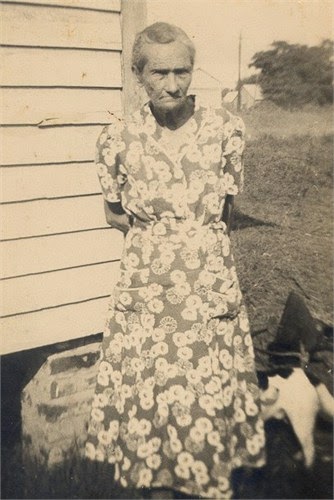
My great-grandmother
Alice Beman Lankford |
Daddy often told the story that two school teachers, Annie Mae Durham and Leana Mae Moody of Woodville, Greene County, Georgia, pulled him and his older sister aside to share this story with them. I estimate Daddy would have been about 12 or 13 years old at the time. Now fast forward to the year 2017 when I learn that my cousin took a DNA test and got a direct hit on the Janes line. Of course, I had to see for myself, so I ordered my own test kit from ancestry.com.
When the results were posted, there it was—the proof I’d been looking for. To date, of the 14 DNA Circles that have developed for me, one is a direct link to Absalom Janes and a second circle is a direct link to his wife Martha Cordelia Callaway. For those of you that don’t know what a DNA Circle is, ancestry.com describes it as:
“A DNA Circle is a group of individuals who all have the same ancestor in their family trees and where each member shares DNA with at least one other individual in the circle. These circles are created directly from your DNA and your family tree in a five-step process.”
 |
My grandparents Floria and Carroll Lankford
and their eight children |
We’ll never know exactly what happened to Alice—she took that information to her grave, as did other family members that supported her at the time. But I do feel that the DNA link at least solves part of this family legend.
I’ve not researched Thomas Jr. yet but have done extensive research on his father Thomas Sr., my 2nd great-grandfather, so will tell his story here today. This, however, should not be considered a complete bio as I didn’t include everything I found on him.
Thomas P. Janes Sr., son of Absalom Madison Janes Sr. and Martha Cordelia Callaway, was born on September 11, 1823 in Crawfordville, Georgia. At the time, Crawfordville was part of Greene County. Two years later, Taliaferro County was formed using that part of Greene County, as well as parts of Wilkes, Hancock, Oglethorpe, and Warren counties. There were at least 11 children in his family, possibly 13—Palemon Lawrence Janes, Cornelia Marion Janes, Thomas Montgomery Pike Janes, Nancy Winifred Janes, Mary Elizabeth Janes, Anna Milledge Janes, Martha Eugenia Janes, Felix William Janes, Susan Helen Janes, Cordelia Frances Janes, and Absalom Madison Janes Jr. The book “Cemeteries of Greene County, Georgia” by E. H. Armor” lists two unnamed sons buried in the Absalom Janes family cemetery. Thomas is my paternal 2nd great-grandfather.
For the most part, Thomas’ name is listed as Thomas P. Janes in news articles and records. On one occasion, I found his middle name written as “Pike” on a manila folder of Civil War correspondence. On another occasion, it’s written as “Thomas Montgomery Pike Janes” on bible records in a Daughters of the American Revolution listing. It’s also possible the “P” could also stand for Palemon—he named one son Thomas P. Janes Jr. and you often see his middle name written as Palemon. He also had a brother named Palemon.
Thomas descends from a prominent Greene County, Georgia family. According to the book “History of Greene County, Georgia, 1786–1886,” Thomas’ father Absalom Janes was one of “… Georgia’s first three millionaires ….” making his money in cotton. The historical marker that stands just outside the Janes Family Cemetery notes that Absalom was “One of the founders of Mercer University and a trustee 1833–47, treasurer of the Georgia Baptist Convention 1836–45, member of Bethesda Church 1828–38, of Penfield Church 1839–47.” The book “The Janes Family. A Genealogy and Brief History of the Descendants of William Janes: The Emigrant Ancestor of 1637” written by Rev. Frederic Janes in 1868 notes that Absalom represented “the people of Taliaferro county, as a senator to the state legislature …”, a position for which “he was several times elected …” An article in
The Sunny South on February 17, 1883 described Absalom as being born with a silver spoon in his mouth. Thomas’ grandfather William Janes is noted as being “one of Georgia’s largest planters” on a Crawfordville Baptist Church Georgia historical marker.
Thomas was just four years old when he lost his paternal grandparents. Both his grandfather William Janes IV and grandmother Selah Gresham Janes died in 1827. They were buried in Taliaferro County, Georgia on what is believed to be the old Janes family plantation. His two-year-old sister Anna died on July 24, 1832, a one-year-old sister Martha died on July 28, 1834, an unnamed 10-day-old brother died on July 18, 1835, and his 20-year-old brother Palemon died on September 12, 1838. These siblings were buried at the Absalom Janes Family Cemetery on Randolph Church Road in Greene County.
 |
| Absalom Janes family cemetery |
 |
| Daddy standing beside the Absalom Janes historical marker at the family cemetery |
In 1839, Absalom moved his family to Penfield, Greene County, Georgia and enrolled 16-year-old Thomas at Mercer University, named for the Rev. Jesse Mercer, a “prominent Baptist pastor, philanthropist, and publisher” according to the
New Georgia Encyclopedia. When Mercer died in September 1841, “his body was brought to Penfield to the home of Absalom Janes” and then buried at Penfield Cemetery. His grave is located near my Lankford ancestor graves.
In 1842, Thomas received his A.B. from Columbian College (now part of The George Washington University) in Washington, DC. The year ended with his marriage on December 20, 1842 in Baldwin County, Georgia to Emily Eliza Fish, daughter of Vines Fish and Sarah Harvard. Thomas and Emily had 14 children together—Emma C. Janes, Mary Frances Janes, Thomas P. Janes Jr., Lillian H. Janes, William Felix Janes, Charles P. Janes, Edward H. Janes, Sarah Margie Janes, Lilla E. Janes, David Arthur Janes, James Madison Janes, Walter Lee Janes, Absalom E. Janes, and John Henry Janes.
 |
| Thomas received an A.B. from Columbian College in 1842 (Washington, DC) |
 |
| Thomas Janes-Emily Fish marriage certificate, 1842 |
In July 1845, Thomas’ six-and-a-half-month-old brother Absalom died. A year later, his mother Martha died in Greene County at the age of 44 on July 1, 1846. Both were buried in the family cemetery. In 1846, Thomas was a medical student at the University of the City of New York. He earned his M.D. from there in 1847. That same year, Thomas’ sister Nancy, lost her second child during the pregnancy and died herself shortly afterwards on June 18. She was only 21 years old. They buried Nancy at Woodville Cemetery in Woodville, Greene County, Georgia. Nancy was married to Robert Ligon McWhorter, a member of another prominent family in Greene County. That fall, Thomas’ father Absalom died in Penfield on September 25, 1847. Absalom was buried with his wife and children in the family cemetery. Absalom left Thomas the following in his will:
“To son Thomas P. Jones, I have already given to him negroes: Lucy valued at $500; Caroline valued at $350; Turner valued at $600; Tolomans valued at $600; Nance valued at $500; Harty valued at $100; Lize valued at $300; Adaline valued at $300, plus household furniture and tract of land where he now lives in Greene County called the Burch Place valued at $2,300.”
Thomas was a medical student at the University of the City of New York in 1846, graduating with a degree in Medicine in 1847. In 1848, Thomas attended the College of New Jersey, at Princeton. Page 9 of the 1848–49 catalogue listed him as Thomas P. Janes, a.m. Col. Columb. ad eundem.
On October 22, 1850, Thomas and his family lived in District 163 of Greene County, Georgia. At age 26, Thomas was a physician with real estate valued at $8400. Thomas and Emily had three children—Emma (age 3), Fannie (age 2), and Poleman (age 6 months). Thomas was the owner of 35 slaves—17 males and 18 females according to the U.S. Federal Census Slave Schedule that year. On April 5, 1853, Thomas’ 17-year-old brother Felix died suddenly in Penfield. At the time, he was a freshman at Mercer University. Felix was buried at the family cemetery. About 1855, Thomas gave up his medical practice and turned to farming full time.
In the 10 years since the 1850 federal census was taken, Thomas’ wealth had grown considerably. On July 24, 1860, he and his family lived in Penfield. He was a farmer with real estate valued at $22,000. Thomas and Emily’s family had also grown since the 1850 census, now with eight children—Emma C. Janes (age 13), Fannie C. Janes (age 11), Thomas P. Janes Jr. (age 10), Felix W. Janes (age 7), Charlie P. Janes (age 6), Eddie H. Janes (age 4), Margie Janes (age 2), and Lilla Janes (2 months). The non-population schedule goes into great detail about the livestock, agriculture, and slaves Thomas had on his farm, but I’ll save that for next week since that’s the theme for the 52 Ancestors week 34 post.
The Civil War broke out on April 12, 1861, tearing the country apart. Many men from Greene County left home to fight but Thomas remained at Redcliffe Farm, his home in Penfield. In an effort to raise a Calvary regiment for the state of Georgia, Thomas sent a letter to Governor Joseph Emerson Brown on October 20, 1861. In the letter, Thomas stated that he had remained at home to take care of his farm and other county business and spent his time studying cavalry tactics. He proposed setting up a state regiment of cavalry to be ready for service the following spring and requested the authority to do so. Thomas sent a second letter to Governor Brown on February 15 stating that he had received authority from the C.S.A. war department to raise a Calvary regiment to serve three years or the length of the war. Thomas read in the papers that the President had requested 12 regiments from Georgia and felt that any regiment organized should be done with the consent of the state executive so was asking for his consent and authority to be of service to his state by helping to raise one. The governor had previously stated that many Calvary companies had offered their service, so Thomas requested if the Governor gave his consent, that he send a list of those companies to facilitate organizing a regiment. Thomas received permission to raise a regiment from the Secretary of War on February 22, however, he still wanted consent from the Governor so sent another letter on February 27, 1862 stating that since the proclamation, he had done nothing towards raising his regiment and would hold off until the request for 12 regiments was responded to. Thomas mustered into the 16th Regiment, 2nd Brigade, 3rd Division of the Georgia Militia as an assistant surgeon on July 26, 1862. He would serve less than a year, however, resigning his commission on June 1, 1863 via a letter to Adjutant General Henry C. Wayne after the office of Assistant Surgeon in the State Militia was done away with. He felt his position was “null and void” at that point.
 |
| June 1, 1863 resignation letter |
He had not given up on raising a regiment though. On April 9, 1864, the
Southern Confederacy ran the following article:
Companies of Cavalry Wanted for the War—I have been authorized by the Secretary of War to raise a regiment of cavalry for the Confederate States service for three years or for the war, which he has promised to arm. I propose to receive companies to be mustered into service, to be combined with companies now being raised by Col. W. J. Lawton to constitute a regiment. Immediate correspondence is respectfully invited. T.P. Janes, Penfield, Georgia. Mar15-1m. – T. P. Janes
The 1864 Census for Re-Organizing the Georgia Militia in Greene County noted that Thomas was 40 years, 4 months of age, a physician, and farmer born in Georgia. Thomas had been exempted by Surgeon Certificate. The 1865 State of Georgia, Greene County tax assessment noted that Thomas was a physician in Penfield. His tax assessment included a carriage, watch, and a piano. The 1866 U.S. IRS tax assessment list recorded him as a physician living in Woodville, Greene County, Georgia. On October 27, 1871, The
Times-Argus of Selma, Alabama reported that on June 8, 1869, “Mr. H. M. Burns, of the Greensboro Herald, writes, June 8th, 1869: ‘Last week we visited the farm of our enterprising friend, Dr. Thomas P. Janes, which lies on Fishing Creek, some seven or eight miles north of Greensboro, to see what can be done by trying on our old lands in middle Georgia. We had previously heard much said of Dr. Janes’ success in growing the different kinds of grass, and expected to find something more than usual in our country, but were totally unprepared to see red clover, herds grass, orchard grass, blue grass, and timothy grown to such perfection in Greene county as not to be surpassed by the best farms in Virginia, Maryland, or Pennsylvania.” In July 7, 1869, the
Southern Watchman reported that Thomas was successfully growing clover and various kinds of grass on old lands of Middle Georgia—land that had been in cultivation for the last 30 years, and without manure.
On July 20, 1870, Thomas and Emily were still living in Penfield. In the 10 years since the 1860 census, the value of his real estate had doubled. Still farming, his real estate was now valued at $45,000, up from $22,000. Thomas’ personal estate was valued at $5,000. His wife Emily was keeping house. Of the 11 children living in the home, three had grown to adulthood—Emma (age 23), Fannie (age 21), and Poleman (Thomas Jr., age 20). Poleman was a farm laborer. They had three teenagers in the home—William (age 27 and in school), Charlie (age 16 and a farm laborer), and Eddie (age 14 and a farm laborer). The other five children were Margie (age 12), Arthur (age 9), James (age 7), Walter (age 6), and John (age 3). There was a 39-year-old man named William Fish living next door. I assume he has a connection to Emily’s family, but I don’t know how yet.
 |
My sister Jennifer visited the Georgia Department of Agriculture
building where this picture of Thomas hangs. She took a photo
of the picture that day. |
Thomas was named the first Commissioner of Agriculture for the State of Georgia by the Governor on August 26, 1874.
The Atlanta Constitution reported that there were 16 applicants that had been recommended by 300 Georgia citizens. The Constitution reported that Thomas “appeared to be ‘worthy and well recommended.’” They further reported that Thomas “has taken a very active and zealous part in the interests and usefulness of the state agricultural society. Since 1846 he has served it as vice-president or on its executive committee. He has been well known for a number of years as the energetic and able president of the ‘Greene county agricultural and mechanical association,’ and otherwise at all times and in many ways as popularly identified in the honorable standing and solid advancement of the great command interests of agriculture throughout the state and country, being fully alive to its wants, capable and experienced in all maters thereto appertaining. The faithful discharge of his public duties is a marked assurance that his appointment is meritorious and appropriate; that it will give general satisfaction to the planting community of the state and fulfill the designs of the agricultural act of the last general assembly. He is represented, moreover, as a very expert, hard-fisted, practical and successful farmer and planter, in fact, has devoted his life to successful farming; not confining himself to corn and cotton, but growing clover and the grasses, so as to be ‘known and read of all men.’”
Thomas made it his mission to educate the farmers of Georgia. The book
Georgia: Her Resources and Possibilities published by the Georgia Department of Agriculture in 1895 noted that “… Within the first two years [of his commission] a large amount of valuable information on labor and various features of farm economy, stock raising, the cultivation of grasses, forage and other crops upon which the farmers of Georgia had not been well informed, were collected and published for the information of the agriculturists of the State. …” His first publication was “Sheep Husbandry in Georgia,” followed by the “Hand Book of Georgia (1876).” The book
Georgia: Her Resources and Possibilities notes that this publication was “designed to supply the people of Georgia with correct information of their own State, its conditions, resources, and institutions, and to furnish immigrants, actual and prospective, with accurate and reliable information on subjects connected with Georgia, which would be of interest to them.” Other publications included the “Manual on the Hog (1877),” the “Farmers’ Scientific Manual (1878),” the “Manual of Georgia: For Use of Immigrants and Capitalists (1878),” and “Georgia from the Immigrant Settlers’ Standpoint (1879).” If you google Thomas, you’ll see that you can buy reproductions of his publications today. Thomas also made sure that Georgia farmers knew everything they needed to know about fertilizers, so they could buy a quality product at a good market value.
On January 13, 1875, the
North-East Georgian published the news that Thomas had promised to contribute to their columns. In one column, he requested that Georgians submit samples of agricultural and horticultural productions to be exhibited at the Great Fair of the Georgia State Agricultural Society in Macon, Georgia for one week beginning October 18, 1875. This included soil and plant samples, fertilizer, and machinery. On October 17, 1876,
The Atlanta Constitution declared Thomas as the “champion turnip grower of the state.”
The Daily Constitution in Atlanta published a story on April 17, 1877 in which Thomas “… advises young men to marry good, clever, Georgia girls, settle on a farm and try to raise sheep.” In 1877, worried about food shortages due to a war in Europe (perhaps the Russo-Turkish War), Thomas encouraged the farmers in Georgia to increase their crops and to “take care of the pigs.” The
Athens Weekly Georgian published an article on May 3, 1877 in which Thomas offered the following advice: “… In view of the war in Europe, and the probable scarcity and high prices of breadstuffs and low price of cotton which will prevail, I again respectfully advise that you will, by every means in your power, increase the area planted in provision crops. I suggest checking your fields of cotton with corn in rows fifteen to twenty feet apart, one hill at every intersection. With fair sessions, this will very largely increase the product of corn, without a corresponding decrease of the cotton. I further suggest the planting of the stubble fields in peas so soon as the wheat and oats shall have been harvested. Pay special attention to the raising every pound of pork possible. Take care of the pigs. These suggestions are not designed to alarm or to create a sensation. A word to the wise is sufficient. A prudent man foreseeth the evil and hideth himself, but the simple pass on and are punished.”
To conduct the business of the State Commissioner of Agriculture, Thomas needed to spend a lot of time in Atlanta. In 1878, the Atlanta City Directory noted that he lived at the Markham House, a large hotel that opened in Atlanta in November 1875.
 |
Markham House, Wikipedia, public domain
https://commons.wikimedia.org/wiki/File:Markham-1871.JPG |
Thomas was a member of the National Agricultural Congress, holding the office of vice president in 1878 and elected to president in 1879. The congress met semi-annually and so Thomas was often required to travel to places such as Washington DC, New York, Tennessee, and Connecticut.
Thomas was known as a scientific farmer. One example of how he used science to help perform his work as the commissioner was when he sought the help of John T. Duncan, a judge in Laurens County, Georgia who “established the county’s first weather station on April 1, 1878” according to a blogpost by Scott Thompson. On June 4, 1878,
The Dublin Post published the following article:
WEATHER REPORT—As recorded by Hon. J. T. Duncan—State Commissioner of Agriculture T. P. Janes, has furnished Judge Duncan with a thermometer and rain gauge, and requested him to act as “observer” for this section. He records in a book prepared for the purpose the temperature at 7 a.m., at 2 p.m., and at 9 p.m., each day from which the daily average is obtained. At the end of the month the monthly average is made out. The rainfall and motions of the wind are also carefully recorded. Monthly reports are forwarded to the Commissioner to be utilized in the solution of the great problems of meteorology. The Judge commenced his observations the 1st of April last. Below are given results for June: Lowest mean temperature 14th 67 1/2 degrees, Highest mean temperature 20th 84 1/4 degrees, Mean temperature for the month 77 1/4 degrees, Total rainfall 4.65 inches.
Thomas raised eyebrows in the summer of 1878 when on June 15,
The Atlanta Constitution reported that he had “flooded” the state with letters to citizens attempting to manufacture “an expression of popular opinion in his favor,” and that he “used an amount of stationary, postage and printing for this purpose.” It was noted by the
Constitution that it “involved a direct breach of public trust”… “if it had been paid out of the public fund appropriated for the use of the agricultural bureau.” He requested that citizens write the “… Governor A. H. Colquitt, giving, in any manner you may deem proper, an expression of your views, and the views of your neighbors generally, on the question of my re-appointment.” He also requested that they send him a copy of the letters. Thomas’ term as Commissioner of Agriculture was due to expire in August so he was attempting to put himself in good favor with the public. It was felt that it was the governor’s job to name his successor and he was out of place promoting himself.
I don’t know if Thomas’ letter campaign had anything to do with it, but the Governor appointed him for a second term beginning September 1878. Thomas had just completed the first year of the term when in mid-September 1879, rumors surfaced of a possible resignation from his commission. It seems Thomas’ office was being investigated for mis-management. Before the month ended, Thomas did in fact resign, delivering the following letter to Georgia’s Governor:
To His Excellency Alfred H. Colquitt, Governor of Georgia: I have been reliably informed that the opposition to the department of agriculture, and the demand for its abolition, which has found expression in various forms, is, to a large extent, based upon personal opposition to myself, and believing, as I do, that such opposition will not only impair my usefulness as the head of the department, but seriously endanger its existence; believing, too, that the abolition of the department at this time would be a calamity to the farmers of Georgia and the best interests of the state, I am not willing, even seemingly, to be an obstacle to the advancement of these interests. Notwithstanding my convictions that I have faithfully discharged my duties to the best of my skill and ability, in a work so new, without example or precedent, errors of judgment and mistakes in the exercise of a very wide discretion may have been committed. In view of these facts, I have concluded that it is my duty to resign my position. I therefore respectfully tender my resignation; absolutely and unqualifiedly, of the office of commissioner of agriculture, to take effect at such time as you may signify your acceptance of the same. – Thomas P. Janes
The Governor accepted his resignation and appointed a successor. Thomas’ resignation was widely reported across many states. Some thought that while he may have been guilty of bad management, his “devotion to the bureau” outweighed those missteps.
The Daily Constitution noted on September 30, 1879 that “… Dr. Janes will return to his plantation in Greene, where he will doubtless enjoy quiet and tranquility. His entire official term has been one consistent and unremitting fight and struggle. He has had to defend his department at every session of the legislature and at the session of the convention.” The
Times-Picayune in New Orleans, Louisiana noted on October 26, 1879 that in the five years since Georgia established the Department of Agriculture, “Dr. Janes and those who have aided and supported him, the State Chemist and State Geologist and intelligent and public-spirited farmers in different parts of the State, have done more for agriculture in that State, and more for the best interests of the State, than has been done by any of the political parties, if not all or any of the legislative bodies, for half a century. We believe the best informed farmers and citizens of Georgia will agree that this statement is strictly correct. The statement that the Department of Agriculture has benefited that State to the amount of a million dollars a year for five years with prospects of increasing benefits yearly, would be placing too low an estimate on the real value of that department. Every Southern State would do well to make liberal appropriations to have Commissioner Janes’s pamphlets and books extensively circulated amongst its farmers. The information they contain is invaluable. …”
After leaving the Department of Agriculture, Thomas settled back into farming and his medicine. On June 26, 1880, the census enumerator found him and his family living in Skull Shoals, Greene County, Georgia. At age 56, he was enumerated as was a farmer and physician. His wife, age 55, enumerated as Emma, was keeping house with the help of her daughter Maggie. Sons Eddie and Arthur were farmers; sons Jim, Walter, and John Henry were laborers, all presumably helping their father on the family farm. Five black servants, enumerated as laborers, were living in the home—Barron George (40), Perry (35), Emerline (30), Lizzie Williams (20), and Elis Tucker (50). A 15-year-old black male named John Tucker , also a farmer, lived in the home.
An article published in
The Atlanta Constitution on May 12, 1883 (republished from the
Oglethorpe Echo) connects Thomas to my Lankford family. The article reads “A few weeks ago while Mr. J. C. Lankford was plowing along down on Dr. Janes’s home place he plowed up the frame of some person who had been buried there in the past. It was lying due east and west and was in its natural form. The contents were gathered up and carried to Dr. Janes for examination and he pronounced it to be an Indian child between 8 and 12 years old.”
James C. Lankford was my 2nd great-grandfather, father of
Alice Beman Lankford, my great-grandmother and a key subject of the family legend. This article shows that the Janes and Lankford families were in close proximity to each other.
In 1884, Thomas was selected as an alternate presidential elector (the United States Electoral College is a body of electors established by the United States Constitution) to Col. J. A. Billups for the democratic party in the 8th district. Both men supported the Grover Cleveland ticket, who in November won the election. According to
Wikipedia, this was the “first election of a Democrat as President of the United States since the Civil War.” That same year, Governor Henry McDaniel appointed Thomas as one of the state commissioners to the World’s Industrial and Cotton Centennial Exposition held in New Orleans.
Yes, I know Thomas was a Southern plantation and slave owner in the mid-1800s, but I was still horrified to read an article published in the
Banner-Watchman on July 1, 1884. The article was an interview of Thomas as the ex-Commissioner of the Agriculture where he talked about cotton, crops, farming, etc. One of the questions was “What about our negro labor?” Here’s his response:
It is getting worse and worse every year. The younger generation are all at school, the women won’t work, and so a very small pro rata of the race are bread-winners. The white children are kept at work, while the negroes are being educated at the expense of the white tax-payers. In my whole observation I do not know a single educated negro who will work in the field, and this race is fit for nothing else. But they are about as good as the average white labor of the North, for which you must pay $20 or $30 per month. When all the blacks are educated we will have to take the sun ourselves, for they won’t work.
The next question was “What do you think will be the future of the negro? Do you fear a war of races?” His response was:
Oh, no; there is no danger of that. When the blacks fail to bear their part of the labor they will have to emigrate, and will be colonized to themselves. I anticipate no trouble, as the whites will always govern this country and be in the ascendency. The negro will accept his fate without a struggle.
It is
NOT a proud moment for me to know my ancestor spoke these words.
Sometime before March 1885, Thomas apparently attempted to regain his position as State Commissioner of Agriculture, however, that was not meant to be when Thomas died suddenly on March 10, 1885. Field hands found him lying unconscious in the field of his Greene County home, Redcliffe Farm. They sent for a doctor, but he died before the doctor arrived. His death was widely reported:
Dr. Janes’ Death. A Rumor That He May Have Committed Suicide, The Atlanta Constitution, March 12, 1885. A Greenesboro special to the Augusta Chronicle says: Dr. Thomas P. Janes died at his residence, about seven miles from Greenesboro, this evening. About 12 o’clock the hands working on his farm found him lying in the field in an unconscious condition. They removed him to his home, but he died before medical assistance could reach him. The report is that he died from an overdose of morphine, but whether administered with an intent to kill himself is not known. Dr. Janes has been suffering for some time from nervous affection, brought on by financial anxiety, and it is thought that he took the morphine to ease his nerves. Dr. Janes was formerly a very wealthy man, but has been very unfortunate, and in a few years has lost much money, although his property is still estimated as being worth from $25,000 to $30,000. He was at one time commissioner of agriculture of Georgia, and was a man who has done much to advance the farming interests of the state. He was a kind and afiable gentleman, and a man of large experience. His death will be felt in the county and will cause much regret.
A correspondent of The Constitution, from the same place furnishes the following: It is rumored that Dr. Janes’s suicide was the result of depression because of financial embarrassment and the fact that he had lost all hope of obtaining the appointment of commissioner of the agricultural department of the government, for which office he had made application. The friends of Dr. Janes in this city do not believe that he committed suicide, and are satisfied that Dr. Janes had no cause for such an act.
The same story was reported by the
Courier-Journal in Louisville, Kentucky on March 12, 1885 and by the
Dunkirk Evening Observer in Dunkirk, New York on March 13, 1885. The
Wilkes-Barre News in Wilkes Barre, Pennsylvania reported the following on March 13, 1885:
An Office Seeker’s Suicide. Greensboro, Ga., March 12.—The death of Dr. Thomas P. Janes, late Georgia commissioner of agriculture, is now alleged to have been suicide, resorted to because of depression at the fact that he stood no chance of securing the federal commissionership of agriculture, for which position he was an applicant.
And the
Baltimore Sun in Baltimore, Maryland reported the following on March 17, 1885:
Dr. Thomas P. Janes, ex-commissioner of agriculture, of Georgia, died last week.
Thomas was laid to rest in the Janes Family Cemetery on Redcliffe Farm. I visited the cemetery with my husband, Daddy, aunt Lucile (Lankford) Epps, and uncle Ralph Epps almost 20 years ago. I remember it seemed like we were riding in the middle of nowhere when Daddy said, “stop the car, it’s in these woods somewhere.” We got out of the car and made our way through the woods until we finally came upon the graves. I took these photos that day.
I brought a large rock from the wooded area that sits in my garden today.
 |
| The rock from the Janes property is in the center of this photo |
Family members filed a probate application for Thomas on May 18, 1885. In the application, his wife Eliza, sons Arthur, Edward, James, and Charles, and daughter Margie certified that on March 8, 1885 (two days before Thomas’ death), he requested that they bear witness to him making a verbal will. They said he felt his end was near and he might not have the opportunity to submit the will properly. He left his entire estate to his wife Eliza. His son Arthur was appointed Guardian ad litem for Thomas’ minor son, John Henry Janes.
The book
How Curious a Land: Conflict and Change in Greene County, Georgia, 1850–1885 by Jonathan M. Bryant notes that after Thomas’ death, “… His sons soon failed financially and drifted away, leaving the farm to tenants. The Janes family then faded into obscurity.”
You'll find a photo of the ruins of Thomas' house in Greene County on the Vanishing Georgia pages of the Georgia Archives web site.
Here's a link to the photo.
If you drive into Greensboro, Greene County, Georgia, you’ll find a State of Georgia Historical Marker near the Greene County Courthouse honoring Thomas as the First Commissioner of Agriculture.
References
- 1864 Census for Re-Organizing the Georgia Militia.
- “A Gloomy Picture: Interview with Hon. Thomas P. Janes, of Greene,” Banner-Watchman, July 1, 1884.
- “A Letter from Atlanta: Our Washington Correspondent Passes Through the City—He Tells of Old Times in Georgia and of Governor Stephens’ Candidature Against Absalom Janes—The Governor’s Invitation to the Rich and the Poor—The Old Boot-black—Atlanta in 1864 and Atlanta To-Day—A Tariff Episode,” The Sunny South, February 17, 1883.
- A Manual of Georgia for the Use of Immigrants and Capitalists paperback; www.amazon.com.
- “A Manual of Georgia,” Weekly Constitution, July 30, 1878.
- “A Seedy Subject: The Resignation of Dr. Janes,” The Daily Constitution, Atlanta, Georgia, September 24, 1879.
- “Agriculture in Georgia—The Great Forward Movement,” The Times-Picayune, New Orleans, Louisiana, October 26, 1879.
- Ancestry.com, U.S., School Catalogs, 1765–1935.
- “Another Resignation,” The Daily Constitution, Atlanta, Georgia, September 17, 1879.
- Armor, E. H., The Cemeteries of Greene County Georgia, 1987.
- Banner-Watchman, August 5, 1884.
- Bryant, Jonathan M., How Curious a Land: Conflict and Change in Greene County, Georgia, 1850–1885, 2014.
- Catalogue of Officers and Students of the College of New Jersey: 1848 – ’49.
- “Clover,” Southern Watchman, July 7, 1869.
- “Clover and the Grasses in the South,” The Times-Argus, Selma, Alabama, October 27, 1871.
- “Commissioner of Agriculture,” The Atlanta Constitution, Atlanta, Georgia, August 27, 1874.
- Commissioner Thomas P. Janes bio, Georgia Department of Agriculture; http://agr.georgia.gov/thomas-p-janes.aspx.
- “Current Events,” The Brooklyn Daily Eagle, Brooklyn, New York, February 20, 1878.
- DNA Circles, AncestryDNA; www.ancestry.com.
- “Dr. Janes and His Department—What Is Said About His Resignation,” The Daily Constitution, Atlanta, Georgia, September 30, 1879.
- “Dr. Janes Resigns,” The Daily Constitution, Atlanta, Georgia, September 23, 1879.
- “Dr. Thomas P. Janes Dead: He Dies Suddenly at His Home in Greene County—A Good Man Gone,” The Atlanta Constitution, Atlanta, Georgia, March 11, 1885.
- Electoral College (United States); https://en.wikipedia.org/wiki/Electoral_College_(United_States).
- Georgia Department of Agriculture, Commissioner Thomas P. Janes, 1874–1879; http://agr.georgia.gov/thomas-p-janes.aspx.
- Georgia Marriages to 1850.
- Georgia, Civil War Muster Rolls, 1860–1864.
- Georgia, Marriage Records From Select Counties, 1828–1978.
- Greene County, Georgia Wills 1786–1877, Freda Reid Turner.
- Historical collections of the Georgia chapters, Daughters of the American Revolution, Volume IV. Front matter.
- Historical marker, Absalom Janes Family Cemetery, Greene County, Georgia.
- Historical marker, Crawfordville Baptist Church, Crawfordville, Taliaferro County, Georgia; http://georgiainfo.galileo.usg.edu/topics/historical_markers/county/taliaferro/crawfordville-baptist-church.
- “How Dr. Janes is Working for Reappointment—A Queer Circulaire,” The Atlanta Constitution, Atlanta, Georgia, June 15, 1878.
- https://en.wikipedia.org/wiki/Taliaferro_County,_Georgia.
- Janes, Rev. Frederic, The Janes Family. A Genealogy and Brief History of the Descendants of William “Janes: The Emigrant Ancestor of 1637, 1868.
- Knight, Lucian Lamar, A Standard History of Georgia and Georgians, Volume 5, 1917.
- Last Will and Testament of Thomas P. Janes Sr., page 511, Georgia Greene County. May 18, 1885.
- Letters to Georgia Gov. Joseph E. Brown, October 20, 1861, February 15, 1862, and February 27, 1862; Ancestry.com, Georgia, Civil War Correspondence, 1847–1865.
- Markham House (Atlanta), Wikipedia; https://en.wikipedia.org/wiki/Markham_House_(Atlanta).
- Mercer at Penfield: 1833–1871, Centennial Celebration, 2nd Edition, Mary Callaway Jones, May 27, 1933; https://libraries.mercer.edu/ursa/handle/10898/2851.
- Nesbitt, R. T., Georgia: Her Resources and Possibilities, Georgia Department of Agriculture, Franklin Printing and Publishing Company, 1895.
- New Georgia Encyclopedia, Jesse Mercer (1769–1841); http://www.georgiaencyclopedia.org/articles/arts-culture/jesse-mercer-1769-1841.
- Oglethorpe Echo news, The Atlanta Constitution, May 12, 1883.
- Rice, Thaddeus Brocket, edited by Carolyn White Williams, History of Greene County, Georgia, 1786–1886, 1961.
- Rome Tri-Weekly Courier, September 2, 1879.
- “Summary of News,” North-East Georgian, January 13, 1875.
- “The Americus Republican remarks,” The Daily Constitution, April 17, 1877.
- “The Georgia State Fair,” Athens Weekly Georgian, December 28, 1875.
- Thompson, Scott, “A History of Dublin and Laurens County, Georgia: The Native American Millennia,” History of Laurens County, Georgia blog, January 11, 2010.
- “To the People of Georgia,” North-East Georgian, September 1, 1875.
- “Town Topics,” The Atlanta Constitution, Atlanta, Georgia, October 17, 1876.
- United States Federal Census, District 163, Greene, Georgia, 1850.
- United States Federal Census, Greene, Georgia, 1860.
- United States Federal Census, Militia District 149, Greene, Georgia, 1870.
- United States Federal Census, Skull Shoals, Greene, Georgia, 1880.
- United States presidential election, 1884, Wikipedia; https://en.wikipedia.org/wiki/United_States_presidential_election,_1884.