John Athya was born on February 22, 1828, in Glasgow, Lanarkshire, Scotland. Due to the lack of a birth record, I cannot be entirely certain, but I believe he was the son of Isaac Athya and Janet Graham. I base my assumption on the following:
- In the 1841 census, John’s parents are recorded with sons James and John.
- Isaac Athya’s death occurred at 117 Hospital Street, Glasgow, in 1860. James, the informant on the death record, listed his address as 103 Commercial Road.
- In the 1861 and 1871 census records, James lived at 117 Hospital Street.
- Janet (Graham) Athya (Isaac’s wife) also died at 117 Hospital Street in January 1861, with James once again as the informant, listing his address as 103 Commercial Road.
- Southern Necropolis Cemetery burial records show Janet’s address as 117 Hospital Street and identify her as the wife of the late Isaac Athya, proprietor of the lair. The cemetery record also lists Isaac’s address as 103 Commercial Road. Given that Isaac passed away in 1860, the proprietorship had likely passed to James who lived at the Commercial Road address.
- Jane (Wylie) Athya, James’ wife, died at 117 Hospital Street in 1882.
- Isaac was the proprietor of lairs 859 and 860 at Southern Necropolis Cemetery. Both he and Janet were buried in lair 859, while James and his wife Jane were buried in lair 860.
Given these connections, while there is no definitive birth or death record for John listing his parents, the above evidence shows a clear link between John, his brother James, and their parents, Isaac and Janet.
If this assumption is correct, John had five siblings: Ann, Mary, James, Janet, and Isaac. Notably, Ann and Mary were twins.
John is my husband’s 3rd great-uncle, with their nearest common relatives being John’s parents, Isaac and Janet Athya.
To provide a comprehensive view of John’s life, I have selected several newspaper articles, in addition to historical documents related to John. These items, chosen from among countless others, detail his and his businesses’ activities, illustrating the world he lived in and his impact on it.
In 1841, the Athya family resided on Surry Street in Gorbals, Lanarkshire, Scotland. According to the 1841 census, John’s father was listed as a P L D, likely indicating his occupation as a power loom dresser. His twin sisters, Ann and Mary, were recorded with the initials P L W, suggesting they were power loom weavers. Meanwhile, his brother James was employed by a grocer.
In the spring of 1850, 27-year-old merchant John embarked on the Steamer Canada, traveling to Boston, Massachusetts. This journey may have been his initial venture to establish business connections in the United States.
On July 21, 1851, the British barque Jane (a type of sailing vessel with three or more masts), captained by Soule and consigned to John Athya and Company of Glasgow, departed New York for Glasgow with a cargo of tar, rosin, and spirits turpentine. The next day, a fire, likely from spontaneous combustion, was discovered in the hold. Despite efforts to contain it, the fire spread, and by the morning of July 23, the ship was burned to the water’s edge. Fortunately, the crew was saved.
John married Catherine Bell, daughter of John Bell and Christina McQueen, on March 23, 1852, in the Hutchisontown parish of Govan, a suburb on the south side of Glasgow along the River Clyde. The ceremony was a joint wedding with Catherine’s sister, Marion to William McKean, and was officiated by Dr. Alexander O. Beattie, a United Presbyterian minister in Glasgow.
Both marriages were announced in The Belfast Newsletter in Belfast, Ireland on April 5, 1852:
March 23, at Bellevue, Glasgow, by the Rev. Dr. Beattie, Mr. W’m. MacKean, merchant, to Marian, eldest daughter of John Bell, Esq.; and, at same time and place, Mr. J. Athya, merchant, Glasgow, to Catherine, second daughter of John Bell, Esq.
John and Catherine were blessed with 13 children, all of whom had red hair: Ada, John, Kate, Christina Emily, Alice, Helen, Jane Bigland, Edwin, Maria Watson, Florence Anna, Charles A., George Howard, and Harriet Sanderson Athya.
At the start of their marriage, John and Catherine resided at 10 Houston Street in Govan. John, a commission merchant, owned and operated a business named John Athya and Company, located at 14 Turner’s Court, Argyll Street, from 1852 to 1853.
In April 1852, John Gibb, a merchant and grocer in Greenock, was forced into bankruptcy. John Athya was appointed as one of three commissioners to oversee the bankruptcy process. Their responsibilities included ensuring the process was fair and properly managed, overseeing decisions about asset sales to repay creditors, reviewing and approving financial accounts, resolving disputes, and preparing reports for creditors and the court on the bankruptcy’s progress and distribution of assets.
By 1853, John’s business had moved to a new location at 9 and 13 Dixon Street, with an additional store at 52 Fox Street.
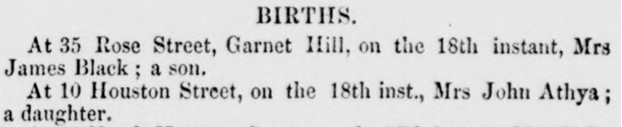
John’s daughter Ada was born at home in Govan on September 18, 1853. Her birth was announced in the Glasgow Herald on September 19:
Births. At 10 Houston Street, on the 18th inst., Mrs. John Athya; a daughter.
On March 21, 1854, John Athya and Company placed an advertisement in the North British Daily Mail, listing their address as 10 Dixon Street.
“North British Daily Mail,” March 21, 1854. At Glasgow, for Montreal.—The far-famed A 1 Iron Clipper Ship Three Bells, 649 tons register, Robert Crighton, Commander, will have immediate despatch.
This fine Ship has just arrived from New York after a rapid run of sixteen days.
To shippers of fine goods this Ship presents a favourable opportunity.—For freight or passage, apply to
John Athya & Co., 10 Dixon Street
John’s son, John Jr., was born in Govan on December 17, 1854. His birth was announced in the Commonwealth Glasgow on December 23:
Births. Athya.—Dec. 17, at Nithsdale Place, Paisley Road, Mrs. John Athya, of a son.
John Jr. was baptized on March 4, 1855 at Regent Place United in Glasgow.
John was recorded as the tenant of a house on Nithsdale Place located in the parish of Govan on Scotland’s 1855–1856 Valuation Roll. The proprietor was Thomas Watson of 70 West Nile Street in Govan. The yearly rent or value was estimated at £28.
By 1856, John’s company had expanded its services to include American produce brokerage in addition to commission merchandising. The business was situated at 11 Dixon Street. John and his family continued to live at Nithsdale Place on Paisley Road, described in the Ordnance Survey Name Books on the Scotland’s People website as “a range of fine buildings on the north side of Paisley Road.”
John’s daughter, Kate, was born in Govan, on July 7, 1856. Her birth was announced in the Glasgow Courier on July 10:
Births: At Nithsdale Place, on the 7th inst., Mrs. John Athya, of a daughter.
By 1857, John and his family had moved to Langside, Glasgow, Lanarkshire, Scotland, while his business remained at 11 Dixon Street. An advertisement published in the North British Daily Mail on June 10, 1857, announced an auction to be held that day at John Athya and Company’s store, located at 29 Adam’s Court Lane. The auction featured 164 boxes of American cheeses that had been damaged by salt water.
North British Daily Mail, Wednesday, June 10, 1857.
On Account of Whom It May Concern. To be Sold, by Auction, within Messrs. John Athya and Co.’s Stores, 29 Adam’s Court Lane, this day (Wednesday), 10th June, at Half-past One o’clock, 164 boxes American cheese, damaged by salt water.
Hutchison & Dixon, Auctioneers.
On February 7, 1858, John’s daughter Christina (known as Teeny) was born in Cathcart, Renfrewshire, Scotland. Her birth was announced in the North British Daily Mail in Glasgow on February 9:
Births: At Langside, on the 7th inst., Mrs. John Athya, of a daughter.
On May 15, 1858, the partnership between John Athya and Company (Glasgow), Bigland, Athya, and Company (Liverpool), and Francis MacDonald and Company (New York) was dissolved by mutual consent regarding Peter MacLeod. Consequently, MacLeod was no longer part of the partnership, but the remaining partners continued their business operations under the same firm names.
In September 1858, John was fined £2 at the Clyde Police Court for leaving unshipped goods on the quay. A quay (pronounced “key”) is a structure on the edge of a harbor or river where ships can dock to load and unload cargo or passengers. This was John’s third offense for failing to remove the goods.
John’s daughter, Alice, was born on August 12, 1859, in Langside. Her birth was announced in the Glasgow Courier on August 16:
Births. At Langside, on the 12th inst., Mrs. John Athya, of a daughter.
Alice was baptized on September 5, 1859 at the Regent Place United in Glasgow.
 |
Alice Athya, ca. 1862 (photo used with
permission of Sarah (Fox) Simpson) |
On August 3, 1860, John’s father, Isaac, aged 70, passed away at 117 Hospital Street in Glasgow due to a stomach ulceration. His son James, who resided at 103 Commercial Road, was the informant on the death register. Isaac was laid to rest in Lair 859, which he owned, at Southern Necropolis Cemetery in Glasgow.
In 1861, John and his family resided at 108 Clifton Street in the parish of Barony, Anderston, Lanarkshire, Scotland. John was listed as an American produce merchant. At that time, only two of his children, Ada (7) and John (6), were attending school. The census record highlights a comfortable middle-class lifestyle for the Athya family: their home had nine rooms with windows, and they employed two domestic servants to help maintain the household. These servants were Lilias Watson, a 30-year-old woman, and Elisabeth Johnston, a 26-year-old woman, both of whom were unmarried and from Scotland.

On January 24, 1861, John’s mother, Janet, aged 65, tragically took her own life at 117 Hospital Street in Glasgow by cutting her throat, resulting in instantaneous death. The death register, with John’s brother James as the informant, noted that Janet was melancholic, suggesting she likely suffered from depression. Janet was laid to rest alongside her husband Isaac in Lair 859 at Southern Necropolis Cemetery in Glasgow, where the cemetery register recorded her death as self-destruction.

In August 1861, Andrew Lindsay, a grain weigher living in Main Street, was charged with stealing 12 bolls of wheat from John Athya and Company or Hugh Ronald at Glasgow Harbour on August 23. The wheat was offloaded from the ship Maid of Orleans and stored under Lindsay’s supervision. Employed by Ronald, Lindsay was required to provide daily accounts and carters’ receipts for the wheat he distributed, but failed to account for the 12 bolls, claiming he gave them to an unknown carter. (A carter is someone who drives a horse- or oxen-drawn cart, historically used to transport goods between places like markets, warehouses, or ports.) Due to insufficient evidence proving theft, the charge was withdrawn, and Lindsay was found not guilty, cleared of the charges, and dismissed from court.
In November 1861, the partnership between Francis MacDonald and Company (New York), John Athya and Company (Glasgow), and Bigland, Athya, and Company (Liverpool) was mutually dissolved.
John’s daughter, Jane, was born on December 2, 1862, at 2 Clifton Street in Anderston, Glasgow. Her birth was announced in the Glasgow Herald on December 3:
Births. At 2 Clifton Street, on the 2d instant, Mrs. Athya; a daughter.
In April 1863, John journeyed from New York to Liverpool aboard the RMS Persia, traveling in first class.
As early as 1865, John was elected to be a trustee of the Clyde Navigation Trust. Established in 1858, the Clyde Navigation Trust focused on enhancing navigation and trade on the River Clyde in Glasgow. Their primary tasks included dredging the river, constructing quays and dry docks, and providing shipbuilding and repair facilities. This work transformed the Clyde into a major international waterway, significantly boosting Glasgow’s status as a key port city. The organization met every other Tuesday. John’s work with the Trust extended until at least 1875.
John was recorded as the proprietor of House Kirklinton, located in the parish of Cathcart, on Scotland’s 1865–1866 Valuation Roll. Although John owned the house, the land it stood on was leased from the Trustees of Neale Thomson. The yearly rent or value was estimated at £120, which determined the amount of local tax payable for the property. John paid £28 1s 2d (28 pounds, 1 shilling, and 2 pence) to lease the land the house sat on. This leasing arrangement was called a feu.
In 1866, John owned two businesses. The first was John Athya and Company, located at 110 Buchanan Street, where John operated as an American produce broker and commission merchant. The second was Athya, Pickering, and Company, located at 58 Fox Street, where John served as a corn and provision broker. During this period, John and his family lived on Kirklinton Street in Langside, a community within Cathcart.
The home pictured below is believed to be the family residence known as Kirklinton. This photo was proudly displayed in the dining room of John’s great granddaughter, Anne Elizabeth (Miller) Fox.
 |
Photo used with permission of Sarah (Fox) Simpson |
UPDATE 7/10/26: John Athya and His Burgess Status.
In June 1868, John’s daughter, Ada, attended the Glasgow Ladies’ College at 218 Bath Street. She received an Institutional Prize for Excellence in the Intermediate Section, which would likely be equivalent to her junior year today.
In July 1869, John Athya and Company were fined for leaving wheat at Berth No. 63 of the harbor, violating the Harbour Trustees’ 16th regulation. They received fines of £5 10s and £2. In today’s currency, these fines would amount to approximately £7 10s, which is about $9.45.
By 1870, Athya, Pickering, and Company had ceased operations, but John Athya and Company continued at its Buchanan Street address. John and his family remained residents of Langside.
In August 1870, John, as the chairman of the Cathcart Parochial Board, provided various forms of relief to the poor and financial support to five individuals in an asylum. The Board also arranged for water supply extensions to Cathcart. Due to his effective leadership, John was unanimously re-elected as chairman for the following year.
That same month, John’s son, John Jr., attended Mr. Smeaton’s Educational Establishment, a private boarding school run by David J. Smeaton in Abbey Park, St. Andrews, Scotland. The school catered to approximately 80 young gentlemen. John Jr. excelled in the English Department, earning second place for Literature, History, and Composition in the First Division, and achieving second place for distinction in Roman History.
In 1871, John and his family continued to reside at their home on Kirklinton Street. John was listed as a grain merchant, and his son, John Jr., worked as a clerk in the grain business, likely his father’s. Kate, Christina, Alice, Helen, Jane, and Edwin were all attending school. Their youngest child, Charles, was just five months old. The family lived in a substantial house with 15 rooms with windows, as recorded in the 1871 Scotland Census, which counted rooms with windows to assess housing conditions and public health. Catherine managed the large household with the help of three domestic servants: Agnes Strathearn (20), Margaret Peddie (19), and Lilias Forgie (17).


In April 1871, John attended a meeting of the Standholders at the Glasgow Corn Exchange. The Standholders were involved in the buying and selling of grain, meeting in the market hall to display samples and engage in trading activities. The Exchange served as a central hub for grain merchants, flour millers, and importers, facilitating the distribution and pricing of grain. The primary purpose of the April meeting was to address the arbitrary action of the proprietors in closing the exchange.
On November 26, 1872, a public meeting to support women’s suffrage was held at Queen’s Park U.P. Church in Crosshill. The event saw a large attendance, chaired by John. In his introduction, he defended the movement’s justice and read an excerpt from the Women’s Suffrage Journal. This excerpt outlined parliamentary efforts to remove women’s disabilities and the challenges faced by Jacob Bright’s bill. Bright introduced the Women’s Disabilities Removal Bill in 1870 to extend the right to vote to women. Although it faced significant opposition and was not passed, the bill was a key effort in the 19th-century women’s suffrage movement, helping to lay the foundation for future advancements in women’s rights.
John’s 16-year-old daughter, Kate, passed away on December 31, 1872, at Kirklinton, Cumberland, England. Her death was announced in the North British Daily Mail on New Year’s Day, 1873:
Deaths. Athya.—At Kirklinton, Langside, on the 31st ult., Kate, aged 16, second daughter of John Athya.—Friends will please accept this intimation.
John expressed his gratitude by publishing a thank you note for his re-election as trustee of the Clyde Navigation Trust in the Glasgow Herald on November 14, 1873:
To the Electors of the Clyde Navigation Trust.
Gentlemen, I beg respectfully to thank you for my Re-election as a Member of the Clyde Trust, which I regard as a proof that my past conduct has merited your approbation. I need scarcely say that I shall endeavour faithfully to discharge my duties in the future, and to show that this renewal of your confidence has not been misplaced. I am, Gentlemen, Your obdt. Servt., John Athya.
28 Hope Street, Glasgow, 13th November 1873.
In January 1874, the Committee of Management of the Parochial Burial Ground Board in Glasgow identified that the existing burial ground accommodation was insufficient. A sub-committee, led by John, was tasked with finding additional suitable land for expansion. However, by November 1875, little progress had been made.
From that point, the responsibility largely fell to Mr. Martin, chairman of the Board, and John. Their official activities ceased to be recorded after March 1876, but it is alleged that they continued to negotiate land acquisitions on behalf of the Board. Mr. Gordon of Aikenhead sold them 43 acres of Bogton Estate for £20,412, which they later sold to the Cathcart Cemetery Company for £30,000, earning a profit of £9,588 shared among them and five other associates.
Once these activities came to light, the Parochial Board launched an investigation. They formed a new committee to negotiate with the individuals involved, but no satisfactory resolution was reached. A second committee was then tasked with seeking either a reasonable compromise or legal action.
The committee proposed two settlement options:
- Mr. Martin and his associates could either donate six acres of land or pay £3,700 in cash.
- Alternatively, they could guarantee a reduction in the price of burial plots for 15 years. This included specific terms for lowering the cost of graves.
Both proposals were ultimately rejected, and the matter was left unresolved. The committee reported these findings to the Board, which then had to decide on further legal actions. I was unable to locate a news article showing that the issue had been resolved as of June 1878.
The afternoon of December 25, 1874, a Christmas dinner for the poor was held at Glasgow’s City Hall, funded by gentlemen who donated up to five shillings each. Tickets were distributed to deserving individuals by the Glasgow City Mission agents, Bible-women, and church missionaries. Around 1800 guests, mostly women, attended. The event was presided over by Lord Provost Bain, with John among the attendees. After Rev. Mr. Jamison said grace, a meal of warm beefsteak pie, hot potatoes, and a tumbler of beer was served, followed by warm plum pudding. Music from the organ played as the guests assembled and dined.
On July 19, 1876, John Athya and Company, corn merchants located at 73 Gordon Street in Glasgow, were listed as a failure in the book “Record of Failures and Liquidations in the Financial, International, Wholesale, and Manufacturing Branches of Commerce (Including Drapers and Ironmongers) in the United Kingdom, From 1865 to 1884, Both Inclusive.” The listing aimed to inform creditors in deciding whether to extend credit to the business. It indicated that the business had failed and guided creditors to seek further information about the character of each business.
In July 1876, John Athya and Company suspended payments to their creditors due to significant financial losses both locally and internationally. These creditors likely included suppliers, business partners, and other entities to whom they owed money. Despite this setback, John was re-elected as a trustee for the Clyde Navigation Trust that same year.
During the period 1877–1880, John’s business, John Athya and Son, produce and commission merchants, was located at 54 Gordon Street. Throughout these years, John and his family continued to reside at their home in Kirklinton, Langside.
The photo below features John’s wife, Catherine (Bell) Athya. If you look closely, you can see “Grandmother Athya” written across the top of the photo and “Dear old Mother taken at Kirklinton” written across the bottom.
 |
Image used with permission of Sarah (Fox) Simpson |
In a legal case on March 6, 1877, John sued the owners of the Lake Megantic for £1,000 (one thousand pounds sterling) in damages to his cargo caused by a collision in Baltimore’s harbor. Due to John’s recent insolvency, the defendants requested that he provide security for the lawsuit costs. Despite counterclaims of his current solvency, the court required him to pay £300 as security for costs, since he failed to sufficiently prove his financial stability.
On May 27, 1879, the Court of Session, First Division ruled in a case involving John Athya and Son and Hough and Others. The owners of the steamship Polam sued John Athya and Son for £80 in demurrage fees for a delayed cargo. The court affirmed the previous judgment against John Athya and Son, agreeing that demurrage was due because the discharge of the cargo took longer than the agreed lay days. Demurrage is a compensation for the delay caused by the charterer or consignee.
On January 6, 1880, the Lord President authorized the transfer of 24 cases to be heard in the Inner House, from the First Division to the Second Division with Lord Rutherfurd Clark presiding. One of the cases involved John Athya and James Wyllie Guild against the Clydesdale Banking Company.
On January 29, 1881, John Athya was a grain merchant based in Glasgow and the sole partner of the firm John Athya and Company. Facing financial difficulties, he became the subject of legal action initiated by the Clydesdale Banking Company due to the debts he owed. James Wylie Guild, a Chartered Accountant from Glasgow, was appointed as the trustee to manage these debts on behalf of the creditors. To address the financial issues, a trust-deed was signed on August 28, 1876, involving John Athya and his company, outlining the agreement to manage his assets and liabilities. Despite these efforts, the court’s decision did not favor the recovery of assets or funds, leaving the financial situation unresolved.
The 1881 Census for Scotland was taken on the night of April 3, 1881. It is likely that John moved to England after the aforementioned legal action. By the time of the 1881 census, the Athya family resided at 32 Oxford Street in the Abercromby district of Liverpool. The household was bustling with 15 people, including children ranging in age from 27 to 5 years. Additionally, two general servants, Marion McDougal (29, born in Scotland) and Mary Price (22, born in Flintshire, Wales), lived and worked in the home.
John continued his work as a corn merchant, working with his son John Jr. in the family business. Ada, at 27, was employed as a music teacher. Edwin worked as a ship owner’s clerk, while Maria, Florence, Charles, George, and Harriet were all attending school.
In May 1881, John, once a grain merchant in Glasgow and the only partner in his business, John Athya and Company, owed money to the Clydesdale Banking Company. Having left Glasgow for Liverpool, he closed the business there and was now operating as a grain merchant at a new location in Liverpool.
On April 23, 1884, John’s daughter, Alice, married Joseph M. Miller, son of Isaac Miller. The ceremony was conducted by the Rev. G. M. W. Carey at the Myrtle Street Baptist Chapel in Liverpool. The marriage announcement appeared in the Liverpool Weekly Courier on April 26, 1884:
Marriages. Miller–Athya–April 23, at Myrtle-street Baptist Chapel, by the Rev. G. M. W. Carey, Joseph, second son of Isaac Miller, of Liverpool, to Alice, third daughter of John Athya, merchant, Liverpool.
On their wedding day, Alice and her husband Joseph departed from England and moved to New Zealand, where they welcomed all their children.
 |
John’s daughter Alice, her husband Joseph,
and their son George, likely taken in Timaru,
New Zealand (image used with permission of
Sarah (Fox) Simpson) |
On July 5, 1884, the Warrington Examiner reported on an intriguing event at the Viaduct Wagon Works. A workman discovered what appeared to be banknotes worth £5,000 in an old wagon. The initial excitement was tempered when it was found the documents were actually bills of exchange from 1862, linked to Messrs. John Athya and Son, Glasgow, and accepted by Barnett, Hoares, and Company, London. These bills had no value to anyone but the owner, typically kept as receipts and evidence of financial transactions. It was a mystery how the documents ended up in the wagon.
On March 4, 1885, John’s daughter, Christina, married James Sanderson. The ceremony, officiated by the Venerable Archdeacon Harper, took place at St. Mary’s Church in Timaru, New Zealand. Their marriage was announced in the Liverpool Mercury on April 18, 1885:
Marriages. Sanderson–Athya–March 4, at St. Mary’s Church, Timaru, New Zealand, by the Ven. Archdeacon Harper, James, eldest son of the late James Sanderson, of Pall Mall East, London, to Christina Emily, third daughter of John Athya, of Abercromby Square, Liverpool.
In a letter John wrote to his son-in-law, Joseph Miller, in August 1891, he expressed that although he had not heard directly from Joseph, he had been kept informed of his well-being by Alice. John thanked Joseph for his kindness towards his son Charles who had moved to New Zealand, particularly in helping him secure a job and asked that Joseph continue to look after Charles. John mentioned his desire to see his grandchildren although he doubted that would happen. He updated Joseph on his father, Isaac, who was in good health and seen regularly at the chapel. John requested Joseph to write back and expressed the family’s affection and concern for him.
On July 23, 1892, John’s daughter, Jane, married John Gemmell McKerrow. The ceremony, officiated by the Rev. Dr. Garrett, rector at Christ Church, took place in Mosside, Manchester, England. The marriage was announced in the Liverpool Echo on July 30, 1892:
MARRIAGES. M’KERROW—ATHYA—July 23, at Christ Church, Mosside, Manchester, by the Rev. Dr. Garrett, rector, John Gemmell, second son of the late Matthew M’Kerrow, of Liverpool, to Jane Bigland, sixth daughter of John Athya, of Liverpool. (No cards.)
In 1894, John’s corn merchant business, John Athya and Son, was situated at 22 Fenwick Street. His personal residence was at 4 Edge Lane in West Derby, a district of Liverpool.
On June 19, 1895, John’s son, Edwin, married Eliza Ann Greenwood, daughter of William Timothy Greenwood, a bookkeeper. The ceremony, officiated by the Rev. Francis D. Ringrose, took place at the Church of St. John in Egremont, Cheshire, England. Edwin, who resided at 22 East Down Park in Lewisham, worked as a timber salesman. Eliza, a spinster, lived at 18 Kenilworth Road. The marriage license noted that John’s profession was listed as a coal merchant, rather than a corn merchant. The marriage was witnessed by William Timothy Greenwood and Florence Maud Hutchin.
The marriage was announced in the Liverpool Mercury on June 21, 1895:
MARRIAGES. ATHYA–GREENWOOD–June 19, at St. John’s Church, Egremont, by the Rev. F. D. Ringrose, Edwin, second son of John Athya, Liverpool, to Eliza Ann (Elsie), eldest daughter of W. T. Greenwood, Egremont.
John’s son, John Jr., passed away on September 30, 1895, at Hahnemann Hospital in Chicago, Cook County, Illinois, at the age of 40. He was laid to rest at Rosehill Cemetery following a funeral service at Scotch Presbyterian Church on Sangamon and Adams Streets. A bookkeeper by profession, John’s death was announced in the Chicago Tribune on October 2:
DEATHS. ATHYA—Sept. 30, at Hahnemann Hospital, John Athya Jr., aged 40 years. Funeral Thursday, 2 p.m. from Scotch Presbyterian Church, Sangamon and Adams-sts. Interment at Rosehill.
John’s brother, James, passed away on February 13, 1896, in Glasgow from senile degeneration, which we would now refer to as dementia or Alzheimer’s disease. He was laid to rest on February 15 at Southern Necropolis Cemetery in Glasgow.
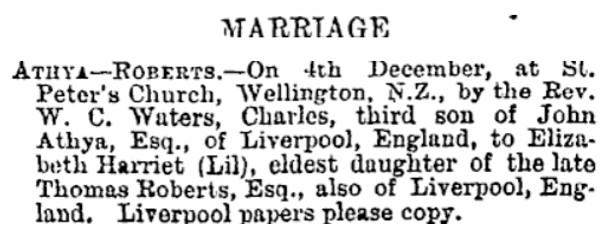
On December 4, 1897, John’s son, Charles, married Elizabeth “Lil” Harriet Roberts, daughter of the late Thomas Roberts. The ceremony was officiated by the Rev. W. C. Waters of St. Peter’s Church and took place in Wellington, New Zealand. The marriage was announced in the Evening Post in New Zealand on December 13:
MARRIAGE. ATHYA—ROBERTS.—On 4th December, at St. Peter’s Church, Wellington, N.Z., by the Rev. W. C. Waters, Charles, third son of John Athya, Esq., of Liverpool, England, to Elizabeth Harriet (Lil), eldest daughter of the late Thomas Roberts, Esq., also of Liverpool, England. Liverpool papers please copy.
Charles worked at A. S. Paterson and Company in Wellington, while Elizabeth had just arrived from Liverpool.
In 1900, John resided at 63 Errol Street, Aigburth Road, in Liverpool. His business, John Athya and Son, where he continued to work as a corn merchant, was located at 9 Britannia Buildings, 22 Fenwick Street West. On November 16, 1900, John’s wife, Catherine, passed away in Liverpool. She was laid to rest on November 19, 1900, at Toxteth Park Cemetery in Toxteth, a borough of Liverpool, Merseyside, England.
 |
Toxteth Park Cemetery |
Catherine’s death was announced in The Weekly Courier in Liverpool on November 24, 1900:
ATHYA—Nov. 16, at 63 Errol-street, Aigburth-road, aged 70 years, Catherine Bell, the beloved wife of John Athya. (Glasgow papers please copy).
In 1901, a widowed John and his daughter, Maria, resided in the parish of Toxteth Park in Liverpool. At 73 years old, John was a self-employed corn broker working from home. Maria, aged 34 and single, was employed as a school teacher.
Maria would remain single for only three more years. On February 25, 1904, she married a widower, John Francis Gibbons Smith, leaving John with no other family in the home.
Maria’s marriage was announced in Evening Sentinel in Stoke-on-Trent, Staffordshire, England, on March 12, 1904:
SMITH—ATHYA.—On the 25th ult., at St. Philemon’s, Liverpool, J. F. G. Smith, of 6, Newcastle street, Burslem, to Maria Watson, seventh daughter of Mr. John Athya, of Liverpool.
In July 1905, John wrote a letter to his 16-year-old granddaughter, Aileen Miller, expressing his delight at receiving her letter and his concern over her mother’s accident. He sought information about her father’s health, which was not included in her letter. John mentioned that her numerous friends in the country were well, but sadly informed her of the death of her second cousin, Gladys Sanderson, aged 15. He apologized for not writing more fully due to his own health, promising to write more in the next mail. He sent love and regards to her parents and all his granddaughters.
 |
Image used with permission of Sarah (Fox) Simpson |
The photo below features John’s daughter Alice (Athya) Miller, along with her daughters Aileen and Marjorie, her daughter-in-law Eileen, and her granddaughter Anne.
 |
Image used with permission of Sarah (Fox) Simpson |
John wrote Aileen again in August 1906, expressing his delight in reading her letter from Port Patrick and reminiscing about having a similar experience in the area when he was her age. He mentioned that having her mother and Margery with her would increase her joy. John apologized for the delay in his reply due to the challenging weather. He hoped for good news from New Zealand regarding Aileen’s father and brothers. He asked Aileen to continue writing, as he enjoyed her letters. John also extended birthday wishes to Aileen and sent love to her mother, Marjorie, and herself. He mentioned Dr. Moore, an old friend.
 |
Image used with permission of Sarah (Fox) Simpson |
 |
John Athya (ca. 1909). Photo used with
permission of Sarah (Fox) Simpson. |
Living alone may not have suited John after having such a large family. In 1911, at 84 years old, he lived as a boarder in the home of Mrs. Catherine Hughes, a 73-year-old widow. Also residing in the home were Catherine’s unmarried daughters, Catherine (40), Margaret (40), and Harriett (35), as well as her nephew John Letts (14) and niece Dorothy Letts (8). The home was located at 17 Welfield Place in Toxteth Park. John, who was listed as a retired corn merchant, likely found companionship in this bustling household.
 |
John’s daughters, Harriet and Florence at the home of Florence
in Moss Lane, Southport, England (photo used with permission of
Sarah (Fox) Simpson) |
John passed away on May 15, 1912 at the age of 84 at 3 Dingle Hill, Toxteth Park, Lancashire, England. His death was attributed to senile decay and cardiac failure and announced in the Journal of Commerce, published in London, on May 17, 1912:
Death of Liverpool Corn Broker. The death is announced of Mr. John Athya, aged 80, a well-known Liverpool corn broker.
John’s son Edwin, who resided at Glencairn on Eardley Road in Streatham, London, was the informant on the death certificate.
 |
Image provided by Sarah (Fox) Simpson |
The Weekly Northwestern Miller, an American periodical published in Minneapolis, Minnesota, and focused on the milling and grain trade, announced John’s death on June 5, 1912:
Death of John Athya. The death has occurred at Dingle Hill, Liverpool, the residence of his daughter, of John Athya, one of the oldest members of the grain trade in this country. Mr. Athya, who was over 80 years of age, was in business in Glasgow for nearly 30 years, and was one of the pioneers in the grain and produce trade between America and this country. Since he left Glasgow, Mr. Athya has resided in the Mersey city, where he carried on business until lately.
John was laid to rest on May 18 in grave number 598, beside his wife, in the Church of England section of Toxteth Park Cemetery in Merseyside, England.
My heartfelt thanks to Sarah (Fox) Simpson, John’s 2nd great granddaughter, for generously sharing photos, documents, and cherished family information, which greatly enriched this sketch.
References
- Alice Athya, Scotland, Select Births and Baptisms, 1564–1950.
- Births, Commonwealth (Glasgow), Glasgow, Lanarkshire, Scotland, December 23, 1854.
- Births, Glasgow Courier, Glasgow, Lanarkshire, Scotland, August 16, 1859.
- Births, Glasgow Courier, Glasgow, Lanarkshire, Scotland, July 10, 1856.
- Births, Glasgow Herald, Glasgow, Lanarkshire, Scotland, September 19, 1853.
- Births, Glasgow Herald, Glasgow, Scotland, December 1862.
- Births, North British Daily Mail, Glasgow, Lanarkshire, Scotland, February 9, 1858.
- Bright hopes for suffrage: Lydia Becker and the struggle for democracy, Chetham’s Library, Manchester, UK, June 2, 2017
- British barque Jane, Glasgow Chronicle, Glasgow, Lanarkshire, Scotland, August 20, 1851.
- Cathcart Burial Ground, The Glasgow Herald, Glasgow, Scotland, June 2, 1877.
- Cathcart Parochial Board, The Glasgow Herald, Glasgow, Scotland, August 15, 1870 and June 26, 1878.
- Catherine Athya, Toxteth Park Cemetery, Court Orders 1900, image 1129, FamilySearch.org.
- Catherine Bell Athya, The Weekly Courier, Liverpool, England, November 24, 1900.
- Christmas Dinner to the Poor, North British Daily Mail, Glasgow, Lanarkshire, Scotland, December 26, 1874.
- Clyde Navigation, Post Office Directories, Glasgow, Lanarkshire, Scotland, 1875–1876.
- Clyde Navigation, Post Office Directories, Glasgow, Lanarkshire, Scotland, 1876–1877.
- Commercial, Liverpool Exchange, The Liverpool Weekly Mercury, Liverpool, England, July 22, 1876.
- Copartnership dissolved, The Edinburgh Gazette, Edinburgh, Scotland, November 8, 1861.
- Court of Session, First Division—Tuesday, May 27, Glasgow Herald, Glasgow, Scotland, May 28, 1879.
- Death of John Athya, The Weekly Northwestern Miller, p. 597, vol. 90, June 5, 1912.
- Death of Liverpool Corn Broker, The Journal of Commerce, London, England, May 17, 1912.
- Deaths, Athya, North British Daily Mail, Glasgow, Lanarkshire, Scotland, January 1, 1873.
- Edwin Athya (1895), Cheshire Marriage Licence Bonds and Allegations, 1606–1905, Cheshire Archives and Local Studies Service, Chester, England.
- Election of Clyde Trustees, Glasgow Herald, Glasgow, Scotland, November 11, 1865.
- Extraordinary Discovery at the Viaduct Works, Warrington Examiner, Warrington, Lancashire, England, July 5, 1884.
- Family information, including content from the Athya family Bible, provided by Sarah (Fox) Simpson.
- General Directory, Scotland, Post Office Directories, Glasgow, Lanarkshire, Scotland, 1852–1853, 1853–1854 , and 1856–.
- Glasgow Docks, Broomielaw, Clyde River and Firth, Govan, Partick, August 5, 2017; https://www.dalmadan.com/?p=4648.
- Glasgow Ladies’ College, Glasgow Herald, Glasgow, Scotland, June 1, 1868.
- Grain theft, Glasgow Saturday Post, and Paisley and Renfrewshire Reformer, Glasgow, Lanarkshire, Scotland, November 9, 1861.
- Isaac Athya, Burial Registers, vols. 3, 6–7 (4 and 5 missing), June 1850–December 1851, September 1853–October 1854, June 1862–July 1865, 1857–1864, Southern Necropolis Cemetery, Glasgow, 1840–1995, image 760, familysearch.org; https://www.familysearch.org/ark:/61903/3:1:3Q9M-CSMZ-YXB7?cat=1322281&i=759.
- Isaac Athya, Statutory Registers Deaths 644/10 876, National Records of Scotland, 1860.
- Jacob Bright, Spartacus Educational; https://spartacus-educational.com/Jacob_Bright.htm.
- Janet Athya, Burial Registers, vols. 3, 6–7 (4 and 5 missing), June 1850–December 1851, September 1853–October 1854, June 1862–July 1865, 1857–1864, Southern Necropolis Cemetery, Glasgow, 1840–1995, image 796, familysearch.org; https://www.familysearch.org/ark:/61903/3:1:3Q9M-CSMZ-YFX3?cat=1322281&i=795.
- Janet Athya, Statutory Registers Deaths 644/10 120, National Records of Scotland, 1861.
- John Athya (1850), United States, Atlantic Ocean and Gulf Coast Ports Passenger Lists, 1820–1874.
- John Athya (1852), Scotland, Parish Marriages & Banns, 1561–1893.
- John Athya (1855), Scotland, Parish Births & Baptisms 1564–1929.
- John Athya (1912), England and Wales Deaths 1837–2007.
- John Athya, 1870 Post Office Directory of Glasgow, UK, City and County Directories, 1766–1946.
- John Athya, Census 560/7/11, National Records of Scotland, 1871.
- John Athya, Census 644/242/7, National Records of Scotland, 1841.
- John Athya, Census 644/861/33, National Records of Scotland, 1861.
- John Athya, Census of England and Wales, Toxteth Park, Lancashire, England census, 1911.
- John Athya, Certified Copy of an Entry of Death, General Register Office, England, 2001.
- John Athya, Chicago City Directory 1889.
- John Athya, Cook County, Illinois, U.S., Deaths Index, 1878–1922.
- John Athya, Corporation of Liverpool, Toxteth Park Cemetery, Register of Burials in the Consecrated Ground, 1912.
- John Athya, Deaths, Chicago Tribune, Chicago, Illinois, October 2, 1895.
- John Athya, England and Scotland, Select Cemetery Registers, 1800–2016.
- John Athya, General Minute-Book of the Court of Session from 16th October 1880 to 15th October 1881, vol. C, Scotland, Court Records 1880–1881, family.search.org, image 139.
- John Athya, General Minute-Book of the Court of Session from 16th October 1880 to 15th October 1881, vol. C, Scotland, Court Records 1880–1881, family.search.org, image 105.
- John Athya, General Minute-Book of the Court of Session from 16th October 1880 to 15th October 1881, vol. C, Scotland, Court Records 1880–1881, family.search.org, image 223.
- John Athya, Gore’s Directory of Liverpool and Birkenhead, 1900.
- John Athya, Kelly’s Directory of Liverpool and Birkenhead, 1894.
- John Athya, Liverpool, Lancashire, England census, 1881.
- John Athya, Old Parish Registers, Marriages 644/1 Glasgow, National Records of Scotland, 1852.
- John Athya, Old Parish Registers, Marriages 646/Govan, National Records of Scotland, 1852.
- John Athya, Scottish Post Office Directories, General Directory, Glasgow, 1866–1877.
- John Athya, Toxteth Park, Liverpool, England census, 1901.
- John Athya, Valuation Rolls VR010700003-/4, Lanark County, National Records of Scotland, 1855.
- John Athya, Valuation Rolls VR011400011-/445, Renfrew County, National Records of Scotland, 1865.
- M’Kerrow-Athya marriage, Liverpool Echo, Liverpool, Merseyside, England, July 30, 1892.
- Maria Watson Athya, Liverpool, England, Church of England Marriages and Banns, 1754–1935.
- Marriage, Athya—Roberts, Evening Post, vol. LIV, no. 142, p. 6, New Zealand, December 13, 1897.
- Marriages, Athya–Greenwood, Liverpool Mercury, Liverpool, Merseyside, England, June 21, 1895.
- Marriages, Miller-Athya, Liverpool Weekly Courier, Liverpool, Lancashire, England, April 26, 1884.
- Marriages, Sanderson–Athya, Liverpool Mercury, Liverpool, Merseyside, England, April 18, 1885.
- Marriages, Smith—Athya, Evening Sentinel in Stoke-on-Trent, Staffordshire, England on March 12, 1904.
- Miller-Athya, Liverpool Echo, Liverpool, Merseyside, England, April 24, 1884.
- Mr. J. Athya, Belfast, Northern Ireland, The Belfast Newsletter (Birth, Marriage and Death Notices), 1738–1925.
- Mr. Smeaton’s Educational Establishment, Abbey Park, St. Andrews, Prize List, St. Andrews Gazette and Fifeshire News, St. Andrews, Fife, Scotland, August 6, 1870.
- New York City, New York, United States records, images, FamilySearch (https://www.familysearch.org/ark:/61903/3:1:939V-5G9J-K4?view=index : Nov 12, 2024), image 323 of 520; United States National Archives and Records Administration.
- Nithsdale Place, Records, Ordnance Survey Name Books, Lanarkshire OS Name Books, 1858-1861, Lanarkshire volume 28, OS1/21/28/63, ScotlandsPlaces; https://scotlandsplaces.gov.uk/digital-volumes/ordnance-survey-name-books/lanarkshire-os-name-books-1858-1861/lanarkshire-volume-28/63.
- Notice of Dissolution of Copartnery, The London Gazette, London, England, September 7, 1858.
- Obstruction on the Quay, North British Daily Mail, Glasgow, Lanarkshire, Scotland, September 7, 1858.
- Partnerships Dissolved, Huddersfield Chronicle, Huddersfield, Yorkshire, England, November 2, 1861.
- Personal Items, New Zealand Herald, vol. XXXIV, no. 10622, December 10, 1897.
- Post Office Directories, Glasgow, Lanarkshire, Scotland, 1877–1878, 1878–1879, and 1879–1880.
- Probate, Divorce, and Admiralty Divisions, Admiralty Business, The Lake Megantic, The Law Times Reports, vol. XXXVI., N.S., March 31, 1877.
- River Bailie Court, Glasgow Evening Citizen, Glasgow, Lanarkshire, Scotland, July 19, 1869.
- Second and Final Liquidation and Distribution Account in the Intestate Estate of the Late George Howard Athya of Durban, Bachelor – Estate No. 34847 M, December 28, 1942.
- Sequestration of John Gibb, Merchant and Grocer in Greenock, Scotland, Edinburgh Gazette, May 4, 1852.
- Severe Losses at Home, Edinburgh Evening News, Edinburgh, Midlothian, Scotland, July 20, 1876.
- Severe losses, Evening Express, Liverpool, England, July 21, 1876.
- Seyd, F.S.S., Richard, Record of Failures and Liquidations in the Financial, International, Wholesale, and Manufacturing Branches of Commerce (Including Drapers and Ironmongers) in the United Kingdom, From 1865 to 1884, Both Inclusive, London, England, 1885.
- Standholders Meeting, North British Daily Mail, Glasgow, Scotland, April 6, 1871.
- The Clyde Navigation Trust, Hebridean Connections; https://hebrideanconnections.com/record/organisations/108314/.
- To the Electors of the Clyde Navigation Trust, Glasgow Herald, Glasgow, Scotland, November 14, 1873.
- Women’s Suffrage Meeting at Crosshill, Glasgow Herald, Glasgow, Lanarkshire, Scotland, November 27, 1872.