Showing posts with label Liddell. Show all posts

Friday, January 23, 2026

James Durie

James Durie, son of George Durie and Mary Elisabeth Taylor, was born on April 26, 1824, in Inveresk with Musselburgh, Midlothian, Scotland. George and Mary raised six children: William Durie, James Durie, Agnes Durie, Elizabeth Durie, John Durie, and Robert Durie. 

James is my husband’s 2nd great-grandfather, with their nearest common ancestor being James’ daughter Jemima, my husband’s great-grandmother.

James was baptized on May 30, 1824, at Inveresk with Musselburgh, in a ceremony witnessed by John Paul and John Braidfoot. The parish, situated near Edinburgh, blended village and town life and was closely tied to the region’s coastal economy.


Birth and baptism record

James’ brother William enlisted in the military on February 13, 1837, despite being only 14 years old. I will share more about William’s life and service in my next post.

By 1841, the Durie family appears across three separate census pages. James’ father, George, was living alone at the West Pans Tollhouse, where he worked as a tollkeeper. The tollhouse—a small roadside cottage built by the turnpike trust—was designed for constant duty rather than family living. With its angled frontage and bay window, George would have monitored passing traffic and collected fees for carts, horses, and pedestrians. Its cramped interior explains why he lived there alone while his family remained nearby.

Mary and the children—James, Agnes, Elizabeth, John, and Robert—lived less than a mile away on High Street in Musselburgh. James, age 16, was recorded as an apprentice “c/wright,” almost certainly a coachwright. This trade, combining woodworking with ironwork, was a natural entry point into Glasgow’s expanding transport and engineering industries. William, the eldest brother, does not appear in the household, likely absent with his military unit.


George in the 1841 Scotland census


Elisabeth in the 1841 Scotland census


James and four of his siblings in the 1841 Scotland census

James married Jane Liddell Braidwood, daughter of Andrew Braidwood and Mary Liddell, on May 13, 1849, in Glasgow. At the time, James was working as an engineer. The couple welcomed nine children: Mary Durie, Agnes Durie, Elizabeth Durie, George Durie, Jemima Durie, Andrewina Durie, John Durie, Robert Durie, and Jane Durie. Their first child, Mary, was born on September 14, 1849, with John Braidwood and John Durie serving as witnesses.


James and Jane in the Scotland marriage register

By 1851, James had transitioned fully into engineering, a natural progression from his coachwright apprenticeship. The family lived at 67–69 Carrick Street in the St. George civil parish of Glasgow. James’ sister‑in‑law, Jessie Braidwood, age 21, was also living with them, likely working as a boy’s clothing maker.


1851 Scotland census

James’ brother William, a private in the 72nd Regiment of Foot (The Duke of Albany’s Own Highlanders), died on April 8, 1853, and was buried at Sandymount Cemetery in Glasgow.

James’ father, George, died of apoplexy on February 10, 1857, at 53 Cadogan Street in the Blythswood district. He had worked as a cotton storekeeper and was buried at Southern Necropolis Cemetery in Glasgow.

In 1861, the Durie family lived at 62 Brown Street in the Clyde District of St. George Parish. James, age 36, was working as an engine smith—crafting and repairing engine parts during Glasgow’s industrial boom.


1861 Scotland census

Tragedy struck that spring when two‑year‑old Andrewina died on May 26, 1861, after six weeks of dothinenteritis (typhoid fever) and two weeks of “water in the head,” likely hydrocephalus. She was buried at Eastern Necropolis in Lair 4964, held by her maternal grandfather, Andrew Braidwood.

James continued working as an engine fitter/journeyman, and by February 6, 1863, the family was living at 22 Pitt Street in Blythswood, Glasgow, where their son Robert was born.

James’ mother, Mary, died two years later on July 13, 1865, at her Cadogan Street home at age 69. Despite searches of Southern Necropolis and other Glasgow cemeteries, her burial place has not yet been identified. A notice of her death appeared in The Herald on July 15.

Another loss followed on November 6, 1866, when James and Jane’s youngest daughter, Jane, died of croup after only two days of illness. Her burial location remains unknown.

By 1871, the family remained at Pitt Street in a two‑window tenement. James continued as an engine fitter, while daughters Mary and Jemima worked as warehouse girls. George was an iron turner, and the younger boys attended school. A Liddell family also lived at the address, possibly relatives of Jane’s mother.


1871 Scotland census

The Durie children began forming their own families in the 1870s. Elizabeth married John Alexander in 1873, and Jemima married James Athya in 1877. By 1881, the family had moved to 46 Lancefield Street in Barony Parish. James was still an engine fitter, and his son Robert had become a plumber. James’ grandson Thomas Alexander, age 8, was also living with them, and was attending school.


1881 Scotland census

James’ son John married Annie Frew in 1881 and had three children—James, Jane, and Annie. Sadly, baby Jane died before her first birthday, and his wife Annie died sometime after 1890.

In 1886, James and Jane were listed in parochial relief records when their daughter Jemima applied for assistance in Cambusnethan.

Robert married Mary Lochhead on February 15, 1889, with James recorded as a journeyman engine fitter.

In 1891, James and Jane lived at 99 Hotcross Street in Barony Parish with their widowed son John and grandchildren James and Annie. James, now a marine engine fitter, continued working well into his later years.


1891 Scotland census

James’ sister Elizabeth died on May 2, 1897, in Kelvin, Lanarkshire, after several months of declining health following what would now be understood as a stroke. She was buried in Lair 974 at Western Necropolis Cemetery. His sister Agnes died on August 22, 1900, in Helensburgh, Row Parish, and was buried in Lair 973 at Western Necropolis. She never married.

In 1901, James and Jane lived at 33 McIntyre Street in Barony Parish with their son John and his children. James, age 77, was still working as a marine engine fitter. His grandson James was apprenticed in the same trade, while Annie attended school.


1901 Scotland census

James died at home on December 13, 1902, from a cerebral hemorrhage and senile decay. His son John was the informant on the death register.


James in the Scotland burial register

James was buried on December 16 at Eastern Necropolis Cemetery in Lair 384, compartment 13, at a depth of 10 feet. The lair, purchased by his son John, became a family resting place. Those buried with him include:

  • Catherine Durie (granddaughter, died 1908)
  • Jane Durie (wife, died 1908)
  • Elizabeth Alexander (daughter, died 1911)
  • Mary Durie (believed to be John’s daughter, died 1927)
  • John Durie (son, died 1928)


Eastern Necropolis Cemetery burial register (see John on both line of both pages)


Lair 384 register

References

  • Agnes Durie, Statutory Registers Deaths 503/109, National Records of Scotland, 1900.
  • Andrina Durie, Statutory Registers Deaths 644/5 442, National Records of Scotland, 1861.
  • Andrwine Durie, Glasgow, Scotland, Burial Records 1855–1861, image 236, FamilySearch.
  • Daily interment books, December 1897-August 1912, cemetery records for Eastern Necropolis Cemetery, Glasgow, 1861-1995, film no. 008685206, image 333, FamilySearch.
  • Deaths, Mrs. George Durie, The Herald, Glasgow, Scotland, July 15, 1865.
  • Eastern Necropolis: Glasgow, Scotland, Cemetery Records 1900–1995, image 41, FamilySearch.
  • Elisabeth Durie, Census 689/12/5, National Records of Scotland, 1841.
  • Elizabeth Durie, Statutory Registers Deaths 644/6 358, National Records of Scotland, 1865.
  • Elizabeth Durie, Statutory Registers Marriages 644/9 127, National Records of Scotland, 1873.
  • Elizabeth Morris, Statutory Registers Deaths 644/9 551, National Records of Scotland, 1897.
  • George Durie, Census 689/9/1, National Records of Scotland, 1841.
  • George Durie, Statutory Registers Deaths 644/6 86, National Records of Scotland, 1857.
  • Glasgow, Scotland, Burial Records 1850–1854, images 207–208, FamilySearch.
  • Glasgow, Scotland, Burial Records January 1882–March 1900, image 274, FamilySearch.
  • James Athya, Statutory Registers Marriages 644/12 176, National Records of Scotland, 1877.
  • James Durie, Census 644/1 47/15, National Records of Scotland, 1851.
  • James Durie, Census 644/10 30/20, National Records of Scotland, 1881.
  • James Durie, Census 644/5 55/7, National Records of Scotland, 1861.
  • James Durie, Census 644/69/19, National Records of Scotland, 1871.
  • James Durie, Census 689/12/7, National Records of Scotland, 1841.
  • James Durie, Census 689/12/7, National Records of Scotland, 1841.
  • James Durie, Old Parish Registers Births 689/Inveresk and Musselburgh, 1824.
  • James Durie, Scotland, Select Births and Baptisms, 1564–1950.
  • James Durie, Statutory Registers Deaths 644/10 734, National Records of Scotland, 1902.
  • Jane Braidwood, Old Parish Registers Marriages 644/1 Glasgow, National Records of Scotland, 1849.
  • Jane Durie, Statutory Registers Deaths 644/6 504, National Records of Scotland, 1866.
  • Jemima Durie (or Athya), Cambusnethan. Parish Poor Law Records 1886–1887, image 180, FamilySearch.
  • Jemima Durie, Census 644/5 55/8, National Records of Scotland, 1861.
  • John Durie, Census 644/10 13/10, National Records of Scotland, 1901.
  • John Durie, Census 644/10 17/3, National Records of Scotland, 1891.
  • Mary Durie, Old Parish Registers Births 644/1 Glasgow, National Records of Scotland, 1849.
  • William Durie, Old Parish Registers Births 689/Inveresk and Musselburgh, National Records of Scotland, 1821.
  • William Durie, UK, Royal Hospital Chelsea Pensioner Admissions and Discharges, 1715–1925.
  • Wm. Durie, UK, Royal Hospital Chelsea Admission Books, Registers and Papers, 1702–1980. 

Friday, July 11, 2025

Thomas Bowman

Thomas Bowman was born January 23, 1877, at 102 Foundry Lane in St. Rollox, Glasgow, Lanarkshire, Scotland, to Joseph Bowman and Mary Braidwood. His parents had married on September 1, 1876, and had been together for just under five months at the time of his birth. His father, a journeyman glassblower, was originally from England. Thomas was the oldest of three, with Joseph Bowman and Alexander Bowman as his younger siblings. 


Thomas in Scotland birth register

Thomas is my husband’s 2nd cousin 2x removed. Their closest shared ancestors are Andrew Braidwood and Mary Liddell—Thomas’ great-grandparents and my husband’s 3rd great-grandparents.

By the time Joseph was born, the family had relocated to 77 East-John Street in Camlachie, Glasgow. By 1881, they were living in Dennistoun, Glasgow, where Alexander was born. That same year, the Bowman family resided at 5 County Park Terrace in Saint John Parish, Glasgow. Their home had only one windowed room, indicating modest living conditions. At age 26, Thomas’ father continued working as a glassblower.


1881 Scotland census

By 1891, Thomas (14) was living at 33 Mill Street in Bridgeton with his widowed grandmother, Christina (Martin) Braidwood (58), his widowed mother (30), aunt Martha Braidwood (26), and brothers Joseph (11) and Alexander (9). His father had evidently passed away between 1881 and 1891. His mother and aunt worked as paint workers, while his brothers were noted as scholars—though Thomas was not. Compared to their earlier home, this one had three rooms with windows, suggesting improved circumstances.


1891 Scotland census

Thomas married Sophia Johnston on February 7, 1899, at Fairbairn Free Church in Bridgeton, according to the Forms of the Free Church of Scotland. At 22, he worked as a furniture warehouseman, and his 20-year-old bride, Sophia, was a spinster. Thomas resided at 56 Albany Street, while Sophia, daughter of William Johnston and Mary Lowrie, lived at 5 Harvie Street.


Thomas in Scotland marriage register

The couple had five children—Mary Bowman, Sophia Bowman, William James Bowman, Violet Bowman, and Thomas Bowman. Their first child, Mary, was born five months after their wedding at the Johnston family home on June 10, 1899. At the time, Thomas continued as a furniture warehouseman.


Mary Bowman in Scotland birth register

Mary passed away on April 8, 1900, at 219 London Road in Camlachie, Glasgow, at just nine months old. She succumbed to acute bronchial pneumonia, which she battled for seven days. Sadly, her great-grandmother and Thomas’ grandmother, Christina (Martin) Braidwood, had died just one day prior. Mary was buried in Lair 3224 at Sandymount Cemetery, in a plot owned by her grandfather, William Johnston.


Mary Bowman in Scotland death register

Their second daughter, Sophia, was born on January 21, 1901, at the Johnston home. Thomas remained in furniture warehousing. However, in the 1901 census, Thomas and Sophia lived separately—Thomas with his widowed mother and brothers in Dalmarnock, and Sophia with her widowed father and brother in Calton. Both were recorded as married, yet their separation raises speculation—perhaps for work, family care, or other reasons.


Sophia Bowman in Scotland birth register

Thomas later worked as a paint maker, responsible for mixing pigments, oils, and resins for buildings, ships, and machinery. His brothers, Joseph and Alexander, worked as machinemen, operating and maintaining industrial machinery.

In 1901, the census captured two households connected by marriage. Thomas, a paint maker by trade, shared a modest two-windowed home at 29 Ardenlea Street with his mother Mary and brothers Joseph and Alexander. Both brothers worked as machinemen, likely in one of the area’s industrial facilities.

Meanwhile, Thomas’ wife Sophia was living separately with her family in their two-windowed home on Harvie Street. She stayed there with her widowed father William, her nine-year-old brother (also named William), and her infant daughter Sophia, just two months old at the time. Her father worked as a bleachfield worker in the textile industry—a job that involved spreading cloth across open fields and using both chemicals and natural sunlight to achieve the desired white color. Young William, like many children his age, was listed as a scholar, attending local schooling.


Thomas in the 1901 Scotland census

Thomas' wife and daughter in the 1901 Scotland census

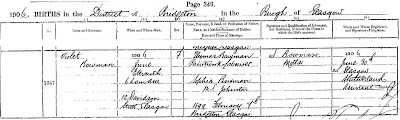
By May 25, 1904, Thomas and Sophia seemingly reunited, as their son, William James Bowman, was born at 125 Summerfield Street in Bridgeton. Their third child, Violet Bowman, arrived on June 11, 1906, at 12 Davidson Street. Thomas continued to be employed as a paint worker.


William James Bowman in the Scotland birth register

Violet Bowman in the Scotland birth register

Thomas passed away on June 7, 1908, at age 28, at the Royal Infirmary in Glasgow. His death resulted from lockjaw (tetanus), caused by a puncture wound in his left foot sustained weeks prior. He endured 12 days of suffering before succumbing. At the time, he lived at 44 East Hope Street in Dennistoun and worked as a bone work laborer, a role involving processing animal bones for industrial goods like buttons, combs, and fertilizer.


Thomas in the Scotland death register


Correction sheet to Thomas’ death register

Thomas was laid to rest in Lair 4963 at Eastern Necropolis Cemetery on June 10, 1908, alongside his grandmother, parents, and other relatives. His great-grandfather, Andrew Braidwood, was the lair’s proprietor.


Thomas in Eastern Necropolis Cemetery's burial records


Eastern Necropolis Cemetery, Lairholder Registry

Sophia was left to care for their three young children—but it turns out she was already pregnant. On November 7, 1908—five months after Thomas’ death—she gave birth to a son, Thomas Bowman, at 39 Springfield Road in Bridgeton.


Thomas’ son Thomas Bowman in Scotland birth register

Sophia passed away in 1920 from smallpox. She was buried in Lair 3224 at Sandymount Cemetery, alongside her father and daughter, Mary.


Sophia in Scotland death register


William Johnston Lair, Register of Lair Owners and Burials,
Sandymount Cemetery, Glasgow

References

  • Alexander Bowman, Statutory Registers Births 644/3 670, National Records of Scotland, 1881.
  • Andrew Braidwood, Glasgow, Scotland, Burial Records 1800–1970, images 1 and 40, FamilySearch.
  • Bridgeton, Glasgow, Lanarkshire, Scotland Census, 1891. DOWNLOAD
  • Eastern Necropolis Cemetery: Glasgow, Scotland Burial Records 1906–1912, image 86, FamilySearch.
  • Joseph Bowman, Statutory Registers Births 644/2 940, National Records of Scotland, 1879.
  • Mary Bowman, Statutory Registers Births 644/1 1741, National Records of Scotland, 1908.
  • Mary Bowman, Statutory Registers Deaths 644/2 320, National Records of Scotland, 1900.
  • Sandymount Cemetery: Glasgow, Scotland, Burial Records 1880–1989, images 4 and 425, FamilySearch.
  • Sophia Bowman, Census 644/116/2, National Records of Scotland, 1901.
  • Sophia Bowman, Statutory Registers Deaths 644/1 625, National Records of Scotland, 1920.
  • Thomas Bowman, Census 644/130/3, National Records of Scotland, 1891.
  • Thomas Bowman, Census 644/175/14, National Records of Scotland, 1901.
  • Thomas Bowman, Census 644/321/13, National Records of Scotland, 1881.
  • Thomas Bowman, Statutory Registers Births 644/1 1741, National Records of Scotland, 1908.
  • Thomas Bowman, Statutory Registers Births 644/6 239, National Records of Scotland, 1877.
  • Thomas Bowman, Statutory Registers Deaths 644/4 761, National Records of Scotland, 1908.
  • Thomas Bowman, Statutory Registers Marriages 644/1 76, National Records of Scotland, 1899.
  • Violet Bowman, Statutory Registers Births 644/1 1036, National Records of Scotland, 1899.
  • William James Bowman, Statutory Registers Births 644/1 1033, National Records of Scotland, 1904. 

Friday, August 25, 2023

Mary Liddell

Having recently written a sketch for Mary Liddell’s husband, Andrew Braidwood, I already knew much of her story. However, I had not made the connection to her parents nor determined her birthdate yet. So, before I could write her story, I needed to find those two critical pieces of information. 

Mary was 83 years old when she died, so was most likely born about 1788 or 1789. From the Scotland’s People website, I searched the “Church Registers—Old parish registers—Births and Baptisms” database and found two females born during that timeframe. One was born in Glasgow on January 7, 1788 to Robert Liddell and Ann Drew. The other was born in Glasgow on September 19, 1788 to John Liddell and Margaret McCaul. I next looked at Mary’s children to help me determine which of the two couples could possibly be Mary’s parents. Scots generally use a select set of naming patterns to name their children. According to the Family Search website, when naming a child, “the first son was named after the father’s father, the second son after the mother’s father, and the first daughter after the mother’s mother.” In this case, I compared the two sets of parents based on the children Mary and Andrew had together and believe that John and Margaret are the correct set of parents. Mary named her first son James, presumably after Andrew’s father James Braidwood. Her second son was John which tracks to her father, John Liddell. Her first daughter was named Margaret, which tracks to her mother, Margaret McCaul. None of their children were named Robert or Ann which is why I eliminated them. Now armed with what I believe to be her parents’ names, I looked at the birth record for the child Mary Liddell that listed John and Margaret as the parents and she was born in Glasgow, Lanark, Scotland on September 19, 1788. Her birth was witnessed by John Liddell and Archibald McCaul. I feel good about this choice, but if you can prove otherwise, I would love to hear from you.


Mary Liddell 1788 Birth Register (click to enlarge)

Mary married Andrew Braidwood, son of James Braidwood and Margaret Moodie, in Newton Parish, Edinburgh, Scotland in July 1818. Both lived in Newton Parish at the time they made a proclamation to wed on June 20, 1818. 

Mary and Andrew had at least eight children together—James Braidwood, Margaret Braidwood, John Braidwood, Jane Braidwood, Janet Braidwood, Jessie Braidwood, Andrew Braidwood (twin), and Mary Erskine Stewart Braidwood (twin).

The Braidwood family lived in Newton, Edinburghshire, Scotland when son James was born in 1819. They had moved to Inveresk, Midlothian, Scotland by 1821 when Margaret was born. Mary’s husband was working as a joiner (woodworker) at the time. They remained in Inveresk through 1825 where John (1823) and Jane (1825) were born. The family moved back to Newton Parish by December 1828 when Janet was born. Their daughter Jessie was born about 1830, location unknown. Mary gave birth to twins Andrew and Mary in September 1831. At that time, the family lived in Wright, North Leith, Midlothian, Scotland.

In 1841, the Braidwood family lived at Wood Hall in Cambusnethan, a village in Wishaw, North Lanarkshire, Scotland. Mary’s husband Andrew worked as a house carpenter. Besides Mary and Andrew, the others in the home included daughters Margaret (20), Jean [Jane] (15), and Janet (12).

In 1851, the Braidwood family lived at 45 Brown Street in St. George’s Parish, Lanarkshire, Glasgow, Scotland. At age 51, Andrew worked as what is transcribed from the census as millionght, journeyman. I believe he was probably a millwright but could be wrong. Mary’s 29-year-old daughter Margaret and a niece Margaret Shiers, age 10, also lived in the home. I have been unable to determine who the parents of the niece are at this point in my research. During the period 1855 to 1856, the family lived on Stockwell Street, which had a yearly rent or value of $12.

Andrew died on January 29, 1858 of a paralytic stroke/palsy at the age of 59 in the Clyde District of Glasgow, Lanarkshire, Scotland. He was buried on February 1 in Lair 4964 at Glasgow’s Eastern Necropolis Cemetery.

In 1861, Mary lived as a boarder in the home of a 58-year-old Irishwoman named Martha Johnston. The home was located on Dalmarnock Road in the Calton Parish of Glasgow. Mary was enumerated as a pauper, age 75. Martha worked as a cotton winder.


1861 Calton Parish, Glasgow, Scotland census (click to enlarge)

Mary should have been enumerated in the 1871 Scotland census; however, I have been unable to find her. She died on February 14, 1872 in the City Poorhouse located in the Central District of Glasgow. Her cause of death was senile decay, which she had suffered from for months. Unfortunately, the only name listed in the column for her parents was “Liddell.” I have also been unable to find the location of Mary’s final resting place. She is not listed in the burial records of Eastern Necropolis where her husband was buried. There are extensive records for that cemetery so I feel certain she would be listed if she had been buried there. 


Mary Liddell Braidwood Glasgow, Scotland Death Register

References

  • Andrew Braidwood, Cemetery Records, Eastern Necropolis Cemetery, Glasgow, Scotland, 1858.
  • Andrew Braidwood, Old Parish Registers Births 692/1 Leith North, National Records of Scotland, 1831.
  • Andrew Braidwood, Statutory Registers Deaths 644/5 86, National Records of Scotland, 1858.
  • James Braidwood, Old Parish Registers Births 696/Newton), page 142 of 152, 1819.
  • Jane Braidwood, Old Parish Registers Births 689/Inveresk and Musselburgh, page 168 of 509, 1825.
  • Jane Braidwood, Scotland, Select Births and Baptisms, 1564-1950.
  • Janet Braidwood, Old Parish Registers Births 696/Newton), page 97 of 363, 1829.
  • John Braidwood, Old Parish Registers Births 689/Inveresk and Musselburgh, page 113 of 509, 1823.
  • Margaret Braidwood, Old Parish Registers Births 689/Inveresk and Musselburgh, page 52 of 509, 1821.
  • Mary Braidwood, Scotland Census 644/366/9, National Records of Scotland, 1861.
  • Mary Braidwood, Statutory Registers Deaths 644/1 352, National Records of Scotland, 1872.
  • Mary Liddell, John Liddell/Margaret McCaul, FR1471, Church registers, Old parish registers, Births and Baptisms, Scotland’s People, 1788; https://www.scotlandspeople.gov.uk/record-results/125245770564b56f715a46d.
  • Naming Patterns, Scotland Personal Names; https://www.familysearch.org/en/wiki/Scotland_Personal_Names. 
  • Scotland Census 628/6/7, page 7 of 33, National Records of Scotland, 1841.
  • Scotland Census, 644/143/10, page 10 of 25, National Record of Scotland, 1851. 

Thursday, July 6, 2023

John Braidwood

John Braidwood, son of Andrew Braidwood and Mary Liddell, was born March 5, 1823 in Inveresk, Midlothian, Scotland. His parents had at least eight children—James Braidwood, Margaret Braidwood, John Braidwood, Jane Liddell Braidwood, Janet Braidwood, Jessie Braidwood, Mary Erskine Stewart Braidwood (twin), and Andrew Braidwood (twin). John is my husband’s 3rd great-uncle with their nearest common relatives being his parents. His sister Jane Liddell Braidwood is my husband’s 2nd great grandmother.

John was baptized on April 6, 1823. Witnesses were James Braidwood and John Liddle. His father Andrew worked as a joiner.


Birth record for John Braidwood

I have been unable to find John in the 1841 census. He was not living with his family.

John married Margaret Robertson on June 21, 1850 in Barony, Lanark, Scotland. John and Margaret were blessed with seven children—Mary Braidwood, Andrew Braidwood, James Braidwood, John Campbell Braidwood, John Robertson Braidwood, Margaret Robertson Braidwood, and Willian Ronald Braidwood. Sadly, several would not survive infancy/childhood. 

The 1851 census record shows that John, Margaret, and a three-month-old daughter named Mary lived at 19 Oswald Street in the St. George parish of Glasgow, Lanarkshire, Scotland. At the time, John worked as a journeyman millwright. I am confused by Mary. The Scotland census was taken on March 30, 1851 so that means since she was three months old, she would have been born about January 1851. 


1851 census record

Yet, when John’s son Andrew was born at 8 Greenhill Street Christmas day 1852 in the Barony Parish of Lanarkshire, Scotland, the parish register notes it was “their 1st child.” His birth was witnessed by Alexander and John Robertson. I do know that Margaret had a brother named Alex.


Birth record for Andrew Braidwood

Son John Campbell Braidwood was born April 18, 1855 at No. 8 Greenhill Street in Anderston, Glasgow, Lanarkshire, Scotland. John worked as an engineer. 


Birth record for John Campbell Braidwood

Son James Braidwood was born September 28, 1857 at 27 Roxburgh Street in Greenock, Renfrewshire, Scotland. John worked as an engineer.


Birth record for James Braidwood

Sadly, he only lived for nine months. James died at 27 Roxburgh Street in Greenock of whooping cough on June 30, 1858. He was buried at Greenock Cemetery.


Death record for James Braidwood

Son John died on July 27, 1858 from gastric fever in Greenock at the age of three. He too was buried at Greenock Cemetery.


Death record for John Braidwood

Son John Robertson Braidwood was born August 27, 1860 at No. 8 Ingleston Road in Greenock, Renfrewshire, Scotland. John worked as an operation engineer at the time.


Birth record for John Robertson Braidwood

In 1861, John and his family lived at No. 8 Ingleston Road in Greenock, Renfrewshire, Scotland. John worked as an engine fitter. Mary and Andrew were both scholars. There was a 22-year-old lodger named James McNee living in the home with the family. James also worked as an engine fitter. A Liddell family lived two houses from John's consisting of a 270-year-old male named Robert, his wife Elizabeth (23), daughter Lillias (1), and brother David (19). I have yet to determine if he connects to the maternal side of John's family. Going back to daughter Mary’s age, she enumerated as 10 years old here which fits with the 1851 census. 


1861 census record

On May 30, 1861, John’s nine-month-old son, John Robertson Braidwood, died at Hay Peak Cottage on Florence Street in Greenock, Renfrewshire, Scotland from ulceration of fauces (throat). The infant had suffered with the ulceration for six days, along with croup for two days prior to his death.  


Death record for John Robertson Braidwood

Daughter Margaret Robertson Braidwood was born April 24, 1862 at Hyde Peak Cottage in Greenock, Renfrewshire, Scotland. John worked as a practical engineer (journeyman). 


Birth record for Margaret Robertson Braidwood

John was killed at age 40 when a building he was working on collapsed on top of him on February 27, 1865 in South Leith, Midlothian, Edinburgh, Scotland. The death register noted that he was “accidentally killed by the falling of [unreadable] of a building.” His brother-in-law Alex Robertson was the informant on the death register.


Death record for John Braidwood

John was buried on March 2, 1865 at Edinburgh and Leith Cemetery in Edinburgh, Scotland.


Burial record for John Braidwood

The Airdrie and Coatbridge Advertiser published the details of the building collapse on March 4, 1865:

Dreadful Accident at Bonnington Sugar Refinery: Four Persons Killed and Several Injured, The Airdrie and Coatbridge Advertiser, March 4, 1865.

On Monday afternoon, about four o’clock, a calamitous occurrence took place at the extensive sugar refinery at present in course of erection at Bonnington, whereby four workmen lost their lives and several were severely injured. The accident occurred in the main building, which is 82 feet in length, by 44 in breadth and right storeys high. The flats are supported by large malleables iron girders and massive columns, with fireproof arches, composed chiefly of brick, between each storey. The disaster was caused by one of the foundation stones on which the pillars rested giving way. The column was at the north end of the building; and when it slipped from its place almost the whole of the internal structure fell with a loud crash, burying a number of men in its fall.

A few minutes before the catastrophe took place Mr.Wm. M’Geachin, the inspector of the works, and Mr. Butt, the manager, happened to be in the building, when they observed a number of rents in the stone on which the pillar rested. Orders were immediately given to get the pillar shored up, and workmen began to collect material for that purpose. In the meantime the inspector examined some of the other columns; and at the opposite end of the building he observed another foundation stone giving way. Shortly afterwards the pillar at the north end at which the workmen were employed, slipped from its rest, and the whole of the flooring, brick arches, and iron beams, with the exception of a small part at the south end, fell to the bottom. The walls, which are built of brick, and varying from two to three feet in thickness, remained almost uninjured. As soon as the alarm was given, the workmen who were on the ground floor endeavoured to make their escape. Some who were in the upper flats made for the staircase, and others took refuge in the window sills, which, on account of the thickness of the walls, were comparatively safe. Several providential escapes were made. One man was working in an upper storey when he was struck by a beam and thrown upon the staircase, and his life was thereby saved. Another jumped into a window still in the third storey, and was rescued by the people below. The interior of the building presented a most extraordinary appearance. The weight of the whole mass could not be less than several thousand tons; and the iron girders and columns were twisted and, to a great extent, destroyed. The uppermost portion of the ruin was a large cast-iron cistern, four feet deep, capable of holding 10,000 gallons of water, and which was also very much smashed. When the workmen in the neighbourhood had recovered from their surprise, they entered the premises in search of the missing bodies of workmen known to have been in the building at the time of the accident. After examining the ruins carefully they came upon the bodies of Alexander Mackay, a bricklayer, belonging to Glasgow; and John Braidwood, an engineer residing at Redhall. The bodies were fearfully mangled and disfigured, and scarcely recognizable. The injuries had been sustained chiefly about the head. Mackay was married, and has left a family. Braidwood, who was also married, left Hawthorne’s Foundry on Saturday, and commenced work at the refinery on Monday, being employed in putting up the machinery. At the time of the fatal occurrence he was on the top flat fitting up a winch for a hoist. It is ascertained that the other two workmen killed are a bricklayer belonging to Glasgow, named James Cook, and an old man, a mason, residing in Edinburgh, whose name is Peter Christie. It was understood by his fellow workmen that he has hitherto been much engaged in laying pavement in Edinburgh. One of the men who were injured was so slightly hurt that he was conveyed home; but two others, named Thomas M’Gough, a labourer, residing in Giles’ Street, Leith, and John M’Kay, a bricklayer, belonging to Glasgow, were seriously injured, and were taken to the Hospital. M’Gough sustained a fracture in the shoulder bone, and was cut and bruised about the face and legs. Mackey’s left hand was dislocated, and his left foot fractured. The thumb of his right hand sustained a compound fracture; there were five wounds on his head; and his neck, back, and legs were considerable bruised. Mackay and M’Gough state that when they saw the building begin to give way, they endeavoured to get out, but were knocked down before they could make their exit. Mackay fell immediately above M’Gough, and their lives were saved by a large beam bearing up the mass and preventing them from being crushed. One of those who escaped states that as he was leaving the building, he heard groans proceeding from some person near him, but he was unable to render any assistance.

KILLED: Alexander Mackey, bricklayer, belonging to Glasgow. John Braidwood, engineer, Redhall. James Cook, bricklayer, belonging to Glasgow. Peter Christie, mason, Edinburgh.

INJURED: Thomas M’Gough, labourer, Leith. John Mackay, bricklayer, belonging to Glasgow, and several others slightly injured.

The accident is attributed to the insufficiency of the stone under the pillar to bear the great weight of the superincumbent mass; and there is every reason to believe this, considering that the stone was found rest in several places. The block is four feet square, about 12 inches in depth, and a ton and a quarter in weight. The pillars are from 9 to 10 inches in circumference; and besides being girded firmly together with large iron tin rods, are jointed into one another at the ends. A cast-iron sole plate is sunk into the stone; and a piece of iron rises up around the base of the pillar from the height about 1 ½ inch to 2 ½ inches at the centre. We have not ascertained from what quarry the stone was obtained, but there is no doubt full inquiry will be made as to whether it was of the proper description. The loss sustained by the proprietors will be probably not under £5000 or £6000.

The architects are Messrs. Blake & Barclay, engineers, Victora Works, Greenock; the contractors for the brickwork, Messrs. Allan & Mann, Glasgow; for the machinery, Messrs. Blake & Barclay; for the iron beams, columns, tasks, and metal roofs, Messrs. Cowden & Brodie, engineers, Paisley. The inspector of the works is Mr. William M’Geachin; and the manager Mr. Butt—both of whom were formerly connected with large sugar refineries in Greenock. The architects, builders, and others engaged in the erection of the refinery have had great experience in the construction of similar works, and have a high character for ability and skill. It was estimated that the probable cost of the Bonnington Refinery would excel £80,000 and the works were expected to be completed about the month of June.

This would have been a horrific death for John. One can only pray that he died instantly. Sadly, Margaret was pregnant when John died. Their seventh child, a son she named William Ronald Braidwood, was born in South Leith, Midlothian, Edinburgh, Scotland, on October 14, 1865. An aunt named Jessie Ronald was the informant on the birth record, noting that she was present at the birth. Since we know John had a sister named Jessie, this is my most likely her but I have not found a marriage record yet to confirm her last name was Ronald in 1865. 


Birth record for William Ronald Braidwood

In a newspaper article published by The Caledonian Mercury on July 4, 1866, we learn that John’s wife Margaret sued the Bonnington Sugar Refining Company for his death.

Court of Session—Saturday, Second Division: Braidwood vs. Bonnington Sugar Refining Company and Others, The Caledonian Mercury, July 4, 1866.

In February 1865, the building which was being erected at Bonnington by the Bonnington Sugar Refining Company (Limited) fell, and John Braidwood, engineer, was in consequence killed. His widow and children now sued the company and Black, Barclay, & Co., engineers, Greenock, for damages, on the ground that the fall of the building was owing to its imperfect construction, attributable to the fault of the defenders.

On the previous Saturday the Court held that, as against the sugar-refining company there was no relevant case. The company had employed persons of proper character, not alleged to be unqualified, and they had entered into contracts with tradesmen to execute the work, and in these circumstances, on the authority of the case of Russell & Macnee, no liability attached to them. And although it is here said that the company had not, as in the usual case, separated themselves from the work, but had an inspector looking after their interest, that made no difference. The inspector was not there to attend to any interest of the deceased, and did not fail in any duty with regard to him, and if he failed in his duty at all, he failed to the company. He might be personally liable, no doubt, for his own delinquency, but could not bind the company. As against the other defenders, the Court were of opinion that a relevant case was stated. 

After some delay in adjusting an issue, the following issue was approved of by the Court:—“It being admitted that the pursuers are respectively the widow and children of the said John Braidwood; and it being also admitted that the said John Braidwood was killed by the fall of a sugar refinery at Bonnington on the 27th February 1865: Whether the defenders undertook to furnish the plans and specifications for the said building and to superintend the erection thereof? And whether the fall of the said building was caused by the insufficiency of the foundations arising from a defect in the plans and specifications, or from the failure of the defenders duly to superintend the execution of the work; to the loss, injury, and damage of the pursuers? Damaged laid at £1200 sterling.”

Counsel for the Pursuers—Mr. F. W. Clark and Mr. Black; Mr. D. Forsyth, S.S.C., agent. Counsel for the Refining Company—Mr. A. R. Clark and Mr. Guthrie Smith; Messrs. Murdoch, Boyd, and Henderson, W.S., agents. Counsel for Barclay and Co.—the Solicitor General and Mr. Thoms; Messrs. Lindsay and Paterson, W.S., agent. 

Today, £1200 sterling would be $1539 in U.S. dollars.

To finish my thoughts on Mary’s birth year, she died at age 69 in 1922. The death register records her parents as John Braidwood and Margaret Robertson so I feel certain this is her. If the age is correct, that would make her birth year about 1853. Unfortunately, I have been unable to find a birth record for Mary. For all I know, I could have it all wrong. If you can shed any light on this discrepancy, I would love to hear from you. 


Death record for Mary Braidwood McKay

Note: Click images to enlarge.

References

  • Andrew Braidwood, Old Parish Registers Births 622/Barony), National Records of Scotland, 1852.
  • Court of Session—Saturday, Second Division: Braidwood vs. Bonnington Sugar Refining Company and Others, The Caledonian Mercury, July 4, 1866.
  • Dreadful Accident at Bonnington Sugar Refinery: Four Persons Killed and Several Injured, The Airdrie and Coatbridge Advertiser, March 4, 1865.
  • Fauces (throat); https://en.wikipedia.org/wiki/Fauces_(throat).
  • James Braidwood, Statutory Registers Births 564/3 731, National Records of Scotland, 1857.
  • James Braidwood, Statutory Registers Deaths 564/3 323, National Records of Scotland, 1858.
  • John Braid, Scotland, Select Births and Baptisms, 1564-1950.
  • John Braidwood, Edinburgh and Leith Cemetery Record of Mortality, 1865.
  • John Braidwood, Scotland Census 564/2 14/2, National Records of Scotland, 1861.
  • John Braidwood, Scotland Census 644/1 36/11, National Records of Scotland, 1851.
  • John Braidwood, Statutory Registers Deaths 564/3 3623, National Records of Scotland, 1858.
  • John Braidwood, Statutory Registers Deaths 692/2 124, National Records of Scotland, 1865. 
  • John Robertson Braidwood, Statutory Registers Births 564/2 390, National Records of Scotland, 1860.
  • John Robertson Braidwood, Statutory Registers Deaths 564/2 110, National Records of Scotland, 1861.
  • Margaret Robertson Braidwood, Statutory Registers Births 564/2 212, National Records of Scotland, 1862.
  • Mary Braidwood, Statutory Registers Deaths 685/11 670, National Records of Scotland, 1922.
  • William Ronald Braidwood, Statutory Registers Births 692/2 888, National Records of Scotland, 1865.