John Holland, often referred to as Capt. John Holland, of Anderson County, South Carolina, is my 3rd great-grandfather. Our nearest common relative is his daughter, Eliza Amanda Holland, who is my 2nd great grandmother.
There are very few records documenting John’s birth, and even fewer documenting his parents and siblings. One record in my possession is a 10-page, single-spaced document titled “History of Aaron Hall and Clementina Ann (Norris) Hall,” written by John’s grandson, Aaron Hall Holland, in 1964. Aaron shared this family history with my grandfather, Samuel Jackson Holland, and it was subsequently passed down to me by my aunt Barbara.
Although the majority of Aaron’s document details his Hall (maternal) family, it also includes one and a half pages dedicated to Holland family history. At the top of page one of the Holland history, Aaron typed: “This is a true record as copied out of the records of the original which were badly damaged due to age. They were first copied Dec. 11, 1930.” Page one provides names of John’s children and details on Leroy Thomas Holland and his children. Leroy was Aaron’s father and my 2nd great-grandfather.
Page two is one long paragraph that speculates on John’s grandfather, whom all researchers believe to be Rev. Moses Holland, along with some family lore about John. At the end of page two, Aaron typed: “Copied from old records by Aaron Hall Holland at Denver, Colorado Feb. 23, 1940.” Aaron, born in 1880, would have been 84 years old when he shared this family history with my grandfather.
Aaron writes that John was born in March 1810. However, according to the 1850 census, which was the first to record a person’s age, John was 44 years old, suggesting a birth year of around 1806. In the 1860 census, he was recorded as 53 years old, indicating a birth year of approximately 1807. Similarly, the 1870 census recorded him as 63 years old, again suggesting a birth year of around 1807.
As I lack a paper trail connecting John to his parents and siblings, I will focus on his life after his marriage for this sketch. But first, I will share a piece of family lore that Aaron recounted in 1964, written many years earlier.
... The last part of this is a story that was told me by Father and often repeated by Mother, so I give it here and may be it was told you also as follows: That Grand Father Capt. John Holland was an orphan and that when he was quite young the man who was raising him fell out with a near neighbor and wanted to get rid of him so he thought the best way to do that was to have Capt. John set him a fire. Having decided on the procedure, so on a very windy day and as it was blowing in the right direction, the woods being full of dry leaves, the man ordered Capt. John to get a nice big fire brand from the fire place and follow him. This Capt. John did. After going quite a way in to the woods the man ordered Capt. John to set the wood a fire. This he refused to do. Then after much abuse the man scraped away the leaves and left the fire brand there, thus saving destroying his neighbors home. Just how he obtained the Captianship that is applied to him I do not know, unless he was a Captain in the Musters that was held up until the Civil War. That is all folks.

It is believed that John’s father was Chesley Holland, although I cannot confirm or deny this or the family lore above written by Aaron. John married Elizabeth “Betsey” Hutchinson Major around 1828, likely in Anderson County. While I have not found a marriage record to confirm the date, their son, Elijah, was born in Anderson on May 18, 1829.
Initially, I believed that John and Elizabeth had 16 children. However, after thoroughly reviewing my research, I have revised the number to 11: Elijah Major Holland, Martha L. Holland, Leroy Thomas Holland, Caroline Emeline “Emma” Holland, Miranda Elizabeth Holland, Nancy L. Holland, Samantha Jane Holland, John Louis Holland, Mary M. Holland, George “William” Perry Holland, and Eliza Amanda Holland.
The 1830 census record shows a John Holland living in Anderson County. The household included one male and one female between the ages of 20 and 29, and one male under the age of 5. Given that John and Elizabeth’s oldest child, Elijah, was born in 1829, I believe this indicates John and his family.
In 1840, there were two individuals named John Holland living in Anderson County. One can easily be ruled out, as the two adults in that household were significantly older. John would have been 33 that year, while the adult male in this household was listed as being between the ages of 50 and 59. Additionally, there were only two others in the home: an adult female aged 60 to 69, and a male aged 10 to 14. At this point in his life, John had five children between the ages of 1 and 11, making it clear that this household does not match his family’s profile.
The other John Holland more closely matched, although it was not an exact fit. The census record shows a household of eight people: two adults and six children. Specifically, the household included one free white male under the age of five, one free white male aged 5 to 9, one free white male aged 10 to 14, one free white male aged 30 to 39, two free white females under the age of five, one free white female aged 5 to 9, and one free white female aged 40 to 49.
As previously mentioned, John would have been 33 years old, his wife Elizabeth 31, Elijah aged 11, Martha aged 9, Leroy aged 4 (he would turn 5 in September, while the census was taken in June), Caroline aged 2, and Miranda an infant of about 8 months. This means Elizabeth’s age does not match, and there is one male between the ages of 5 and 9 unaccounted for. This child could have died before the 1850 census, so he was never listed, or he could have been a nephew.
Although I am not certain, considering that John appears in Anderson County in future census records, I feel safe assuming this is him. The census record also noted that one of the eight individuals, under the age of 14, was deaf and dumb, and one individual (no age specified) was recorded as ‘insane and idiots at private charge.’ I have no knowledge of anyone in the Holland family who was deaf and dumb or classified as insane or an idiot.
On August 16, 1850, John and his family were living in the Eastern Subdivision of Anderson County. John was a farmer with real estate valued at $1500. His son Elijah, aged 21 and listed as a student, was the only child in the household who had attended school that year. Leroy, aged 15, was the only child in the home who was employed. Interestingly, John lived just two houses away from John C. Horton, who would later play a significant role in managing his estate after John’s death.
On February 7, 1851, John, along with his wife Elizabeth, who was a daughter of Daniel Major, became involved in the legal proceedings to settle Daniel’s estate. Following Daniel’s death in 1851, Elizabeth, as one of the heirs, was entitled to a share of his real estate. William Major’s (Elizabeth’s brother) petition to sell Daniel’s land aimed to distribute the proceeds among the heirs, including John and Elizabeth. On January 14, 1854, John acknowledged receiving $22.91 from Herbert Hammond, the Ordinary of Anderson District. This amount represented his distributive share of the proceeds from the sale of the real estate belonging to Daniel Major, John’s father-in-law. John received additional funds from the estate, though I still need to conduct more research to gain a comprehensive understanding of the full picture.

On June 25, 1860, John and his family resided in Regiment 4 of Anderson County. John continued working as a farmer and had increased the value of his real estate to $2000, with his personal estate valued at $500. His daughter Nancy (aged 18) and her husband Marcus Hall (aged 22), who was employed as a day laborer, lived next door.
All the children in the household—Miranda (aged 20 and enumerated as Elizabeth), Samantha (aged 17), John (aged 16), Mary (aged 14), William (aged 11 and enumerated as George), and Amanda (aged 8 and enumerated as Eliza)—had attended school within the year.
John’s farm covered a total of 155 acres, with 55 acres improved and 100 acres unimproved. His farm equipment was valued at $50. The livestock on the farm included 3 horses, 2 milch cows, 2 working oxen, 4 other cattle, 50 sheep, and 3 swine, all collectively valued at $500. The farm produced 300 bushels of Indian corn, 3 bales of ginned cotton (each weighing 400 pounds), 100 pounds of wool, 5 bushels of Irish potatoes, 100 bushels of sweet potatoes, 150 pounds of butter, and 3 tons of hay. The value of homemade manufactures was $50, and the value of animals slaughtered was $100.
When the Civil War began in April 1861, at least two of John’s sons joined the Southern cause. Elijah served with Captain William Anderson’s Company J, 4th Regiment South Carolina Infantry Volunteers, and later in Company L of the Palmetto Regiment South Carolina Sharpshooters. Leroy served in Company L of the Second South Carolina Rifles, Jenkins Brigade. Both received parole at Appomattox Court House, Virginia following Lee’s surrender on April 9, 1865.
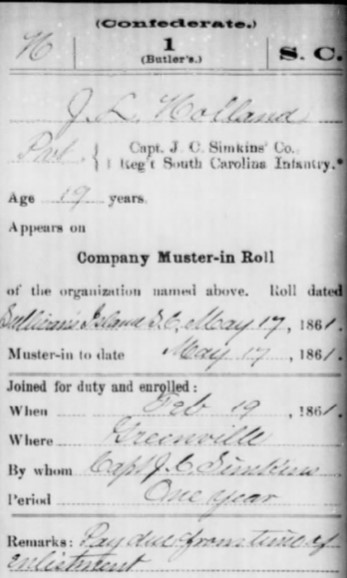
It is possible that a third son also served South Carolina during the Civil War. Records show a John L. Holland who served with Company B of the 1st Regiment, South Carolina Infantry, until November 1863 when he was discharged due to disability. In March 1863, he suffered a stroke of apoplexy, rendering him unable to perform his duties. He was 19 years old when he joined the regiment in Greenville, South Carolina, on February 19, 1861, and mustered into the regiment at Sullivan’s Island, South Carolina, on May 17, 1861. His age aligns closely with the approximate age of John Louis Holland at that time, making it a strong possibility that they are the same person.

On July 11, 1870, John and Elizabeth lived alone in the Broadway Township of Anderson County. At age 63, John continued working as a farmer, while Elizabeth, aged 61, maintained the house. The census recorded real estate valued at $800 and a personal estate of $900, both listed under Elizabeth’s name. John was one of the pioneer settlers of the township.
Tragedy struck the family when John’s son, John (Louis), aged 29, passed away on July 28, 1873, at their home in Anderson County. He left behind five young children: Maggie M. Holland, Matthew Gambrell Holland, Anna S. Holland, Mary E. Holland, and John I. Holland. The youngest, John, was just an infant, born in January of that year.
The first page of John Louis’ probate papers features his will, which was written at Sullivan’s Island in Charleston, South Carolina, on July 7, 1863. While I cannot confirm that he was the third soldier mentioned above, it remains a strong possibility.
While researching the death of John Louis Holland, I made an intriguing discovery: his wife, Martha Ellen Scott, is the sister of Amanda Elizabeth Scott. Amanda, in turn, is married to John Louis Holland’s brother, Leroy. And as you know from above, both John (Louis) and Leroy are sons of John Holland, the focus of this sketch. It is always exciting to unearth these familial connections!
John’s wife, Elizabeth, passed away on February 27, 1876, likely in Anderson County. They had been married for at least 47 years. It is believed that she was laid to rest near or on Math Cobb’s land, located across the railroad from the old Holland home place on Pea Creek, about four miles from Belton.
In mid-November 1876, the Broadway Democratic Club hosted a basket dinner at Neal’s Creek Baptist Church. The invitation extended to all citizens of the township, regardless of their voting choices in the recent election. The purpose of the gathering was twofold: to express gratitude to those who had cast their votes for Wade Hampton, a Democratic candidate for governor, and to acknowledge those who abstained from voting. The organizers specifically requested that the ladies attend with their baskets well filled, contributing to the communal feast. John and his son Elijah played active roles in organizing the event. They were assigned to a committee responsible for coordinating the logistics and ensuring the smooth execution of the dinner.
In February 1877, John married his second wife, Martha A. (last name unknown). Unfortunately, John fell ill around March of the same year. By May, he had summoned John C. Horton to his home to draft his will. Dated May 14, 1877, the will outlined the distribution of his estate.
After ensuring all debts were paid, John bequeathed $700 to Martha for her own use. He specified that any property she produced on the farm during his lifetime was hers alone. Additionally, Martha was to receive his bed, bedclothes, bureau, one cow and calf, one sow and pigs (if any), and a year’s supply of provisions. She was also given 10 pounds of wool rolls and 10 pounds of good wool.
Each of his daughters—Martha L. Lawless, Emma C. Lawless, Nancy L. Hall, Elizabeth M. Walker, Samantha J. Grant, Mary M. Lawless, and Eliza A. (Amanda) Dove—received one dollar, with Emma also receiving a bed. John’s real estate was to be equally divided among his sons: Elijah, Leroy, and William (George). He directed each son to select an impartial individual to divide the land into three equal and equitable tracts. If the division was unequal, funds from the sale of personal property were to be used to balance the shares.
The heirs of his deceased son, John (Louis), received one dollar from the estate. All remaining personal property was to be sold, with the proceeds equally divided among Elijah, Leroy, and William (George), accounting for any prior advances made by John. These advances included $42.25 to his son Elijah, $50 to his son-in-law William D. Grant (husband of Samantha), and $210 in cash and supplies to John E. Dove (husband of Amanda).
Any discrepancies in the value of the land were to be rectified using funds generated from the sale of his personal property. John Horton was appointed as the executor of the will.
John passed away in Anderson on September 9, 1877. It is believed that he was laid to rest alongside his wife, Elizabeth, at Math Cobb’s cemetery.
John’s will was submitted for probate on September 12. Allison Langston and John Horton, along with J. A. Langston, signed a sworn statement confirming that they witnessed John sign his will. They further attested that, to the best of their knowledge, John was of sound and disposing mind, memory, and understanding at the time he signed the will. On the same day, the court legally proved and approved the will, granting John Horton the authority to act as the executor of the estate.
A Warrant of Appraisement for Executors was issued by W. W. Humphreys, Judge of Probate in Anderson County. This warrant authorized designated appraisers—M. A. Cobb, A. Langston, I. A. Major, J. Hayne, and W. P. Kay—to assess and appraise the goods and chattels of the estate. The appraisers were sworn in and authorized to conduct a thorough inventory and appraisal on September 15, and they were ordered to return their findings to Judge Humphreys by November 12.
On September 15, an inventory and appraisement of John’s goods and chattels was conducted. The inventory included household and farming tools, a spinning wheel and loom, dishes, glassware, cooking utensils, furniture, a buggy, tack equipment, a wagon, livestock such as hogs, oxen, cows, calves, and sheep, bottles and lamps, a fiddle, a looking glass, books, a watch, a clock, two rifles, a shotgun, and grain and cereal crops like corn, maize, and wheat. Items attributed to his wife Martha included a cow, a calf, a sow, a pig, a bed and furniture, a bureau, 10 pounds of wool, and 10 pounds of wool rolls, reflecting John’s wishes as stated in his will. The estate had $15.05 cash on hand.
The appraisers determined that the following provisions were a reasonable amount to support John’s wife Martha for one year under the conditions of the will: 100 pounds of bacon, 1 barrel of flour, 7 bushels of corn, 5 gallons of molasses, 15 pounds of lard, 10 pounds of coffee, 20 pounds of sugar, and 1/2 bushel of salt.
On September 28, 1877, John’s daughter, Martha Lawless, filed a petition in Probate Court requesting an investigation into the circumstances surrounding the execution of John’s will by John Horton. The petition listed the heirs as defendants, including E. M. Holland, L. T. Holland, M. C. Lawless, Miranda E. Walker, Nancy L. Hall (residing in New Orleans, Louisiana), Samantha J. Grant, Mary M. Lawless, Amanda Dove, G. W. Holland, and the children of John L. Holland: Maggie Holland (about 15 years old), Gambrell Holland (about 12 years old), Anna Holland (about 9 years old), Mary Holland (about 7 years old), and John Holland (about 1 year old). Martha requested that the court prove the will in due form of law and provide any necessary relief.
On October 5, a Summons for Relief was issued in the Court of Common Pleas in Anderson County, with John Horton, the plaintiff, bringing a legal action against the heirs. Separate summonses were addressed to each heir, requiring them to respond to the complaint within 20 days of receiving the summons, excluding the day of service. If they failed to respond within the 20-day period, Horton would seek the relief demanded in the complaint. The notice also informed the heirs that the petition involved the probate of John’s will.
On the same date, Horton filed a petition in the Probate Court, stating the date of John’s death, the existence of John’s will, and the admission of the will to probate. He also noted that John’s daughter, Martha Lawless, had filed a petition to prove the will in due form of law. Horton requested permission to examine witnesses regarding the will’s execution and to summon all potential beneficiaries to answer the petition.
After hearing the petition, the court ordered Horton to submit a written request for permission to swear in and examine witnesses regarding the will. Additionally, he was required to involve all individuals who would have been entitled to a share of the estate if John Holland had died intestate (without a will). The process for involving these individuals was to follow the same procedures used for summoning parties in civil actions in the Court of Common Pleas.
The following announcement was published in The Intelligencer beginning October 11 and running through at least November 15:
 |
The Intelligencer, Anderson,
South Carolina, October 11, 1877 |
On October 12, Sheriff James H. McConnell documented the admission of service by Martha Lawless, Miranda E. Walker, and another individual who received the summons related to the legal action filed by John Horton against E. M. Holland, Martha Lawless, and others. The summons, issued by the plaintiff’s attorneys Moore and Allen, required the defendants to respond within 20 days.
The affidavit of personal service confirmed the delivery of the summons and complaint to the defendants. Additionally, on October 13, Deputy Sheriff E. Cahill certified that he personally served the summons and complaint to several defendants, including E. M. Holland, Maggie Holland, Gambrell Holland, Anna Holland, J. W. Holland, Mary Holland, L. T. Holland, and Amanda Dove. He noted that Mary M. Lawless and Samantha Grant had left the county and could not be served.
On October 13, Horton filed a petition for the probate of John’s will. The defendants (heirs), represented by their attorney Joseph N. Brown, contested the validity of the document presented by the plaintiff. They argued that the legal requirements for executing and attesting the will were not properly followed. Additionally, they claimed that John was not of sound mind when he signed the will due to his weakened intellect from illness and alleged that he was unduly influenced by his young wife, whom he had recently married. Consequently, the defendants requested that the will be invalidated and not admitted to probate.
An order was issued on November 12, following a petition by Horton, on the motion of Moore and Allen and with the consent of Joseph W. Brown. This order directed Horton to sell all of John’s personal property, except for his notes and accounts, at the deceased’s residence on Saturday, December 1. The sale was to be conducted for cash, and the collected funds were to be held by Horton, subject to further court orders. Judge Humphreys signed the order, and Brown consented to it on behalf of the legatees (individuals entitled to inheritance).
On November 12, Horton filed a petition explaining to Judge Humphreys that the personal estate of the deceased, John Holland, included livestock (such as horses, cows, and hogs), household and kitchen furniture, plantation tools, corn, shucks, and wheat. Horton emphasized that these items were at risk of waste or significant decline in value if not properly managed. He noted that no one was available to maintain and safeguard these assets. Therefore, he requested permission from the court to sell the personal property under conditions and terms prescribed by the court. This request aimed to prevent the estate from losing value due to neglect or deterioration.
On November 14, Martha A. Holland filed a petition in the Anderson County Probate Court seeking a writ of admeasurement of dower. In her petition, Martha explained that her late husband, John Holland, had left a will that was admitted to probate. The will included a specific legacy of $700 for Martha, among other bequests. The real estate, consisting of a 159-acre tract of land, was to be divided among his sons, E. M. Holland, L. T. Holland, and G. W. Holland, with no interest granted to John’s other children.
Martha, who resided on the land, requested that the court issue a writ to measure and assign one-third of the land to her as her dower. She suggested E. J. Major and M. A. Cobb as commissioners to oversee this process. The petition aimed to secure her rightful share of the property.
Also on November 14, Martha Ellen Holland, the mother of Maggie, Gambrell, Anna, Mary, and John Holland, filed a petition seeking appointment as the guardian ad litem for her children, who were minor defendants in the probate of their grandfather John Holland’s will. A guardian ad litem is a person appointed by the court to represent the best interests of minor children in legal proceedings.
In 1877, South Carolina followed the common law doctrine of coverture, which meant that a married woman (feme covert) had no legal rights to her husband’s property unless he explicitly left it to her in a will. Essentially, a wife could not own property, enter into contracts, or control her wages independently of her husband, nor were they automatically named the guardian of their own children. If a father died without naming a guardian in his will, the court would appoint a guardian based on the best interest of the child standard, considering what arrangement would best support the child’s needs. Typically, a close relative such as a grandparent or an aunt or uncle might be appointed as the guardian.
Martha responded that her children, all under the age of 21, were minor defendants and unfamiliar with the specific details of the matters and claims made in the complaint. The petition noted that more than 20 days had passed since the summons was served, and the children currently had no general or testamentary guardian and resided with their mother, the petitioner. She requested the court appoint her, or some officer of the court, as the guardian ad litem to appear and defend the action on behalf of her children.
Upon reviewing the petition, the court found Martha to be a competent and responsible person and ordered that she be appointed as the guardian ad litem for her children, authorizing and directing her to appear and defend the action on their behalf. On November 15, 1877, Martha formally consented to serve as the guardian ad litem for her children.
That same day, James H. McConnell appeared in court and made an oath affirming that Martha was a fit and proper person to act as the guardian ad litem for the “infants” mentioned in the petition. This oath was sworn before Judge Humphreys, ensuring that Martha was recognized as capable and responsible for representing her children’s best interests in the legal proceedings.
On November 29, 1877, subpoenas were issued to John Horton, Allison Langston, J. A. Langston, and Dr. E. M. Brown, mandating their appearance in court on December 6, 1877. They were required to provide testimony regarding the pending court case related to John’s estate.
An annual return filed on December 1, 1877, detailed the disposal of John’s personal property and the proceeds from these sales, indicating the thorough settlement of his estate’s assets. The five-page document listed various buyers and the items they purchased, along with the prices paid. Notable items sold included farming tools like hoes, mattocks, pitchforks, and a log chain, as well as livestock and equipment. Horse-drawn equipment and accessories, fodder, corn, wheat, and oats were also among the items sold. Household items such as a spinning wheel, barrels, and a table, along with personal items like an iron judge, a small square, a shotgun, a rifle, and a fiddle, were listed. The document also recorded the prices paid for these items, with many buyers, including John’s widow and sons, Elijah and Leroy.
As directed by subpoena, John Horton, Allison Langston, J. A. Langston, and Dr. E. M. Brown provided testimony on December 6 regarding John’s estate.
John Horton, the executor of John’s estate, testified about his role as a subscribing witness to John’s will. Horton explained that he was informed by Leroy Holland that his father, John, wanted to see him, though Leroy did not specify the reason. Three or four days later, Horton went to John’s home as requested. Upon arrival, he found Leroy, his sister Miranda, and her husband, Christopher Walker, present, but they left about five minutes after Horton arrived, and nothing about the will was discussed in their presence.
Horton described how he drafted the will according to John’s instructions, writing it item by item and reading each part to John for approval before proceeding to the next section. Horton asserted that John was of sound mind when he executed the will, and noted that he had known John for many years without ever doubting his mental capacity. He mentioned that no one else was present during the drafting and signing of the will, except for one brief instance when someone entered the room but did not interact with them. The will was executed at John’s house in the presence of only the witnesses and John.
Horton recounted that after the will was signed, he locked it in a drawer at John’s request and returned the key to John. He emphasized John’s firm and resolute nature, stating that when John set his mind to something, he was quite inflexible. Horton confirmed under oath that he witnessed John sign his will, and that he, along with Allison Langston and his son J. A. Langston, signed the will as witnesses in each other’s presence and at John’s request. Horton stated that the paper to which the signatures were attached was blank at the time of signing and remained the same paper now.
Allison Langston testified that his signature on John’s will was genuine. He confirmed that John signed the will in his presence and in the presence of his son, J. A. Langston. All the subscribing witnesses, including Allison and his son, signed the will in each other’s presence and in the presence of John. Allison affirmed that at the time John executed the will, he was of sound mind. He further stated that he had known John for 40 years and that John had always been of sound mind during that period.
Allison noted that the will was not written in his presence, and he did not know its contents. Only the witnesses and John were present when the will was signed. He mentioned that he and his son went to John’s house together and found John Horton there. They stayed for about half an hour, during which John explained what he wanted regarding the will, and then they all left together. Allison did not recall what was done with the will afterward.
He confirmed that the paper presented as the will appeared to be the same paper he had signed, although he could not be certain it was the exact same paper. He reiterated that he did not see the writing of the will or know its contents.
J. A. Langston concurred with his father’s testimony about John’s sound mind and the execution of the will. He mentioned that John was an elderly man, possibly around 70 years old, who had married his last wife in February 1877 before falling ill in March 1877. Langston noted that there were no children from this last marriage, and the will was not seen again until after John’s death in September.
Dr. E. M. Brown, a practicing physician, testified that he had known John for most of his life and attended to him during his final illness. He asserted that he never observed any mental impairment in John. Dr. Brown saw John frequently from April to August 1877 and believed that John was fully competent to handle business matters and make a will. He described John as an eccentric man with an unyielding disposition, noting that there was no change in John’s demeanor during the time he attended to him.
Two other physicians also testified on December 6. Dr. W. H. Todd testified that he attended to John during his final illness, beginning on May 2 and continuing regularly until August 25, 1877. Dr. Todd found John’s mind to be perfectly sound and free from any mental derangement. He believed John was fully capable of managing his affairs and making a will.
The third physician, Dr. M. L. Sharpe, testified that he saw John in his last illness on either August 24 or 26. Dr. Sharpe believed that despite suffering from extreme exhaustion, John was still capable of attending to his business and exhibited no signs of dementia.
On November 28, 1878, The Intelligencer published a list of delinquent land sales, which included John’s property. The land, located in Broadway Township, consisted of 160 acres and one building. It was listed because the estate had apparently not paid the required property taxes. If the taxes remained unpaid by a certain date, the Treasurer of Anderson County could eventually sell the land at a tax sale to recover the owed taxes.
 |
The Intelligencer, Anderson,
South Carolina, November 28, 1878 |
On February 1, 1879, Horton filed an annual return for John’s estate, detailing the financial transactions he had managed. The return provided a comprehensive breakdown of debits and credits involved in settling the estate. Debits amounted to $328.01, while credits totaled $370.69, resulting in an overpayment of $42.68.
Included in the return were expenses for medical, advertising, legal, and sheriff service fees; a coffin; funds allocated to the widow; auctioneer fees for conducting the estate sale; court costs; and taxes. This accounting was presented to and approved by Judge Humphreys on the same day, confirming Horton’s effective financial management of the estate.

In early February 1879, a notice began running in The Intelligencer for a Sheriff’s Sale scheduled for March 1, 1879, in Anderson County. Sheriff James H. McConnell was authorized to sell a 160-acre tract of land, part of John’s estate (referred to as Capt. John Holland in the notice). The land was bounded by properties of Moses Chamblee and E. J. Major, among others. The sale aimed to satisfy a debt owed by John’s son, Leroy, to W. A. Geer and others. The terms of the sale required payment in cash, with the purchaser responsible for any additional costs for the necessary paperwork. This likely indicated that the estate had not paid the appropriate property taxes, as advertised in The Intelligencer on November 28, 1878.
 |
The Intelligencer, Anderson, South Carolina, February 27, 1879 |
On March 5, 1879, John Horton filed a petition in the Probate Court of Anderson County to make a final settlement of John’s estate and to be discharged from his duties as executor. Horton explained that while he was prepared to settle the estate, the funds were not yet ready for distribution due to the need to collect a bond from L. W. Kay and to resolve conflicting claims and potential lawsuits. He requested that the court set a date for the final settlement and discharge him from his role as executor.
On the motion of Joseph N. Brown, Horton’s attorney, the court set April 5, 1879, as the hearing date for the petition. Horton was instructed to provide at least 30 days’ public notice of this application in the Anderson Intelligencer and was allowed to apply for an extension of time if needed to collect payments and complete the settlement.
Beginning on March 6, 1879, John Horton placed a notice in The Intelligencer informing interested parties that he would be requesting a final settlement of the estate on April 5, 1879, from the Judge of Probate for Anderson County. During this settlement, Horton also sought to be officially released from his duties as executor. The notice served as an official announcement to ensure that anyone with an interest in the estate was aware of the upcoming proceedings.
 |
The Intelligencer, Anderson, South Carolina, March 13, 1879 |
As part of the final settlement, the court collected testimonies and accounts to provide a thorough overview of the financial and caregiving aspects surrounding John’s estate and final illness.
Dr. Brown testified that a memorandum of his account for $104, exhibited and filed, was an exact transcript from his medical books. The account pertained to medical services provided to John’s wife in 1874, and $53 had been paid towards it. Dr. Brown also mentioned purchasing 70 cents’ worth of property at the estate sale, which should be deducted from the account.
Dr. Todd testified that his account for $133, filed with the executor, was a correct transcript from his books. The $23 admitted on Dr. Todd’s account was collected by Dr. Brown and was part of the $53 previously mentioned.
James P. Haynie, an appraiser, filed a claim for $100. Other appraisers, including Allison Langston, W. P. Kay, and M. A. Cobb, were also qualified.
Additionally, notes payable to Dr. Brown by John were filed for payment and proof. These included one note for $15.97 and another for $11 dated March 4, 1860, payable one day after.
Dr. Todd, upon being recalled, stated that he saw Mrs. Lawless at her father’s house during his last illness, along with Leroy and Eliza Holland. They provided ordinary services typically rendered by children to their parents when sick, which were not usually charged for.
J. H. Hancock testified that Mrs. Lawless was at her father’s house for 30 days or longer during his last illness. He mentioned that Mrs. Lawless intended to make no charge for her services until she was excluded from the will.
Mrs. Sarah A. Woodson testified that she saw Mrs. Walker (Miranda), a neighbor, providing general help and washing at John’s home during his wife’s illness. She noted that a good helper could have been hired for $8 per month.
In the matter of the petition to prove John’s will in due form, the court determined that all proper parties were involved in the proceedings. Testimony from the witnesses confirmed that the will was properly and formally executed. It was evident that John was fully capable of making a will at the time of its execution, freely exercising all his mental faculties without restraint. The will, dated May 14, 1877, was declared to be a deliberate declaration of John’s wishes regarding the disposition of his property after his death.
The court, therefore, adjudged and decreed that the will, attested by Allison Langston, J. A. Langston, and John C. Horton, and admitted to probate in common form on September 12, 1877, was indeed the last will and testament of John Holland. The will was thus established in due form of law, with the probate being declared final and conclusive based on the evidence presented. This decision was issued by Judge W. W. Humphreys, Judge of Probate.
Following Judge Humphreys decision, the defendants (heirs), represented by their attorney Joseph N. Brown, contested the validity of the document presented by Horton as John’s last will and testament. They argued that the will was not executed and attested in accordance with legal requirements. Additionally, they claimed that their father was not mentally competent to execute the will, as his intellect had been weakened and clouded by disease. Furthermore, they alleged that the will was made under undue influence exerted by John’s young wife, whom he had recently married when he was both mentally and physically weak. Therefore, the defendants requested that the court set aside the will and refuse to probate it.
On June 18, 1879, after hearing arguments from both John Horton and the heirs, the court ruled that the costs for both the plaintiff and the defendants should be paid out of John’s estate.
On October 23, 1879, John’s son, Leroy, the defendant, claimed his homestead exemption for the tract of land levied on by Sheriff McConnell. Appraisers were selected for this task: N. Vandiver by Leroy, C. C. Chambler by W. A. Geer (the plaintiff), and R. J. Bailey by the sheriff. These appraisers, all from Anderson County, were responsible for appraising the homestead selected by Leroy in accordance with state law.
On October 25, 1879, the appraisers, having been sworn in, assessed the homestead at 69.5 acres, valuing it at $8 per acre, for a total of $556. This appraisal was recorded and certified, detailing the homestead’s location near Real Creek, Broadway Creek, Rockey River, and the road to Belton.
The following map, submitted by the appraisers, was included as part of Leroy’s homestead exemption claim. It highlights the locations of both John’s and Leroy’s properties, with John’s property appearing upside down on the map.
In 1964, at the age of 84, Aaron Hall Holland drew a map from memory for my grandfather to show the location of John’s old home place. Despite having last been in Anderson County in 1890, when his family moved to Beaverdale, Whitfield County, Georgia, Aaron’s recollection was remarkably accurate. It appears that his memory served him well!
In a case before the Court of Common Pleas in Anderson County, John’s wife, Martha, filed a complaint for dower against Elijah, Leroy, and the other heirs. The court required an accounting by John Horton, the executor of John’s estate. The accounting, presented in November 1879, detailed receipts and payments, resulting in a balance of $37.62. However, two unpaid seal notes held by E. W. Brown created a deficiency. The Master recommended that this deficiency be paid equally by charging it against the real estate devised to John’s sons, Elijah and William Holland. Claims by Leroy and Elijah were dismissed due to the statute of limitations.
On February 26, 1880, it was ordered that upon payment of the balance due on a judgment by Dora E. Breazeale, the Master would execute the title to the premises described in the court documents.
In this context, the term “Master” refers to a court-appointed official (often known as a Master in Equity) who handles certain judicial proceedings, such as the sale of foreclosed properties, under the direction of a judge. The Master ensures that court orders, such as property sales, are executed properly and fairly.
W. P. Holland (William), a legatee under the last will and testament of his deceased father, John Holland, conveyed a tract of land in Anderson County to J. J. Major for $300. The land, located on Pea Creek waters of Rocky River, comprised approximately 26.25 acres and was bounded by the properties of Pickney Davis, T. J. Roberts, J. J. Major, E. C. Chambley, and L. T. (Leroy) Holland. The transaction was formalized on March 24, 1890, with O. S. Ellis and Jesse Ives witnessing the deed. This was likely the portion of land William inherited from John. By this time, William had moved from Anderson to Florence, South Carolina.
In a conveyance document dated October 25, 1880, W. W. Humphreys, the Master of Anderson County, acknowledged receiving $937.33 from Dora E. Breazeale for a 177-acre tract of land. This land was bounded by properties belonging to Mrs. C. Breazeale, John Leavell, William Davis, and others. The sale followed a court decree from September 26, 1879, which ordered the foreclosure of the mortgage and the sale of the land unless the defendants paid half of the mortgage debt and costs by November 1879, with the remaining balance due by October 1880. Upon Breazeale’s payment, the Master was directed to execute the title to her.
The document formally granted, bargained, sold, and released the land, including all rights and interests, to Breazeale and her heirs and assigns.
Ten years after John’s passing, his son Elijah shared a cherished memento of his late father with a local news reporter from The Intelligencer in Anderson County—a pocket knife. This relic was originally purchased from the very first store established at Anderson Courthouse. While the identity of the merchant remained uncertain, the knife served as a tangible connection to his late father.
 |
The Intelligencer, Anderson County, South Carolina, April 28, 1887
|
References
- Amanda E. Dove, Georgia State Board of Health, Bureau of Vital Statistics, Standard Certificate of Death no. 31200, 1920.
- Anderson County, South Carolina, Conveyance Records 1879–1881, images 223–224; https://www.familysearch.org/ark:/61903/3:1:3Q9M-CS8W-M9LS-B?view=fullText&keywords=Holland%2CJohn%2CC%2CSouth%20Carolina%2Cestate%2CSouth&groupId=TH-909-64080-45384-9 (free account required for access).
- Anderson County, South Carolina, Conveyance Records 1890–1892, images 55-56; https://www.familysearch.org/ark:/61903/3:1:3Q9M-CS8W-M37X?view=fullText&keywords=John%20Holland%2CHolland%2CJohn%2CC%2CSouth%20Carolina%2CEstate%2Cestate%2CSouth&groupId=TH-909-64080-2575-44 (account required for free access).
- Anderson County, South Carolina, Court Records 1800–1869, image 427; https://www.familysearch.org/ark:/61903/3:1:3Q9M-C3MJ-63VM-K?view=fullText&keywords=Holland%2CJohn%20Holland%2CCarolina%2CJohn%2CL%2CSouth%20Carolina%2CEstate&groupId=TH-909-81523-96960-68 (account required for free access).
- Anderson County, South Carolina, Probate Estate Case Files 1828–1878, image 540; https://www.familysearch.org/ark:/61903/3:1:3Q9M-C3HR-LSL3-J?view=fullText&keywords=Daniel%20Major%2CMajor&groupId=TH-909-88971-72338-62 (account required for free access).
- Anderson, County, South Carolina, Conveyance Records, 1879–1881, images 330–331; https://www.familysearch.org/ark:/61903/3:1:3Q9M-CS8W-M92L-1?view=fullText&keywords=John%20Holland%2CHorton%2CJohn%20C%2CJohn%2CC%2CSouth%20Carolina%2CUnited%20States%2CEstate%2Cestate&groupId=TH-909-64080-45384-9 (free account required for access).
- Anderson, County, South Carolina, Real Estate Records 1840–1864, image 136; https://www.familysearch.org/ark:/61903/3:1:3Q9M-C9PT-LC8P?view=fullText&keywords=Holland%2CElijah%2CJ%2CSouth%20Carolina%2CUnited%20States&groupId=TH-909-48501-7311-48 (free account required for access).
- Delinquent Land Sales, The Intelligencer, Anderson, South Carolina, November 28, 1878.
- Elijah M. Holland, Certificate of Death no. 35864, State of South Carolina, Bureau of Vital Statistics, State Board of Health, 1916.
- Eureka Items, The Intelligencer, Anderson County, South Carolina, April 28, 1887.
- Find a Grave, database and images (https://www.findagrave.com/memorial/101547273/john_isom-holland: accessed December 16, 2024), memorial page for John Isom Holland (8 Jan 1873–26 Aug 1949), Find a Grave Memorial ID 101547273, citing Silver Brook Cemetery, Anderson, Anderson County, South Carolina, USA; maintained by Bobbie O'Barr (contributor 47643006).
- Grand Mass Meeting, The Intelligencer, Anderson, South Carolina, November 16, 1876.
- History of Aaron Hall and Clementina Ann (Norris) Hall, Aaron Hall Holland, 1964.
- John Holland (1860), Selected U.S. Federal Census Non-Population Schedules, 1850–1880.
- John Holland (1877), South Carolina, Wills and Probate Records, 1670-1980.
- John Holland, Anderson. Probate Records 1828–1878, images 767 – 846; https://www.familysearch.org/ark:/61903/3:1:3QHV-V38J-LN6G?view=fullText&keywords=John%20Holland%2CHolland%2CJohn%2CSouth%20Carolina%2CAnderson&groupId=TH-7758-91431-12881-71 (account required for free access).
- John L. Holland, U.S., Civil War Service Records (CMSR) - Confederate - South Carolina, 1861–1865.
- Married Women’s Property Acts in the United States; https://en.wikipedia.org/wiki/Married_Women%27s_Property_Acts_in_the_United_States.
- Notice of Final Settlement, The Intelligencer, Anderson, South Carolina, March 13, 1879.
- Sheriff’s Sale, The Intelligencer, Anderson, South Carolina, February 27, 1879.
- State of South Carolina, County of Anderson, In the Court of Probate, The Intelligencer, Anderson, South Carolina, October 11, 1877.
- U.S. Federal Census, Anderson County, South Carolina, 1830, 1840.
- U.S. Federal Census, Broadway, Anderson County, South Carolina, 1870.
- U.S. Federal Census, Eastern Subdivision County, Anderson, South Carolina, 1850.
- U.S. Federal Census, Regiment 4, Anderson County, South Carolina, 1860.
- Vandiver, Louise Ayer, Broadaway, Traditions and History of Anderson County, pp. 191–192, Ruralist Press, 1928.
- William Perry Holland, Certificate of Death no. 23528, State of South Carolina, Bureau of Vital Statistics, State Board of Health, 1915.