Showing posts with label McWhorter. Show all posts

Friday, January 22, 2021

Julia Pope McWhorter

Julia Pope McWhorter, daughter of Robert Ligon McWhorter and Nancy Pope Thurman, was born in Georgia (most likely Greene County) on July 20, 1860. Her father, Robert, was first married to Nancy Winifred Janes, daughter of Absalom Janes and Cordelia Callaway. Robert and Nancy had one child in 1846, a son they named Robert Ligon McWhorter Jr. Nancy lost a second child in 1847 and died herself shortly thereafter. In December 1848, Robert (age 29) married Nancy Pope Thurman (age 16) after a short courtship. Robert and Nancy had five children together—James Vason McWhorter, John Alexander McWhorter, Hamilton McWhorter, Julia Pope McWhorter, and an infant son who died in infancy. Julia is the stepdaughter of my 2nd great grand aunt, Nancy Winifred Janes McWhorter. 

Robert McWhorter was a wealthy planter and politician in Greene County. He was a member of the Georgia House of Representatives, including Speaker of the House for one term. 

On August 3, 1860, the census enumerator visited the McWhorter family but for some reason, did not list Julia with the family when counting the household. Julia would have been two weeks old at the time so, where was she?


1860 Penfield, Greene County, Georgia census record for the McWhorter family
(click to enlarge)

During the Civil War, Julia’s father organized and led Greene County’s Company C (Dawson Grays), Third Georgia Infantry Regiment. Her mother, who years later would be named the “Mother of the Third Georgia Regiment,” often spent time, including most winters in Virginia, with the Dawson Grays. One of Julia’s “McWhorter” grand uncles took care of the children while Nancy was away at camp. It was noted that “They were well taken care of, too, for the faithful old family servants helped him look after them.” 

On June 9, 1870, Julia and her family lived in Penfield, Greene County, Georgia. Julia’s father was a farmer, Nancy was keeping house, brothers James and John were both in college, and Hamilton and Julia were in school. There was a 10-year-old girl named Jessie McWhorter living in the home as well. I found a Jessie McWhorter who lived in Woodville, Greene County, Georgia around the same age and who attended college with Julia. Jessie’s father, William Penn McWhorter, was a nephew of Julia’s father Robert. 


1870 Penfield, Greene County, Georgia census record for the McWhorter family
(click to enlarge)

On July 27, 1875, Julia attended Mercer High School’s commencement in Penfield where she won the prize for readings. After high school, Julia (and Jessie McWhorter) attended Southern Female College in LaGrange, Troup County, Georgia, graduating in 1877. Commencement exercises were held in LaGrange in June 1877 with Julia being 1 of 11 graduates who read an essay which was published by The Christian Index a little over a year later, on July 11, 1878:

There is Rest Enough in the Grave. With most people there is a craving for rest; even with the young, there are times when the feet are weary and the heart grows faint, but, as they advance in life, the weariness becomes more frequent and more intense; often there is an earnest, passionate longing for rest, a fearfully painful temptation to turn from the labor which duty has imposed and recline for a time in the bowers of ease. Then we would turn a deaf ear to the monitor who speaks to us of what we owe ourselves and the world; we would gladly sit in dreamy listlessness and watch the ripples of life’s great stream, oblivious of the fact that we have an interest in the scene. We would bid Care and her train speed far away and leave us with nothing for the heart to sigh for, nor the hands to do.

But such are not the promptings of our better teachers. From the realm of Nature, wherever we may look, the lesson is of action, not of rest. Gaze we away to the nightly vault where the bands of Orion are glittering in splendor, and the Pleiades are shedding their sweet influences, and we read the signs of unceasing motion. Look we abroad when the day star comes as a bridegroom from his chamber, and from speeding light and rustling breeze, we learn the same fact of unceasing motion. In the swelling bud and expanding leaf, in opening flower and ripening fruit we perceive there is constant action, constant labor. In the animated creation beneath us we discern no undue pining for rest; no efforts to evade the tasks which the Creator has imposed. The bee is early in the wing; the lark bathes his pinions in morning air that he may salute the rising sun; and the lamb and the fawn are cropping the grass while the dew yet sparkles on its blades. By all these are we taught the lesson of action, motion, labor.

If, however, we consider ourselves and our race, we need not read sermons in stones, nor books in running brooks, in order that we may learn our duty. In whatever direction we may turn our eyes, we see there is much to be done. There is much to do that these bodies of ours may be sustained and rendered comfortable. That the earth may yield of her wealth to fill storehouse and barn, there must be patient and unremitted toil. The furrow must be run, the seed sown, the tender plant nurtured and the harvest reaped. These things require not the hand alone, but the brain must work, that what is done may be done with skill and judgment. It has been said that he who makes two spears of grass grow where only one had previously grown, deserves to be rated as a public benefactor. How far above all the mighty captains whose occupation it has been to devaste and destroy, should be enrolled him who converts a barren, stony waste into a scene of fruitfulness and beauty. Everyone who does something towards providing food and raiment for the world’s teeming millions, performs a noble duty. This is a task in which the great mass of mankind must be employed, and from which they dare not rest. There is no room here for rest. It is a decree of Heaven which we can neither resist nor evade, that if we would live we must labor.

But it is written “Man shall not live by bread alone.” If we do no more than gain sustenance for our physical frames in what are we better than the brute creation? God has endowed us with intellects, and it becomes us not to feed for a season and then die leaving no trace behind us, no impress for good to those who are to come after us. These intellects must be cultivated and thus supplied with that pabulum which that cultivation requires. The powers of the mind must be prepared to understand and enjoy the beauty and order which the Creator has spread around us. There is still a vast unknown, whose hidden mysteries must be explored and the laws which govern its workings made known. We cannot believe that God has thrown an unremovable veil over any of His works; He doubtless, designs that they shall be traced out by man, and be employed by him for the accomplishment of his purposes. But this is a result that can be brought about only by study and labor; not by idly reclining on downy couches and in sweet dreams passing life away did they of the past make electricity and light obedient servants, which have more strength than the human arm, more delicacy than the human hand. For those who labor in the world of thought, there is much, very much to do; there is a great deal to learn and a great deal to teach; every day some new fact may be discovered—every day some new truth may be enforced. If one would rise to the full measure of duty, he must scorn ease and live laborious days. “No time to rest,” is the motto in the world of mind as much as in the realm of matter.

After all, however, this life is but a scene of preparation for another life, and whether that other shall be a higher, depends upon our efforts here. What a vast field for labor here opens before us! The millions of earth are groping their way in darkness; how shall they be enlightened save by the exertions of those to whom the lamp of life has been given. Oh! there is really no time for rest here. The issues are too fearfully momentous; the work to be performed is too vast to admit of any delay, or any cessation of effort. Ye who would dry the flow of human tears or check the course of human guilt, must not conceive that in indolence or self-indulgence you can achieve these high aims, and thus push forward the moral and intellectual march of the world, until knowledge shall have extended its benign influences over the earth and religion shall usher in the day of millennial glory.

Julia’s life took an unexpected and sad turn in the fall of 1877. In what should have been a happy, exciting time in her life at 17 years of age and just a few months from graduation, she was overtaken by consumption and died on September 16, most likely at her home in Greene County. Julia’s family buried her at Woodville Cemetery in Woodville, Greene County, Georgia.


Photo by Cathy Fincher via Find A Grave. Used with permission.

The Greensboro Herald reported her death on September 20, 1877:

Deaths. … It is our painful duty, also, to announce the death of Miss Julia P., only daughter of Hon. Robt. L. McWhorter, of Penfield. All who knew her, say that Miss McWhorter was proverbially amenable and a devout Christian, and the afflictions of the family are mitigated by the fact that their daughter and sister is in the home of the pure. 

A second story ran in The Greensboro Herald on September 27, 1877 that provided a detailed and very moving description of her death:

Julia Pope McWhorter. The shadows of a deep grief rest upon our community. The Death Angel has spread his broad wings here and driven his ice cold blasts against a fair and lovely one. Today we mourn the absence of her who was the light and joy of her home; yet in the midst of our grief and sorry, we are cheered by the bright hopes which filled her soul and lit up with rapturous delight her countenance as she passed over the “dark river.”

Julie Pope McWhorter, only daughter of Maj. And Mrs. R. L. McWhorter, of Penfield, Ga., died on the 16th inst. She made a professional of faith in Christ and was baptized by Rev. [unreadable] of 1874.

But a few short weeks ago, she returned home from LaGrange, where she had completed her College course, and was apparently in blooming health. She had just passed her seventeenth birthday, when Consumption in its most acute and active form marked her for his own. She was confined to her bed but a few days. She was a most patient sufferer. Not a murmur, nor a complaint escaped her lips during her illness. As the disease preyed so rapidly upon her system, her friends became anxious to know whether or not she fully appreciated the fact that her end was near. They forbore to question her, fearing that it might hasten her death. She frequently spoke of what she would do when she should be well again, and up to a very few hours before her death was impressed with the idea that she would recover. On the evening of her death, she said to her old nurse, who stood at her bedside, that she wished to talk with her pastor, Mr. Strickland. He came and had a brief conversation with her—asking her as to her faith and trust in the Saviour. She replied that “He was precious to her, that her whole trust was in Him, and on Him she wholly depended for life and salvation.” After this conversation she turned to her mother and said, “I feel a great heaviness in my breast, do you think I shall get well?” The mother, though moved by the deepest anguish of heart, replied calmly, “we fear not my daughter.”—She then asked, “do you think I can live till morning?” Her mother said, “don’t be alarmed, but I think not.”—She then raised her eyes and seemed engaged in prayer, after which she called for each member of the family separately, not forgetting the servants, and addressed parting counsel and admonition suited to each, following with a prayer that they might accept it and meet her in heaven. God gave her strength of voice and flow of word that enabled her to talk as one inspired.

She addressed herself to many around the bedside, and seemed to feel great concern for those of her schoolmates who were not believers, and begged that they be sought after and urged to turn from their sinful ways. The earnest appeals made to each of her brothers were especially touching. She prayed that her passage from earth might be made easy, and her last utterance was a prayer for “father, mother, brothers, sister and little Robert”—then placing herself on her pillow, with her hands upon her breast, she said more than once, “Clip the thread,” and without a struggle or a moan, she passed through death unto life.

“It was good to be there.” That death chamber had all its gloom dispelled by the visions of glory that opened to her eyes as she neared the shining shore. Her countenance all beaming and radiant with joy and words, uttered as if by lips touched by the hallowed fire, attest the truth and power of Christianity. She lived not and died not in vain.

Never! no, never!! can they who were there that Sabbath night, forget that death-bed scene, and the peaceful, happy and triumphant death of the loved and loving Julia.

A tribute by the Mercer Lodge was published in The Greensboro Herald on November 1, 1877:

Tribute to the Memory of Julia P. McWhorter, by Mercer Lodge, I.O.O.T., Penfield. How inscrutable are the ways of Providence! “His ways are high above our ways. We cannot lay searching find them out.” “He moves in a mysterious way. His wonders to perform.” In some of the dispensation of Providence, how hard it is to reconcile it to our poor, frail human nature that God is just. A little innocent rattling infant, just budding into life—the loving joy of its parents, is suddenly snatched away in the cold embrace of death—How hard it is to bear! How keenly it cuts the heartstrings to gaze upon its lifeless form clad in the habiliments of the grave. The soul sinks within itself and instinctively feels disposed to murmur and ask why is it so?

A lovely daughter of the sweet age of seventeen has returned from boarding school. How the hearts of the doting father and mother thrill with delight! Home is again made happy. The home circle is again complete.—Father, mother, brothers—all look upon her lovely form with gushing pride. The sweet tones of her silvery voice, as she utters words of love and kindness, or as she sings a sweet song, accompanied with the notes of the soft-toned Piano, fall so pleasantly on the ear.—The cheerful smile, as it plays on her face, the many little sets of loving-kindness done—all are silken cords which bind her to the family heart. The dear friends and associates of the village circle look brighter and feel happier as they meet and mingle in the social gathering. All are joyous and happy. The musical festival, the Church, the Good [unreadable] all are occasions where her presence is felt and enjoyed. A smiling Providence blesses all. Such a happy picture.

A change comes. The rosy-dimpled cheek of the sweet girl who was so fair to look upon, is tinted with the hectic flush. The insatiate Archer has marked her for his own. Death with his sickle keen stands at the door. Father, mother, brothers, friends surround the emaciated form of the angelic girl who is so soon to leave them. Death with his icy hand touches the lovely, blooming flower; it withers, droops and dies. The spirit wings its way to God who gave it. The once lovely form is consigned to its narrow house of clay. The home circle is broken, and friends are shocked by the doings of “the dread messenger.” It is a mysterious dispensation of Providence. With hopes blighted and hearts crushed who can read it?

Thus passed away on the 16th of September, 1877, Julia Pope McWhorter, only daughter of Major and Mrs. R. L. McWhorter, of Penfield, Ga.

No more shall family and friends be gladdened by her presence here. Yet we will not murmur or complain.—With crushed and bleeding hearts we humbly bow to this sad dispensation of Providence. The scenes of the dying chamber will ever live in memory. With heartstrings broken, with eyes a fountain of tears, oh! Is there no balm of Gilead! Is there no relief? Thanks, be to God who giveth us the victory in the Christian’s home in glory. Then “death is robbed of its sting and the grave of its victory.”

It was sad to see dear Julie die; but even to this dark cloud there was a silver lining. She had made a profession of faith in Christ. Through the dark valley of the shadow of death He lighted up her pathway. Her last moments were not moments of gloom. As she neared the shining shore, doubtless her ransomed spirit was welcomed with the rapturous shouts of the dear ones who had gone before.

Father, mother, brothers, friends, would you unglorify that saint? would you

“Her unruffled bliss

        Disturb, and pluck the crown from off her brow?

        To bring her back to earth?”

No! no! At the bidding of her precious Saviour she has gone where sickness and sorrow, pain and death can never come. May we all be prepared to meet her in that blessed abode where parting will be no more.

As a daughter she was obedient, dutiful and lovely—as a sister she was loving and kind—as a Good Templar she was an ornament to the order—as a Christian she lived and as a Christian she died.

Therefore, Resolved 1. That the foregoing be sent to the Greenesboro’ Herald and Templars’ Advocate, with a request to publish; and that a copy of the same be presented to the bereaved family with the assurance that they have our profound sympathy.

Resolved 2. That a blank page in our minutes be inscribed to the memory of our departed sister.

Resolved 3. That our Lodge room be draped in mourning for the term of thirty days.

W. S. Williams, Ch’n, Mary S. Champion, Zorah J. Landrum, Jos. O. Boswell, V. T. Sanford, Committee.

A second tribute was published by The Penfield Sunday School in The Christian Index on November 8, 1877:

Tribute of Respect. To the Memory of Julia P. McWhorter. By Penfield Sunday School. September 30th was the saddest day that ever dawned on our Sunday-school at Penfield. Six years our Heavenly Father has permitted us to meet again and again, in unbroken numbers, at the dear old chapel. Faces have changed, new ones have come, old ones have entered various paths in the wide world, but, today was the first time we met after God had appeared in our midst to claim one of His own.

Sadly, tearfully we entered the chapel and gathered around the organ. The very air seemed filled with our sorrow. The hushed greeting, warmer pressure of the hand, and sympathetic cadence of the voice, all whispered how much we missed Julia McWhorter. Yes, strange the thought! And, though we repeat it over again, our hearts refuse to realize the fact that never more, on earth, her sweet presence will gladden our gatherings.

‘Twas sad for the school, but the saddest of all was our class—her class. Every heart quivered with pain as we drew near together, and each boy and girl felt more acutely the dread reality—our circle had lost forever one of its brightest ornaments.

Since her earliest childhood, she was one of our school. Quietly, modestly, unassumingly, she moved among us, fondly loved by her friends, adored by her household.

God’s ways are inscrutable. Hearts lowered down by deepest grief fail to see the mission of this fair, young life—just seventeen, in her rare beauty—to be borne away by angels! But, in the years that are coming, we, perhaps, will recognize the tender love of our Father, even for us, in this decree of His will. Remembering her mother, father, brothers, and ourselves, the prayer rises—

“Thou, O, most compassionate!

Who did’st stoop to our estate,

Drinking of the cup we drain,

Treading in our path of pain—

Through the doubt and mystery,

Grant to us, Thy steps to see,

And the grace to draw from thence

Larger hope and confidence.”

When we think now of our school mate, our classmate, our scholar, it is with joy unspeakable. We know, while we must bear the Cross, she wears a crown in “radiancy of glory, in bliss beyond compare.”

Few of God’s children are so blest in their dying moments as Julia. With composure most marvelous she acknowledged the presence of death, with perfect trust in her Saviour, she left us for the better home beyond. Her first prayer was sublimely eloquent in its earnest demand for Jesus’ pardon and presence. Nothing could have been more touching than her affectionate, loving farewell to each member of her family. Four hours her very soul was lifted up in supplication for the dear ones at home, and friends, too, beyond the home-circle, until her comprehensive love included the world in its vastness. She prayed “that all might meet her in that better land, “where moth and rust do not corrupt, nor thieves break through and steal,” in that “house not made with hands, eternal in the Heavens.”

Her death was a poem beyond words! More eloquent than the grandest strains of oratory!

We felt the eyes so fast closing to mortal vision had already pierced beyond the vail.

“Jerusalem the golden,

All jubilant with song,

Bright with many an angel

And all the martyr throng—” 

was hers now, forever; and henceforth, among seraphic millions, her voice would join the chorus “Blessing, and honor, and glory, and power be unto Him that sitteth upon the throne, and unto the Lamb forever and ever.”

The committee appointed by the Penfield Sunday school to make an expression of their sympathy and sorrow with reference to the death of Julia McWhorter, ask leave to report as follows:

Whereas, It has pleased our Father in Heaven to remove our school mate and loved friend from her earthly home.

Resolved, First. That the tribute above the offered as a token of our regard for her memory.

Second, That we implore God to enable us by the example given in the life of Julia, to live closer to our Saviour, making His will own .

Third, That a copy of the foregoing be sent to The Index, and Kind Words, for publication, and a copy be tendered to the bereaved family, as an evidence of our Christian sympathy.

Marian Sanders, S. L. Arrington, Della Sanford, Zora J. Landrum, Cora S. Stakely, Committee.

Even though only 17 years old, Julia left an estate behind. Her father Robert, the administrator, was tasked with advertising to sell what may been the only inventory in Julia’s estate—stock in the Georgia Railroad. After filing a $2000 bond with Ordinary Joel Thornton in March 1878, Robert began running a notice in The Greensboro Herald in March 1878:

Georgia—Greene County. Robert L. McWhorter, Administrator of the Estate of Miss Julia P. McWhorter, deceased, applied for leave to sell all the Georgia Railroad stock of said deceased, and an order to that effect will be granted on the first Monday in April next, unless good objections are filed. — Joel F. Thornton, Ord’y, March 4th, 1878.


Administrator bond for Robert Ligon McWhorter


Estate notice, The Greensboro Herald, Greensboro, Georgia, March 28, 1878

It’s appears Robert was winding down with Julia’s estate during the summer of 1879, publishing a notice applying for Letters of Dismission in The Greensboro Herald on August 21, 1879:

Georgia—Greene County. Robert L. McWhorter, Administrator of the Estate of Miss Julia P. McWhorter applies for Letters of Dismission and such Letters will be granted on the first Monday in August next unless good objections are filed. Given under my hand and official signature this May 5th, 1879. — Joel F. Thornton, Ord’y.

By all accounts, Julia was loved in her community. How sad that her life ended at such a young age.

References

Friday, December 11, 2020

Felix William Janes

When I decided to write Felix’s story, I thought it would be a short, quick write. Boy was I wrong. It started with me wondering what caused the death of a 16-year-old young man. Knowing the Janes family was prominent in the mid-1850s, I searched the Georgia Historic Newspapers housed on the Digital Library of Georgia’s website to see what may have been published. I found several articles that told Felix’s story, but they also created more questions. I knew his father’s estate papers would probably have answers so went to Ancestry.com and discovered almost 1,300 pages of receipts the estate paid for the minor heirs, which included Felix. Of course, I had to go through every page to see what was there. The estate papers provided a wealth of information and I now know a lot more about the Janes family than I did when I started writing this.

Absalom Janes family cemetery, Greene County, Georgia

Felix William Janes, son of Absalom Madison Janes Sr. and Martha “Cordelia” Callaway, was born in Wilkes County, Georgia on December 11, 1836. There were at least 11 children in the Janes family—Palemon Lawrence Janes, Cornelia Marion Janes, Thomas Montgomery Pike Janes, Nancy Winifred Janes, Mary Elizabeth Janes, Anna Milledge Janes, Martha Eugenia Janes, Felix William Janes, Susan Helen Janes, Cordelia Frances Janes, and Absalom Madison Janes Jr. The book Cemeteries of Greene County, Georgia by E. H. Armor lists two unnamed sons buried in the Absalom Janes family cemetery so there may have been 13 children. Felix would be my 2nd great grand uncle with our nearest common relatives being his parents (and my 3rd great grandparents). His brother Thomas P. Janes is my direct ancestor.

Felix never knew his sisters Anna and Martha. Anna died at age two on July 24, 1832; Martha was just one when she died on July 28, 1834. When Felix was born in 1836, his family lived on a plantation in Wilkes County. Before Felix celebrated his second birthday, his family suffered the loss of his 19-year-old brother Palemon on September 12, 1838.

His father Absalom was said to be “the best merchant outside of Augusta or Savannah, an extensive planter and prominent politician.” In 1839, Absalom moved his family to Penfield, Greene County, Georgia where he had been a Trustee of Mercer University since 1833. He selected Penfield “for the purpose of educating their children.”

Absalom retired from politics after running for and losing a seat in congress to Alexander Hamilton Stephens in 1843 or 1844 (I’ve seen both dates). Retirement was not a happy time for the Janes family though. Shortly after Absalom retired, Absalom Jr., Felix’s youngest brother, was born on December 15, 1844 and then sadly died on July 3, 1845 at just over six months of age. A year later, Felix lost his mother on July 1, 1846, and a year after her death, his sister Nancy died on June 18, 1847. Three months later, his father Absalom died in Penfield on September 25, 1847. 

Felix’s brother Thomas P. Janes and brother-in-law James Raburn Sanders (husband of sister Cornelia Marion Janes) were named testamentary guardians of the three minor heirs. Absalom’s will was filed in Greene County. Felix’s adult siblings were each given slaves, houses, land, household furniture, and cash. The three minor heirs—Felix and sisters Susan Helen Janes and Cordelia Frances Janes—were to be supported and educated with funds from the estate. The minors were to receive an equal share of what was left from the estate after all expenses were paid. Their share was kept together in common stock until they became of age or married, at which time, they could draw their share. Records show they each held 7 9/10 shares ($100 per share totaling $790) of Georgia Railroad stock. The three minor heirs were usually grouped together. It appears they, as a group, were required to pay their fair share of expenses for running the plantation. There were many invoices for hardware for the grist mill that included such items as padlocks, keys, locks, nails, iron, rope, etc. There were also many invoices for clothes and material to make clothes, grooming supplies, and material to repair wagons. They in turn, received their fair share of earnings. Throughout the estate papers, I found multiple receipts of Thomas recording earnings from the sale of cotton and other crops grown on the plantation. They also shared in transportation expenses for traveling. In November 1947, the estate paid $22 to T. D. Martin for tuition for the first and second terms of 1847 at Mercer University. B. E. Spencer was paid $3.62 for soling shoes and shoes purchased in November and December 1847. Tarwater and Company received $.50 for cutting a round jacket for Felix in December 1847. James L. Tarwater was a tailor married to Rebecca L. Hobbs, my 3rd great grand aunt.

The majority of the estate records are receipts covering the expenses for the three minor heirs. These papers gave me a good glimpse into Felix’s life. It appears he never went without anything. If he didn’t have it, they bought it. The Janes family lived well and dressed in fine clothing. Of course, they were able to maintain their large plantation and way of life with the help of slaves. An inventory conducted by B. M. Sanders for Felix, Susan, and Cordelia shows what their share of the estate was at the time. It was valued at $30,058.99 and included the following:

Randle $350, Lile $300, Ausborn $600, Charles $450, Hannah $375: $2075.00
Sarah $375, Riley $360, Delila $300, Betsy $250, Jesse $175, Miller Tom $450: $1910.00
Sally $300, Lydia $450, Lewis $100, Rhody $150, Big Charles $500, Eli $400: $1900.00
Cherry $300, Little Henry $200, Peter $150, Levi $500, Lucy and child $600: $1750.00
Easter $200, Raney $400, Famous $460, Rachel $325, Charles $300: $1685.00
Anna $250, Sophronia $100, Nathan $500, Dice $450, Maria $325: $1625.00
Stephen $225, Rose $500, George $450, Sam $100, Jane $325: $1600.00
Delphy $325, Almyra $325, Bob $425, Mark $600, Adam $300: $1975.00
Hixey $375, Caroline $500, child Sarah $50, Joe $550, Adah $310: $1785.00
Willis $600, Edmond $300, Old Lizzy $00.00: $900.00
23328 lbs. fodder $116.64 - 400 barrels corn $600 – 12692 lbs. pork $634.60: $1351.24
95 head stock hogs $200, 30 head sheep $45, 4 sides leather $4.00: $249.00
17 pair plough gear $10, 1 lot ploughs $20, 20 axes $10, wheels and carts $3.50: $43.50
20 weeding hoes $2.00, lot mechanics tools $2.50, sheep shoes $.025: $4.75
Froe and wedges $1.00, 4 mattocks $1.00, 5 spades and 2 shovels $2.00: $4.00
30 head cattle $150.00, 2 yoke steers $50.00, 1 log chain $0.50: $200.50
400 bushels oates $120.00, lot wheat and oat straw $10, 3 hills potatoes $25: $155.00
10 lbs tallow $1.00, 1 barrow $10.00: $11.00
2364 acres land $10,000
11 mules $545, 6 horses $250, 1 carry log $40: $835.00

In December 1848, the estate paid $43.68 to William McWhorter for a bridle, utility material to make clothing such as homespun tweed, fine material such as Irish linen, silk and casimere, cotton jeans, suspenders, regular and pearl buttons, spools of thread, a knife, straw hat, plush cap, three pair of hose, books, cakes of soap, and a box of wafers. Albert King was paid $10 for 10 buckets of wheat bought for the three minor heirs. They hired the hack service of Moore and Davis, who was paid $12.25, to carry the three heirs to Augusta and for curry combs for the horses. They often purchased shoes. In 1848, three pairs were purchased from B. E. Spencer at the cost of $3.62. Tarwater and Company was paid $.50 for cutting a round jacket for Felix. A student list published by Mercer University in 1847 shows that Felix was a member of the lower class and was boarding with his father, Col. Absalom Janes at the time. 

Mercer University student list (ca. 1847)
(click to enlarge)

It appears that after his father’s death, Felix was sent to boarding school. In March 1848, the estate paid $90 to C. P. (Carlisle) Beman in advance for the use of Felix at the Villa School, a private boarding school run by Beman in Mount Zion, Georgia. In May 1848, the estate paid $1.50 to Elisha Hunter for a groomsman named Don Pedro who took care of what I believe was a horse named Jack for the three minor heirs. In November 1848, the estate paid $120.73 to C. P. Beman for board, tuition, books, paper, Bible, comb, brush, shoes, dictionary, postage, and cash used at the Villa School. In December 1848, the estate paid $45 to A. J. Lumpkin for one set of mill rocks (probably to be used in the grist mill). This would have been a case of the three minor heirs sharing the expenses to run the plantation. And in December 1848, Thomas was reimbursed $45.60 for buying a trunk, pocket money, the making of six coats, seven pair of pants and six shirts, and four months board for Felix at $6.50 per month.

The year 1849 saw a slow, steady stream of money paid out by the estate. In January 1849, G. W. and H. C. Mitchell was paid $63 for 65 pairs of shoes made for the negroes belonging to the three minor heirs. The shoes were purchased on December 25, 1848. In January, the estate paid $125 for Felix’s board and tuition at the Villa School, $6.50 to William O. Price Company for a coat for negro man Randal, and $13.75 to Spencer Stevens for five pair of shoes purchased in 1848. In February, they paid $20 to C. P. Beman for use by Felix and $20 to Dr. Samuel Glenn for a visit to see a negro girl for a fracture of her arm and thigh. On Valentine’s Day, they paid $247.50 for the purchase of three mules for the three minor heirs. The estate paid $50 in June and $80 in November to C. P. Beman at the Villa School for board and tuition. In December 1849, the estate paid $11.40 to Henry Moore of Augusta for hardware for the sawmill. Thomas was once again reimbursed for pocket money given to Felix, an umbrella, and expenses to travel to Augusta for board and making clothes in the amount of $35.90. James Sanders was reimbursed $29.50 in December for items bought for Felix in June, November, and December—croton cloth, gingham, cotton, blue jeans, thread and buttons, a palm lead hat, toothbrushes, homespun cloth of some sort, linen, spools of thread, suspenders, and a ready-made coat. On Christmas Day, Thomas was paid $71.24 for items such as medical expenses for 1848, paying someone to work Christmas, expenses to Augusta to sell cotton, Moses for carrying Nathan home when hurt, two spinning wheels, and another trip to Augusta. The final expense for 1849 was $267.44 to Albert Geiny (spelling of last name is probably wrong) for services as overseer for the three minor heirs, paid on December 27.

On September 5, 1850, 13-year-old Felix was living at the boarding school with schoolmaster Carlisle P. Beman in District 103 of Hancock County, Georgia. In September and October 1850, the estate paid $14.75 to W. Stevens for patent leather shoes, a silk cravet, pocket knife, pants, and the making of pants and coats. In January 1851, the estate paid $18.70 to C. P. Breman for books, paper, and cash. The receipt included a letter (the first line or so was cut off):

Dear Sir, … account for books … position of him please inform in good time that I may fill his place. It will probably be advantageous to Felix to work for a year, for if he works industriously, he will return to his studies with fresh energy. I think him promising and it is certainly gratifying to me to learn that you are satisfied with his improvements. I have receipted the eighteen 90/100 dollars. If Felix does not recollect anything of the additional charge of five 25/100 dollars you can cut your pleasure about paying it for I have distinct recollection in regard to it. Yours with much esteem, C. P. Breman

They made another payment of $5.25 to C. P. Breman in late January 1851 for the balance of Felix’s expenses at the Villa School in the year 1850. In March 1851, Felix purchased a pair of calf shoes for $3.25 from the mercantile owned by B. E. Spencer. Elias B. Moore was paid $60 in May 1851 for one bay mare. William H. Morgan made clothes for Felix in October 1851 at the cost of $7.75. On December 25, 1851, the estate paid Thomas $46 for transportation to Madison, a shotgun, eight pair of socks, and pocket money, presumably for Felix.

Felix spent at least January to August 1852 at the Military Institute in Marietta, Georgia. A receipt for Cadet F. W. Janes from J. J. Northcutt, a dry goods merchant in Marietta, shows that quite a few items were purchased, including military caps, cadet and regular shoes, slates, pencils, ink, blankets, linen and shirt collars, suspenders, gloves, socks, and belts for a total of $22.50. In January, money was provided to defray expenses at the Military Institute and to purchase a uniform. In May 1852, the estate paid to have a coat, five pairs of pants, and two vests made for Felix. By the end of August 1852, it appears that Felix changed schools and started attending Mercer University in Penfield. The estate paid $14 to J. L. Harvard to purchase a bed, mattress, and furniture in the building at Mercer. Felix was sick in October 1852. The estate paid $1.25 to Randle & Carter for a prescription and a box of mustard. Before the year ended, W. P. Morgan was paid $5.13 to make Felix a vest, pants, coat, and handkerchiefs. It took Morgan three months to complete the items (October to December). In November 1852, the estate paid $19 in full for tuition and room rent at Mercer University for the Fall term of 1852.

January 1853 brought the purchase of more boots, slippers, clothes (collar, shirts), school supplies (paper and crayons), tobacco, a knife, and even cinnamon. In February 1853, the estate paid $31 for tuition and room rent for Felix at Mercer University for the Spring term of 1853. Felix was listed, along with his siblings Susan and Cordelia, as stockholders of the Georgia Rail Road and Banking Company in an article that ran in the Daily Chronicle and Sentinel of Augusta, Georgia on January 7, 1853. An additional $60 was paid in February 1853 to P. H. Mell for board from February 3, 1853 to the first of August next. In April 1853, Felix made a trip to Augusta, Georgia for which the estate paid $7, most likely for the hack. Based on what happened on April 5, this trip probably happened April 1 through 4. 

Felix’s life came to a tragic end on April 5, 1853 when he died from an accidental shooting that took place on the grounds of Mercer University in Penfield. Dr. Paul Fitzsimmons Eve, known as “one of the great surgeons in the South during the 19th century,” was called in in an attempt to save Felix, but to no avail. Felix died at home in Penfield and was buried in the Absalom Janes family cemetery in Greene County, Georgia. The stone placed for Felix at the Absalom Janes family cemetery reads:

In Memory of Felix W. Janes, son of Absalom & Cordelia Janes, born December the 11th, 1836, died April the 5th, 1853. He was a member of the Freshman class in Mercer University and was cut down suddenly in the midst of health and manly vigor. "What is our life, it is even a vapor that appeareth for a little while and then vanisheth away."

Photo by M.T. researcher, Find A Grave member 47527061 (used with permission)


Absalom Janes family cemetery

The details of his death were widely reported in multiple newspapers. I’ve transcribed the articles below if you’re interested in reading on. I find it very interesting myself.

Distressing Affair, “Southern Banner,” Athens, Georgia, April 21, 1853. The Temperance Banner of the 9th inst. Says: It is our unpleasant duty to record an event which has cast gloom and sorrow over our whole population. On Monday afternoon, in the progress of a game of marbles, a dispute arose between Masters Benjamin F. Willet and Felix W. Janes; rough words passed, and Willet presented a pistol, which was discharged, the ball taking effect in the abdomen of Janes, who languished till the evening of Tuesday, when he expired. These youths, a moment before this sad event, were members of the Freshman Class in the University, and probably neither over seventeen years of age. The affair is in the hands of the civil authority, and we shall leave it there without further comment.

“The Georgia Citizen,” Macon, Georgia, April 16, 1853. Sad Occurrence—The Christian Index, of the 7th inst. gives the following account of an unfortunate occurrence which took place at Penfield, on the 4th inst. by which a student of the name of F. W. Janes came to his death from a pistol shot, discharged by his fellow student Ben. F. Willet, from Bibb county.—It gives us much pain to record a sad exception to the order of our peaceful village, and the propriety of deportment which has distinguished the students of our University. On last Monday evening, about sun set, Felix W. Janes, a regular member of the Freshman Class, and Benj. F. Willet, a student on trial in the same class, were, with some of their fellow-students, amusing themselves at play. A slight altercation having arisen between Janes and Willet, the latter drew a loaded pistol from his pocket, and presented it in a threatening manner. How far this was done with the criminal intent to inflict injury, will be a subject of legal investigation, and we, therefore, abstain from expressing an opinion; but it is certain that in the issue, the pistol was discharged, and Janes received a wound, which proved fatal in less than 24 hours. The event has greatly shocked our community.

Felix’s Mercer University classmates published a resolution in Penfield’s Temperance Banner on April 16, 1853:

Ciceronian Hall, April 9, 1853. Whereas our brother Felix W. Janes has been removed from our midst by a sudden and violent death, be it therefore

Resolved, That we lament this sad event as a dreadful exception to the peace, good order and friendly feeling which have so long and so generally marked the intercourse of the students of our University.

Resolved, That we deplore with still deeper emotions the unfortunate occurrence, because it has stricken down from our Society, a beloved member, and snatched from the University one of its most gifted and promising students. In both relations, his manly virtues had won the warm affections of his associates, and his talents and energy had given unusually bright indications of future usefulness and distinction.

Resolved, That while we know that words are powerless in a case like this, yet we respectfully offer, to his afflicted relations the assurance of our unaffected sympathy. We mingle our lamentations with theirs over this unexpected bereavement.

Resolved, That we wear the usual badge of mourning for thirthy days and our banner be shrouded in crape for three months.

Resolved, That we inform our sister Society of our bereavement and invite her to condole with us.

Resolved, That as a further mark of respect for our deceased member we immediately adjourn.

Resolved, That these resolutions be published in the papers of our village and a copy be transmitted to the afflicted family, as a testimonial of our respect for the memory of our departed brother.

G. R. McCall, D. W. Lester, W. J. Northen, Com.

Phi-Delta Hall, also from Mercer University, published a second resolution in The Temperance Banner the same day:

Phi-Delta Hall, April 11th, 1853. Whereas we have been informed, by our Sister Society of the sad bereavement, which she has sustained by the death of her highly esteemed member, Felix W. Janes, be it.

Resolved, That we cordially respond to the sentiments of regard, which she has expressed for her deceased member; that we, too, deeply feel the heavy hand of Providence in the afflicting dispensation, and most tenderly sympathize with our Sister, in the irremediable loss which she has sustained.

Resolved, That, with the deepest feelings of sadness, we unite our sympathies with her’s, for the mourning friends, who have been deprived of an interesting and warm-hearted associate, and for the afflicted family, who have lost an amiable and affectionate relation. And, that, while we look up, with wounded hearts, yet becoming resignation, to the infinite wisdom and goodness of its Author, we cannot but shed the tear of sorrow over this mournful dispensation.

Resolved, That a copy of these resolutions be placed at the disposal of the Ciceronian Society.

John W. Brinson, Philip B. Robinson, John T. Clark, Com.

On May 7, 1853, the estate paid $20 to A. M. Lansdell for making a fine coffin for Felix. On September 7, 1853, the estate paid Dr. Eve $100 for surgical attention to Felix in April. It was noted that Felix died in his last illness. Dr. Eve wrote “With many thanks” on the receipt. 

Receipt for Dr. Eve's services (click to enlarge)

On November 23, 1853, the Georgia Journal and Messenger of Macon, Georgia published a short article about Ben Willett’s trial:

Superior Court of Greene County.—The Christian Index, of the 12th inst., says: “An adjourned session of the Superior Court of Greene county was held in Greensboro last week. The case of the State against Benj. F. Willet, charged with the murder of Felix W. Janes, was brought up on Wednesday morning. The day was spent in procuring a jury, and examining witnesses. The case was argued on Thursday, in behalf of the State, by Messrs. Wingfield, Toombs, Cone, and the State’s Solicitor, and in behalf of the prisoner, by Messrs. Reese, Dawson and Stephens. About sundown the argument was closed. Judge Hardeman delivered his charge, and the Jury retired. Soon after 10 o’clock, P. M., they returned with a verdict of acquittal.”

On December 22, 1853, the Daily Chronicle and Sentinel of Augusta, Georgia ran an article listing the stockholders of the Georgia Rail Road and Banking Company. Felix was still listed, along with his siblings Susan and Cordelia.

H. E. Hunt, the Greene County Coroner, held an inquest over the body of Felix after his death. On January 3, 1854, Hunt was paid $12.50 by Thomas for his services. 

Coroner's inquest (click to enlarge)

Upon his death, Felix’s share of his father’s estate was returned to the estate. On November 27, 1854, an inventory and appraisement of the land, negroes, goods, chattels, etc. belonging to the three minor heirs of A. Janes was prepared in preparation of the distribution of Felix’s estate. The estate was valued at $57,078.36 and included 62 negroes, 2,422 2/3 acres of land, 27 horses and mules, 4 yoke oxen, 52 head of cattle, 90 head of sheep, blacksmith and carpenter tools, straw, wagons, tallow, potatoes, rye, a cotton gin, a spinning wheel/loom, peas, wheat, oats, 8 sacks of salt, 15 head of goats, tin pots and pans, plantation tools, cotton yarn, 20 meal bags, fodder, damaged fodder, mill fodder, mill planks, corn, 128 stock hogs, 112 pork hogs, and mill shacks. Felix’s estate was settled on January 1, 1855 at $19.026 13 for his land, negroes, and stock. 

In 1903, The Sunny South published an article about Alexander Hamilton Stephens which provided further details of Felix’s death:

Massey, Dr. R. J., Little Things in Which Alexander Stephens Showed Greatness, “The Sunny South,” Atlanta, Georgia, April 11, 1903. One of the grandest perorations I ever listened to was from the lips of Mr. Stephens during the trial of Ben Willett for murder before the Greene superior court in September, 1853. He and Felix Janes, the best of friends, had some words over a game of marbles. Willett shot Janes, who died in a couple of days. Seeing what he had done, Willett hurried to his brother, Professor Joseph E. Willett, and asked that he be allowed to go to Macon at once and stand his trial before twelve of his neighbors, “men that knew him.” Of course, this could not be done, and Professor Willeitt told his brother so. At the trial Stephens appeared for the defense, and brought this wish of Ben’s prominently before the jury, comparing it in a most beautiful and touching manner to the “twelve cities of refuge” established by the Israelites, to either of which, if a murderer could escape he was safe from all demands of the law. Many ladies were present, and the scene was so touching that there was scarcely a dry eye in the house, and to add to this, it was a dark, cloudy night, when, all at once, from a rift in the clouds the full moon shone in all its spendor through the windows, and “Little Aleck,” as no one else could, called to the jury and the court to “witness that even heaven itself was smiling its welcome to this poor renegade, lighting his way to the twelve cities.” At the end of his speech, and after the charge of the judge to the jury, the jurors scarcely left their seats before, with one acclaim, they brought in a verdict: “We, the jury, find the defendant not guilty.”

Up to this time Willett, who had braced himself up manfully for the occasion, broke down and wept like a child, amid the congratulations of almost every one present.

Little Aleck would have been Alexander Hamilton Stephens.

In 1907, the Atlanta Georgian and News published an article about Alexander Hamilton Stephens which provided even more details of Felix’s death:

Massey, Dr. R. J., Alexander Hamilton Stephens in the Management of Some of His Law Cases, “Atlanta Georgian and News,” Atlanta, Georgia, March 30, 1907. … In all probability one of the most noted and remarkable cases on the criminal side of the court, in which Mr. Stephens was ever engaged, was that of the state vs. Benjamin Willet, charged with murder, tried at the September term of Green county court, 1853.

Benjamin Willett and Felix Janes, both of middle Georgia prominent families, at the tender age of sixteen were students at Mercer university, Penfield, Georgia, during the year 1853. They lived within one block of each other and were bosom friends. They could be seen together daily going to and from their college duties, frequently arm in arm. At a certain corner in the town there was a vicious dog. This dog worried the boys very much, attempting each day to bite them. He had become so annoying to them that they procured from a fellow student an old pistol, single barrel and smooth bore, for the purpose of protecting themselves. One day Willett would carry the pistol, probably the next day James would have it.

Young Willet was the brother of Professor Joseph E. Willet, who had been recently elected to the chair of natural science in Mercer, which he subsequently held for nearly fifty years, making for himself and family a distinguished name. These brothers were the sons of Joseph Willet, of Bibb county, who had come from Norwich, Conn., to Georgia when Bibb was a new county—was one of its original settlers. He prospered, grew up with the country and soon, on account of his many sterling qualities, became very much beloved and highly respected, bequeathing to his family not only a competency, but a good name, a legacy far more valuable than gold or silver.

Felix Janes was the youngest son of the late Hon. Absolom Janes, who had removed to Penfield for the purpose of educating his children. Before moving to this point he had been, it is said, at Crawfordville, Ga., the best merchant outside of Augusta or Savannah, an extensive planter and prominent politician. He was candidate for congress, opposed by Mr. Stephens, in 1843. Stephens was elected and Janes retired to private life, devoting the balance of his days to his extensive planting interests and educating his children at Penfield.

One afternoon soon after college 5 o’clock prayer services had ended, several sets of students began playing marbles on the edge of the college campus. Janes and Willet arm in arm, as usual, came up. Willet took part with one set, Janes with another, contiguous to each other. Occasionally the marbles of one set would be shot over into the grounds of the other. It so happened that Willet’s marble had twice gone over onto Janes’ ground. Janes picked up the marble and jokingly said to Willet, that if he did so again he would whip him. After a while the marble went over onto Janes’ ground again. Janes picking up the marble, said jokingly again: “I have a great mind to whip you.” Willet replied in same good humor, “If you do I will shoot you,” at the same time pulling out the old pistol. Here the boys began a playful struggle, Janes catching hold of the pistol, which was soon discharged, the ball passing through Janes’ abdomen. From the effects of this would Janes died on the third day. No one ever believed that young Willet ever intended to shoot young Janes. In fact, Janes himself made a statement before his death that he had no idea Willet meant to shoot him; that the old pistol would not stand cocked anyhow; that it went off without Willet’s intention to shoot, and that he wanted it distinctly understood that he and Ben Willet were friends till death.

On the second day after the shooting, when the physicians in charge decided that Janes would soon die, young Willet, with his brother, Professor Willet, repaired to Greensboro and voluntarily surrendered himself to the sheriff of the county. Professor Willet at once consulted Captain Dickson H. Saunders, his brother-in-law, then just commencing the practice of law at Greensboro, who is still living at that place, and from whom I gather much valuable information in a recent conversation. Captain Saunders went to Madison on the very next train and retained the services, as consulting counsel, of Hon. Augustus Reese, a prominent attorney, statesman and learned jurist. Fully realizing the gravity of the situation, Captain Saunders, by the consent of Reese, went at once to Crawfordville, where the superior court was in session, and employed both Hons. William C. Dawson and Mr. Stephens in the case.

At the trial excitement ran high, not only Greene county, but the surrounding counties taking great interest in the case. None, however, showed more interest than did the entire student body of Mercer University. Of relatives, particular friends of each family witnesses, at least two-thirds of the college students attended it. After all evidence was in, Judge Reese made one of his able, close, logical, argumentative speeches, showing plainly that the defendant could not have been guilty of murder. But when Cone and Toombs followed for the state, they seemed to have torn into shreds all of Reese’s able speech. In this connection, however, Cone seemed ill at ease, as he always had done, since the unfortunate difficulty between himself and Mr. Stephens, in which he maimed the latter for life. Toombs was particularly forceful in portraying the chivalry of the Southern gentleman, in which he made Janes the hero and martyr, urging the jury to visit vengeance upon young Willet.

Judge Dawson, in his usual happy and graceful manner, made a most favorable impression in his efforts to show the whole affair was but the unfortunate result of a boyish wrangle, that might happen any day among a set of boys.

Stephens had the conclusion. His speech was made at night after supper. Hundreds were present. (Among them almost every student of Mercer had come over.) Notwithstanding the grand efforts of both Cone and Toombs, it was seen that Mr. Stephens had everybody with him. Many people who had never heard Mr. Stephens before said it was the grandest effort they ever witnessed. He made a practical demonstration by displaying the pistol, showing to the jury that the old pistol could not be depended upon, that the old things would go off half cocked and that it went off in Ben Willet’s hands when he did not intend it, also dwelling with great force on Jones’ last statement. The night was cloudy and very dark. In the height of one of his grandest efforts there came a rift in the clouds and the moon shown forth. Mr. Stephens, taking advantage of the occasion, walked to the window, called attention of the jurymen, that even heaven itself was smiling upon their efforts in nobly protecting young Willet from the vengeance of the prosecution. He closed his speech by appealing to the twelve jurors as “the twelve cities of refuge,” to whom young Willet had flown for protection, most fitly, comparing them to the twelve cities of refuge in which the Jews found protection if so fortunate as to reach one of them before overtaken by the pursuer. During his speech at least one-half of the audience was filled with tears, and it is but just to say that almost every lady was weeping.

In a few minutes the jury returned with the verdict, “We, the jury, find the defendant, Benjamin Willet, not guilty.”

In a long-checkered life, I must say that I never witnessed such a scene as I witnessed last night, when Willet was found “not guilty.” Men, women all hastened to congratulate young Willet upon his happy deliverance.

This tragedy occurred just across the street from the office of Drs. Melere and Massey of which firm I was junior member and within two hundred feet. Janes was brought into our office from which he was carried to his home, and either Dr. Melere or myself was at his bedside till death. Janes made a dying statement in which he positively disclaimed any belief that Ben Willet intended to shoot him; that he wanted it distinctly understood that they were friends till death. This evidence was produced in court, Mr. Stephens using it in such way as to satisfy the jurors that the explosion of the pistol was accidental.

There are living today, who were students at Mercer at that time, Ex-Governor Northen, A. T. Spalding, D. D., Colonel John H. Seals, founder and for thirty years proprietor of The Sunny South; Judge George Hillyer, of Atlanta; Dr. L. D. Moore, Rev. J. H. Kilpatrick, D. D., of White Plains; Rev. Edgar Jewell, of Austell, and several others, most of whom remember the circumstances as above related—each one asserting that Aleck Stephens, at that time, made the best speech they ever heard.

There is still living a well-preserved matron of about seventy years, who, as a girl, was present at the trial. For many years she could repeat almost verbatim Mr. Stephens’ speech. She remembers very distinctly that Mr. Stephens called upon the twelve jurors as twelve cities of refuge into which his client was fleeing for protection.

Among Willet’s friends and acquaintances there had never been such a doubt but that he would ultimately be acquitted. He had always been a modest, retiring, moral boy—more like a girl than a boy in manner and disposition, and had the almost entire undivided sympathy of the people, especially the student body where he had always been a favorite.

Although young Sanders did not appear in the case before the jury, his efforts were certainly appreciated by the counsel for the defense. When they met to divide the liberal fees which had been paid by the defense, they admitted that Young Willet’s acquittal was due as fully to the efforts of young Sanders as any other member of the bar, and acknowledged the same by giving him a liberal portion of the same.

As soon as young Willet went to jail, Sanders at once sent his own furniture to the room to make him comfortable. Being of high social position, he enlisted the sympathies of almost every lady in Greensboro and Greene county. This was done with a view to reach the men, which proved to be a decided success, for almost every man in the county felt assured that Willet was not at heart guilty of murder, and the verdict of the jury met an entire response of approval from the whole country. After his acquittal Willet went West and became highly respected. At the beginning of the war he promptly enlisted in behalf of his beloved South, and fighting for his principles, fell at the memorable siege of Vicksburg. …

Today is December 11, 2020 and is Felix’s 184th birthday. Happy birthday Felix. Someone is thinking about you.


References

Friday, June 5, 2020

Rebecca L. Hobbs

Rebecca's stone in Penfield Cemetery
Rebecca L. Hobbs, daughter of Nathan Augustus Hobbs Sr. and Mary Elizabeth Lankford, was born in North Carolina in January 1819. She was the third of eight children—Robert L. Hobbs, Joel Garner Hobbs, Rebecca L. Hobbs, Caroline B. Hobbs, Nathan Augustus Hobbs Jr., Minor Smith Hobbs, Elizabeth Fanny Hobbs, and Marian Langford Hobbs. Rebecca is my 3rd great grand aunt. Our nearest common relatives are her parents. Her sister Caroline is my 3rd great grandmother.

Shortly after Rebecca was born, her family moved to Georgia, settling in Penfield in Greene County.
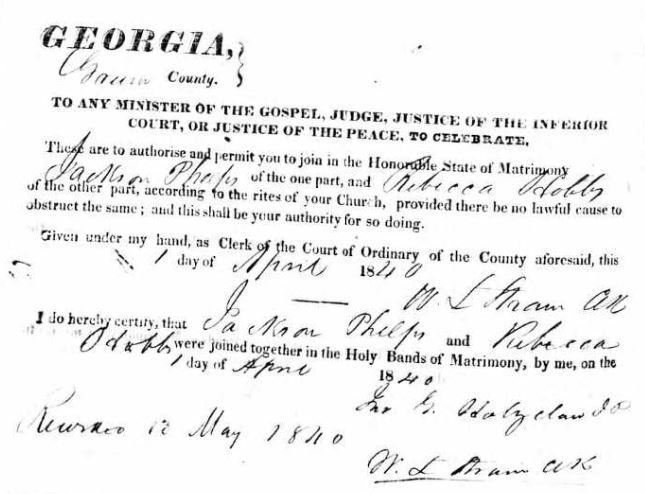
When Rebecca was 21 years old, she married Jackson C. Phelps on April 1, 1840 in Greene County. I haven’t been able to figure out what happened to Jackson but records show that Rebecca married her second husband, James L. Tarwater, on November 2, 1847 in Greene County. James, born 1814 in Virginia, worked as a cutter in the tailoring business in Penfield.

Jackson Phelps and Rebecca Hobbs marriage certificate


James Tarwater and Rebecca Phelps marriage certificate


The pamphlet Mercer at Penfield 1833-1871: Centennial Celebration, published by Mary Callaway Jones on May 27, 1933, has an entry that leads me to believe Rebecca and Jackson may have divorced because it sounds as if he’s still alive in 1852. The entry reads:
46. THE NATHAN HOBBS HOUSE Nathan Hobbs was Postmaster during part of Mercer's Penfield era. One of his daughters was (1) Mrs. Jackson C. Phelps, (2) Mrs. Jas. L. Tarwater. In 1852 Jackson C. Phelps resided on the corner of Davis and Marshall streets. J. L. Tarwater's home was between No. 17 and No. 18. Another daughter was Mrs. Jenkins.
If you can tell me otherwise, I’d love to hear from you.

On October 29, 1850, Rebecca and James lived in Salem, Greene County, Georgia. The census record shows that she was born in North Carolina. James was a tailor with real estate valued at $500. On October 7, 1854, after a church conference, Rebecca received a letter of admission from Baird’s Baptist Church in Oglethorpe County, Georgia and James received a letter of admission for Penfield Baptist Church. He had previously been granted a letter of dismission. In December 1854, Rebecca was awarded a $5 premium for best wove quilt or coverlet in the Southern Domestic Manufacturers category by the Southern Central Agricultural Society at the Ninth Annual Fair held in Augusta, Georgia. On March 12, 1859, Rebecca and James were admonished by the church for dancing, something people do all the time today, and often in a church. An entry in the Penfield Baptist Church minutes held in the Special Collections section of the Mercer University Library reads:
Church met in conference. Rules of Decorum and minutes of the last meeting were read. … The committee appointed at the last conference to inquire into the reports relative to dancing, made report. Bro. Tarwater made a statement to the church, in which he confessed that himself and Sister Tarwater had been engaged in dancing, acknowledged the impropriety of their conduct, and begged the forgiveness of the Church, pledging themselves not again to engage in such amusement. On motion the forgiveness of the Church was extended to Br. and Siter [sic] Tarwater.

The church was not happy that Rebecca and James danced

The 1860s was a busy time for Rebecca and her family. On June 4, 1860, Rebecca and James lived in Penfield. James was still working as a tailor. His real estate was now valued at $600 and personal estate $750. Rebecca’s 10-year-old niece Mary Jenkins, daughter of her sister Marian, was living in the home. There was also a 23-year-old white male named Homer Neeson in the home with the Tarwaters. Homer was a medical student and had a personal estate valued at $950. He was probably attending Mercer University. Rebecca’s brother Nathan, who served with the Dawson Grays, Company C, Third Georgia Infantry Army of Northern Virginia from Greene County during the Civil War, was killed in Gettysburg, Pennsylvania on July 2, 1863. In July 1864, a year after Nathan’s death, Rebecca’s husband James enlisted at Greensboro, Greene County, Georgia with Capt. Wards Company C of the First Georgia Militia or Mell’s Regiment. James was sent home due to illness after serving only nine months. He was not with his command at the surrender at Appomattox Court House. On May 4, 1867, letters of dismission were granted to both Rebecca and James from the Penfield Baptist Church.

On August 8, 1870, Rebecca, James, and Mary lived in Greensboro. James continued to work as a tailor and his personal estate was again at $500. There was a 16-year-old black male named William Langston who worked as a day laborer living in the home. William could neither read nor write. In 1875, Rebecca spent three weeks tending to her sick husband.

On June 14, 1880, Rebecca and James lived in Penfield. James still worked as a tailor and Rebecca was now enumerated as a farmer. The birthplace for both was recorded as Georgia, not North Carolina for Rebecca or Virginia for James. Neither Rebecca or James were able to read or write. There was a 12-year-old black male servant named Warren living in the home. They lived next door to the Ligon McWhorter family, a prominent family in Greene County. During the 1880s, in addition to working as a tailor, James sold churns, washing machines, and sewing machines. In 1886, Rebecca had a severe illness of some sort—severe enough it was noted that she was recovering in the Georgia Home Journal on August 20.

Rebecca’s father Nathan died in Penfield at the age of 99 on June 4, 1889. An Atlanta Constitution article that ran on June 7 marking his death noted that he “was one of the most remarkable men ever raised in the county.” Nathan was buried at Penfield Cemetery in Penfield.

After 45 years of marriage to Rebecca, James died on July 12, 1893 at the age of 79 in Penfield. He too was buried at Penfield Cemetery. At the time, Rebecca suffered from rheumatism, heart trouble, and shortness of breath. Years later when filing for a widow’s pension, Rebecca stated that James left her without any property. With no income, Rebecca had to depend on the help of charity and the Penfield Baptist Church to survive. She lived in poverty. During the years 1899 and 1900, her support cost $60 or $70 per year of which she contributed nothing.

On June 16, 1900, a widowed Rebecca lived alone in Penfield. This census record confirms that Rebecca never had children of her own. Her next-door neighbors were Joseph and Minnie G. Boswell. In 1948, the Minnie G. Boswell Hospital was built in Greensboro. In 1901, Rebecca filed for an indigent widow’s pension in Greene County on the grounds of age and poverty, conditions she had suffered from for at least 10 years. Records show she was approved for pension at least during the years 1901, 1903, and 1904–1907.

Rebecca signed her last will and testament on September 10, 1908.

Rebecca left her mark on her will on September 10, 1908

It was published by John S. Callaway on November 19, 1909. Her niece, Mary Elizabeth (Jenkins) Moore, who had been named as executrix, acknowledged on December 6, 1909 that she would execute Rebecca’s will. I haven’t found a death record for Rebecca but this leads me to believe she died about November 1909 at about 90 years of age. Rebecca was buried at Penfield Cemetery in Penfield.

Line of Hobbs, Lankford, and Tarwater graves at Penfield Cemetery.
You can see the grave of Jesse Mercer, a prominent Baptist minister from Georgia,
in the back at the end of the line of graves. Mercer University was named for Jesse Mercer.

Although Rebecca had filed affidavits that her husband left her with no property and that she had no income, she bequeathed her 10-acre lot in Penfield known as the Tarwater lot, as well as all of her household and kitchen furniture to “her beloved niece Mary.”

Land survey of Rebecca's property (10 acres) taken in May 1908

References

  • “At His Post,” The Greensboro Herald, Greensboro, Georgia, February 25, 1875.
  • Jones, Mary Callaway, Mercer at Penfield 1833-1871: Centennial Celebration, May 27, 1933
  • “List of Premiums,” Southern Banner, Athens, Georgia, December 21, 1854.
  • Marriage Certificate, Jackson Phelps and Rebecca Hobbs, Greene County, Georgia, recorded May 12, 1840.
  • Marriage Certificate, James L. Tarwater and Rebecca Phelps, Greene County, Georgia, recorded September 23, 1848.
  • “Our Esteemed Friend,” The Greensboro Herald, Greensboro, Georgia, April 6, 1882.
  • Penfield Baptist Church Minutes, 1839–1892.
  • Rebecca L. Tarwater, Georgia, Confederate Pension Applications, 1879–1960.
  • “Summary of the News Throughout Georgia,” The Butler Herald, Butler, Georgia, July 22, 1948.
  • “Tailoring,” The Christian Index, Washington, Georgia, January 24, 1845.
  • The Last Will of Rebecca L. Tarwater, probated Probate March 6, 1909.
  • “‘Uncle’ Nathan Hobbs, 98 Years a Resident of Penfield Passes Away,” The Macon Telegraph, Macon, Georgia, June 6, 1889.
  • “Uncle Nathan Hobbs Died in Penfield,” The Atlanta Constitution, June 7, 1889.
  • U.S. Federal Census, District 161, Greene County, Georgia, 1850.
  • U.S. Federal Census, Greensboro, Greene County, Georgia, 1870.
  • U.S. Federal Census, Penfield, Greene County, Georgia, 1860, 1880, 1900.
  • Will, Mrs. Rebecca L. Tarwater, probated September 10, 1908.