Showing posts with label Caldwell. Show all posts

Friday, April 3, 2026

Robert L. Hobbs: A Soldier’s Story

As part of my ongoing look at the Revolutionary War in honor of America’s 250th birthday, I turned to the service of my 5th great‑grandfather, Robert Hobbs. What follows is drawn from his 1843 pension declaration—the story he told, in his own words.

Robert L. Hobbs was 89 years old when he personally appeared before the Greene County Superior Court in 1843 and recounted his Revolutionary War service. His memory stretched back across seven decades, to a time when the Carolinas were a battleground and the young United States was fighting for its life. What he described was not a single enlistment but a series of dangerous tours that carried him from the outskirts of Charleston to the Cherokee Nation and back again.

Born on May 30, 1754, in Queen Anne County, Maryland, Robert moved as a child with his family to Craven County, South Carolina—later known as Chester District. He married Mary Marion Caldwell in 1776 or 1777 on Cherokee Creek, in what became Spartanburg District, and like many young men of the backcountry, he soon found himself drawn into the war.

Between 1779 and 1782, Robert served multiple tours in the Revolutionary War, first marching toward Charleston under Captain Terrill (or Terrell) and later fighting in General Nathanael Greene’s 1781 campaign at Ninety‑Six. He completed additional three‑month tours guarding settlements along the Broad and Congaree Rivers and volunteered for an expedition against the Cherokee, where his company saw two engagements. Altogether, he estimated about three years of active militia service in South Carolina and Georgia.

In addition to his later pension testimony, Robert’s service is also documented in South Carolina’s audited accounts—financial certificates issued to militia soldiers after the war. One of these records credits him for duty “since the fall of Charleston” in Colonel Benjamin Roebuck’s regiment under General Robert Anderson, the same backcountry command structure he described in his 1843 declaration. The state awarded him one pound, two shillings, and ten pence for this service, and a related note shows that he authorized an agent to collect additional indents owed to him for militia duty under officers Thomson, Brandon, and White. Although these records do not describe specific engagements, they confirm that Robert served in the upcountry militia during the dangerous years after Charleston fell in 1780, when local companies were repeatedly called out to defend settlements against British and Loyalist forces.


Robert’s service is also summarized in Bobby Gilmer Moss’ Roster of South Carolina Patriots in the American Revolution, which confirms the same sequence of tours he described in his pension declaration. Moss lists his 1779 draft under Captain Terrill and Colonel Brandon, his volunteer service under Captain George Taylor at the Siege of Ninety-Six, his later draft under Captain John Thompson, and his 1782 Cherokee Expedition under Captain John Mapp, Colonel White, and General Pickens. The roster also notes that he served at some point under Colonel Benjamin Roebuck, matching the South Carolina audited voucher that credits him for militia duty “since the fall of Charleston.”

Robert entered service in November 1779, when he was drafted under Captain Terrill and joined Colonel Brannon’s regiment. The company marched toward Charleston by way of Eutaw Springs and took up position at the Ten Mile House on Charleston Neck. For three months they held their post, waiting for an attack that never came. Robert received a written discharge at the end of the tour—long since lost by the time he applied for his pension. Robert testified:

“ … That he commenced his service in the month of November of the same year 1779 under Captain Terrell, 1st Lieutenant, John Jones, Orderly Sergt. James Mabry, and that our said company was attached to Col. Brannon’s Regiment to rendezvous at Col. Brannon on Brown’s Creek, and that from thence was marched towards Charleston by the way of the Eutaw Springs, to the 10-mile house on Charleston Neck and stationed there during our service, which was for three months. And at the end of which time, I received my written discharge, which was signed by the proper officers, but has been lost. The company to which I belonged had no engagements with the enemy during the tour. I returned home …”

After the British evacuated Charleston, Robert volunteered again, this time under Captain George Taylor. He joined General Nathanael Greene’s army during the famous Siege of Ninety-Six in June 1781. The fort, commanded by Loyalist officer Col. John Cruger, was heavily fortified. Greene’s men dug trenches, built towers, and prepared for a final assault. Robert remembered the siege lasting three weeks, with victory seeming close—until word arrived that Lord Rawdon was marching to relieve the garrison with a large British force. Greene lifted the siege and retreated toward North Carolina. Robert’s company followed the army to the state line before being dismissed. Robert testified:

“ … and did no further service until Charleston was evacuated by the British, after which time I volunteered under Captain George Taylor, 1st Lieutenant, Daniel McLeary, Ensign, Nat Robinson and was mustered into the United States service, under General Greene then marched to the fort known as Ninety-Six, in the month of June. The fort at that time was occupied by the British under Col. Cruger. The object of General Greene was to storm the fort which was invested at that time by the main army. The siege continued three weeks, and future success appeared certain when intelligence arrived that Lord Rawdon having received a reinforcement was approaching with a large army to the relief of the place. General Greene determined to evacuate his position and break up the siege. General Greene then retired towards North Carolina; our company went with to the North Carolina line when we were dismissed and returned to homes. During this year the inhabitants of the Carolinas endured calamity and distress, the country being ravaged and plundered by both armies. …”

Later that same year, Robert was drafted again for a three‑month tour under Captain John Thompson. His company rendezvoused on Brown’s Creek, joined Colonel Brannon’s regiment, and marched down Broad River to Friday’s Ferry on the Congaree. They crossed the river and took up station at Anderson’s Plantation, where they remained for the duration of their service. Robert testified:

“ … It was in the face of the same year (according to the best of my recollection) that I was drafted for a three-month tour under Captain John Thompson, 1st Lieutenant, Nicholas Jasper, our company rendezvoused on Brown’s Creek and joined Col. Brannon’s regiment. We were marched down Broad River to Friday’s Ferry and thence crossed and marched down the river to Anderson Plantation on the Congaree River, where we were stationed during the term of our service, which was three months. There was a portion of Col. White’s command stationed there with us, also some Dutch under the command of Captain Frazier. … ”

This was a dangerous region, plagued by Tory raids. Robert recalled one such attack—likely led by the notorious Loyalist commander William “Bloody Bill” Cunningham—in which mounted Tories crossed the river, burned property, plundered homes, and murdered a man. Robert’s company pursued them upriver but could not catch them. Their duty was to protect the settlement, and they remained until the danger passed. Robert testified:

“… A short time before the expiration of our term of service, a Tory scout of Light Horse commanded either by Cunningham or Guelph Committee some apprehensions on the other side of the river, where we were stationed, we went up the river in pursuit of the Tories, but were unable to come up with them, their operations were confined to burning and plundering and after murdering our man immediately departed. We were stationed there for some time for the protection of the settlement, when we were dismissed. We continued together until we had passed out of the region when the Tories were in force when we were dismissed. …”

In the fall of 1782, Robert volunteered once more, this time under Captain John Mapp. His company crossed the Savannah River at Cherokee Ford and joined South Carolina volunteers under General Andrew Pickens and Georgia troops under General Elijah Clarke. Together they marched the Hightower Trail deep into the Cherokee Nation. Robert testified:

“ … I arrived at home in January, and the succeeding fall, according to the best of my recollection, I volunteered under Captain John Mapp, 1st Lieutenant, Nathaniel Robinson. Our company marched and crossed Savannah River at the Cherokee Force, General Pickens, commanding the South Carolina Volunteers, and joined the Georgians under the command of General Elijah Clark on the Buffalo Fork of Long Creek in Wilkes County, Georgia. …”

At Long Swamp Town, between the Chattahoochee and Etowah Rivers, Robert’s company fought two engagements with Cherokee warriors, killing 10 and capturing 11. After the fighting, the Cherokee came under a flag of truce and negotiated a cession of land that would later form Franklin County, Georgia; Pendleton and Greenville Districts, South Carolina; and Buncombe County, North Carolina. Robert estimated this expedition lasted about three months. Robert testified:

“ … From thence we took the Hightower Trail and marched to the Long Swamp Town in the Cherokee Nation, between the Chattahoochee and Hightower Rivers. We had two engagements with the Indians, killing 10 and taking 11 of them prisoners; after taking the Long Swamp Town, the Indians came in with a flag of truce and had a talk, and at which time ceded the County that composed Franklin County, in the State of Georgia, Pendleton and Greenville districts in South Carolina, and Buncombe County in North Carolina. We volunteered for a three months tour, then six weeks in the Nation, but I cannot positively state, how long we were on our march, in going to and entering from the Nation, on this expectation, but to the best of my recollection we were on duty about three months, which was the last of my services in the Revolutionary War. …”

Taken together, these four tours formed the core of Robert’s Revolutionary War experience. They carried him across the backcountry of the Carolinas and Georgia, placed him under some of the most important commanders of the Southern Campaign, and exposed him to the shifting, often brutal realities of frontier warfare. Beyond these major tours, Robert also served in numerous short scouting parties—rapid‑response groups raised whenever Tories or Native groups threatened local settlements. These missions lasted anywhere from two days to a week. He believed he was liable for service for three to four years and spent roughly three years in actual duty. Robert testified:

“ … I served in many scouting parties against the Indians and Tories for short periods, these scouts were raised on emergencies whenever the Indians or Tories committed any depredations in the region of country where I was; as many now would be raised as could be in the neighborhood, and would then go in pursuit which trips would last from two days to a week. I served as a private in every expedition I was in. I never was wounded nor in any engagement with the exception of those mentioned as having occurred with the Indians. I am of opinion that I was subject to service by draft and otherwise between three and four years and was in actual service for the space of three years (see Davidsons certificate appended). …”

Robert’s pension testimony aligns well with the documented history of the Southern Campaign of the Revolutionary War. The movements he describes—marching toward Charleston in late 1779, serving under General Nathanael Greene at the Siege of Ninety‑Six in 1781, guarding the Congaree River during the height of Tory raids, and joining Generals Andrew Pickens and Elijah Clarke on the 1782 Cherokee Expedition—match the exact sequence, geography, and military actions recorded in contemporary accounts. Even his smaller details, such as the Ten‑Mile House near Charleston, Friday’s Ferry on the Congaree, and the Long Swamp Town campaign, correspond precisely to known events. For a man recalling service more than 60 years later, his testimony is remarkably accurate and provides a reliable, firsthand window into the war as it unfolded in the Carolinas and Georgia.

It is also fitting that Robert spent the last half‑century of his life in Greene County, Georgia—a place named in honor of Major General Nathanael Greene, the very commander under whom he served during the Southern Campaign. Greene was Washington’s most trusted general after the Commander‑in‑Chief himself, and his leadership in the Carolinas, including the Siege of Ninety‑Six where Robert fought, helped turn the tide of the war in the South. After independence, Georgia honored Greene by naming the county for him in 1786, and the general later settled in the state on land granted for his service. That Robert chose Greene County as his home in 1790 creates a remarkable historical echo: the young soldier who once marched under Greene’s command spent his final decades in a community that carried his general’s name.

Robert never took up arms against the United States, never shirked duty, and never received more than one written discharge. When he applied for his pension, he relied on the testimony of fellow soldier John Davidson, who had served with him and could confirm the truth of his account.

After the war, Robert remained in South Carolina until 1790, when he moved to Greene County, Georgia. He lived on the same land for more than half a century, raising his family and becoming a pillar in the county. By the time he gave his pension declaration in 1843, he was one of the last surviving veterans of the Revolution in his community.

He signed his name with a mark—old, frail, but still determined to tell the story of the service he had given his country.

Robert’s pension application was supported by the testimony of two respected Greene County men, John Davidson and William C. Dawson, both of whom affirmed his character and long‑remembered service. Davidson, a neighbor who had known Robert for decades, stated that he had served with him during the Revolution and could personally attest to the truth of his account. Dawson—later a prominent Georgia politician and U.S. Senator—likewise certified that Robert was well known in the community as a veteran of the war and that his reputation for honesty was unquestioned. Their affidavits provided the corroboration the pension office required, especially since Robert’s only written discharge had been lost many years earlier.

Robert died on June 7, 1845, at the age of 91, having lived more than half a century on the same Greene County land he settled around 1790. His pension—modest but meaningful—recognized his service during some of the most turbulent years in the backcountry South. His pension certificate, issued by the War Department on January 6, 1845, and signed by Secretary of War William Wilkins, confirmed his entitlement under the Act of June 7, 1832, payable semi-annually beginning March 4, 1831.

Robert’s name also appears in the Georgia pension rolls created under the Act of June 7, 1832. These tables record his payments beginning in 1833 and continuing each year until his death in 1845. Although they contain no narrative detail, they confirm the duration of his pension and match the timeline he described in his 1843 declaration.

When Robert died on June 7, 1845, his widow Mary was already an elderly woman. She had married him in 1776 or 1777 on Cherokee Creek in what became Spartanburg District, and she had followed him through every move of their long life together—from the backcountry of the Carolinas to the new settlements of Greene County, Georgia. They raised nine children, built a life on the same Greene County land they settled around 1790, and remained there for more than 60 years.

By the time Mary applied for her widow’s pension in 1853, she was 94 years old, nearly blind, and still living on the same property where she and Robert had raised their family. She had no marriage certificate to offer the government; instead, she relied on the testimony of neighbors and the Greene County court. One neighbor noted that she had children born as early as 1780, and the court declared her “reputable and of good credit,” fully worthy of belief. Judge James M. Davison certified that he had known her for decades and that she had lived in Greene County “upwards of 60 years,” never remarrying after Robert’s death.

Mary’s pension was first granted under the Act of June 17, 1844, at the rate of $20 per year, beginning on June 7, 1845, the same day Robert died. In 1848, her pension was continued for life under the Act of February 2, 1848, again at $20 per year unless she remarried. Too frail to travel, she appointed an attorney in Savannah to collect her payments on her behalf. Her final documented payment was issued on September 4, 1853, the last known record of her life.

She signed her name with a mark, just as Robert had. Old, widowed, and nearly blind, she still came forward to claim what was owed to her for her husband’s service. Her persistence ensured that Robert’s Revolutionary War story—and her own quiet endurance—would not be forgotten.

Together, Robert and Mary belonged to the earliest generation of settlers in Greene County, arriving when the region was still a frontier and living long enough to see it transformed by statehood, cotton, and the upheavals of the nineteenth century. Their lives—ordinary in some ways, extraordinary in others—link the Revolutionary era to the world that followed, and their stories survive because they insisted on telling them, even when age and frailty made the telling difficult.

References

  • Accounts Audited of Claims Growing Out of the Revolution (S108092), South Carolina Department of Archives and History.
  • Federal Census Schedules: 1850 and 1870 Greene County, Georgia, documenting the Hobbs household and Mary’s later life.
  • Final Payment Vouchers, Georgia (1818–1864), NARA Publication M1746. Provides payment records for both Robert and Mary.
  • Greene County, Georgia Court of Ordinary Minutes, guardianship and administrative entries.
  • Historical context drawn from published studies of the Southern Campaign, including the Siege of Ninety‑Six, Cherokee campaigns of 1782, and militia activity along the Congaree and Broad Rivers.
  • Moss, Bobby Gilmer, Roster of South Carolina Patriots in the American Revolution (Baltimore: Genealogical Publishing Co., 1983), 430, entry for Robert Hobbs (W5300).
  • Revolutionary War Pension File of Robert Hobbs (S5300), National Archives, Record Group 15. Includes his 1843 declaration, supporting testimony, and War Department correspondence.
  • Robert Hobbs, Georgia, Pension Roll of 1835: Georgia Act of 7 June 1832, Greene County.
  • United States War Department, Revolutionary Claim Certificate for Robert Hobbs, 6 January 1845, signed by Secretary of War William Wilkins and Commissioner of Pensions J. L. Edwards.
  • Widow’s Pension File of Mary Hobbs (W5300), National Archives, Record Group 15. Contains her 1853 declaration, court certifications, and payment vouchers. 

Friday, February 13, 2026

Nathan Lankford: Patriotism Beyond the Battlefield

With the 250th anniversary of American independence on the horizon, I decided to explore the Revolutionary War period through the lives of the men and women in my own family tree. I began with my 5th great‑grandfather, Nathan Lankford—a man long assumed to have been a soldier. What I discovered instead was a story of civic duty, community leadership, and patriotic service that unfolded not on the battlefield, but in everyday work.

Born in 1764 in either Mecklenburg or Rutherford County, North Carolina, Nathan is connected to me through his daughter—my 4th great‑grandmother, Mary Elizabeth Lankford. Although he never enlisted, he is recognized by the Daughters of the American Revolution (DAR) for his Patriotic Service to the cause. His contribution is documented through two Revolutionary War pay vouchers issued by the State of North Carolina, official records showing he was compensated for services rendered. While the vouchers don’t specify the exact nature of his support, they indicate that he aided the Patriot effort, likely by furnishing supplies or labor. This kind of civil service was essential to sustaining the war, and Nathan’s inclusion in the DAR database affirms his role in the struggle for independence, even if he never wore a uniform.


Nathan as shown in the DAR Index

Nathan is sometimes described in online trees as having fought at the Battle of Kings Mountain (October 7, 1780) at age 16 and later helping build the first White House (construction began in 1792), but I find no evidence to support either claim. His name does not appear on the Kings Mountain lists I’ve seen, he left no pension application documenting combat service, and his verified Revolutionary War involvement consists only of North Carolina pay vouchers for patriotic service in 1782. Given that he was born in 1764, he would have been too young for most early‑war military service but old enough by the final years of the conflict to contribute in non‑combat or local support roles, which aligns with the type of service reflected in his voucher. These stories are best treated as unproven family lore.

In June 1782, Nathan was formally compensated by the State of North Carolina for his contributions to the Revolutionary War effort. A pay voucher issued in the Salisbury District records that he was allowed 17 pounds, 10 shillings, and 5 pence in specie (gold or silver) for a public claim—an official acknowledgment by the Board of Auditors that he had either furnished supplies, performed services, or otherwise supported the Patriot cause. A second voucher, issued on September 6, 1782, allowed him one pound specie for another public claim. Although neither document specifies the nature of his contribution, both confirm that Nathan was actively involved in the war’s final year and recognized by the state for his role.


Pay voucher (June 1782)
 

Pay voucher (September 1782)

Around 1790, Nathan married Meron (or Marion) Caldwell, daughter of Curtis Caldwell and Sarah W. Fondren, in Rutherford County. Together they had 11 children that I can document: John, Curtis C., Robert S., Elizabeth, Meron, Mary, Sarah “Sally,” Sibby, Rhoda, Martha, and Minor S. Lankford.

Nathan appears in Rutherford County records as early as April 1794, when the court appointed him overseer of the public road from John Cummins’ place on White Oak to the Block House. Road overseers were typically established householders entrusted with maintaining important transportation routes, so this appointment indicates that Nathan was settled in the area, likely owned or occupied land along the road, and was actively participating in local civic duties. In July 1795, he served as a juror tasked with laying out a new public road, further demonstrating his involvement in community affairs.

By 1800, Nathan was living in the Morgan District of Rutherford County with his wife, seven children under 16, and one enslaved person. His census entry places him in the 26–44 age bracket. The presence of multiple young children and an enslaved laborer suggest a growing farm and a household firmly rooted in the community known as Skywicker.

Nathan’s status as a landowner is well documented. In January 1802, the court appointed him—identified as a freeholder—to help set aside a year’s support for Rebekah Earle, widow of John Earle. This role was reserved for trusted, established men. Between 1804 and 1805, Nathan purchased at least 255 acres in Rutherford County: 100 acres from the administrators of John Earle’s estate on Skyuka and 155 acres from the estate of James Logan on the Long Branch of the Pacolet River. The Logan deed was witnessed by Charles Lankford, highlighting early ties between the Lankford and Logan families—connections that later deepened when Nathan’s daughter Sarah married James Logan Jr. Both deeds were formally proved in court in October 1809.

Despite claims found online, there is no evidence that Nathan Lankford of Rutherford County served in the War of 1812. A reference card does exist for a man of the same name in Pearson’s 7th Regiment, but the full pension file shows that soldier was a different individual—one who lived in Polk County, married Mary Brock in 1862, and died in 1873. Rutherford County’s Nathan died in early 1826 and was married to Meron, not Mary Brock. Based on naming patterns and family proximity, the Polk County Nathan was likely a younger relative, possibly a first cousin (son of Robert Lankford and Sybil Taylor), but the two men should not be mistaken for one another.

Nathan’s daughter Sarah “Sally” married James Logan in Rutherford County on December 2, 1813. In 1816, his son John received a 50‑acre land grant adjoining Nathan’s property on Skyuka. Nathan’s 1825 will later bequeathed John the tract “below the mill,” matching the location of the 1816 grant. On December 15, 1816, Nathan signed the £500 marriage bond for his daughter Sibby, who married Leeroy Caruth. In October 1817, he was appointed constable, entering into a £500 bond and taking the oath of office—a position reflecting trust and responsibility.

Nathan’s 1820 census entry lists 11 individuals in his household: 8 free white persons and 3 enslaved people. He and an adult woman—presumably Meron—were both over 45. The household included several children and young adults, and five individuals were engaged in agriculture, indicating a working farm. Nearby lived Robert Lankford, John Lankford, and Nathan Hobbs (husband of Nathan’s daughter Mary), showing the family’s close geographic clustering.

In April 1822, Nathan appeared in court to prove a deed from Isaac Cloud Sr. to Jonathan Williams. Isaac Cloud was married to Nathan’s aunt, Sarah “Sally” Lankford. Between 1824 and 1825, court executions against Braxton Lankford repeatedly described his 200‑acre tract as adjoining the lands of Robert Lankford, Nathan Lankford, and Watson Collins, confirming Nathan’s property boundaries and his proximity to other Lankford relatives. One case involved a debt originally owed to Nathan, showing his financial dealings within the family.

On December 28, 1825, Nathan wrote his will, describing himself as “sick and afflicted in body” but of sound mind. He provided generously for his wife Meron, granting her the use of all land and personal property during her lifetime or widowhood so she could support herself and the unmarried children still at home. After her death or remarriage, he directed that John receive the Skyuka tract below the mill; Curtis inherit the Long Branch “Piece Place;” and Robert, still underage, receive the home tract under John’s guardianship. He also made provisions for his daughters, including livestock and the future increase of enslaved people, or monetary compensation if no increase occurred. The remainder of the estate was to be sold and divided among his children and the heirs of any who had predeceased him. Nathan named Meron and John as executors, excusing John from commissions.

Just weeks before his death, on January 9, 1826, Nathan completed a final land purchase from George Williams: 100 acres on the North Pacolet River and both sides of Skyuka Creek. Although the deed was not recorded until 1835, the transaction itself occurred during Nathan’s lifetime. Nathan died sometime between January 9, 1826, when he executed the Williams deed, and February 13, 1826, when the deed was proved in court. His son John submitted the estate inventory in April 1826, marking the close of Nathan’s long and active life in Rutherford County.

References

  • Births, Delayed Births, Divorces, Marriage Bonds, Licenses, Certificates, Registers, Cohabitations, and Grave Removals: Rutherford County, North Carolina, Birth Records 1779–1868, Divorce Records 1779–1868, Delayed Birth Records 1779–1868, Grave Registers 1779–1868, Licenses 1779–1868, Marriage Bonds 1779–1868, image 94, FamilySearch.
  • Nathan Langford, Daughters of the American Revolution, Ancestor Search; https://services.dar.org/public/dar_research/search_adb/?action=full&p_id=A068974. 
  • Nathan Lankford, North Carolina Revolutionary Pay Vouchers, 1779–1782.
  • Nathan Lankford, North Carolina, Wills and Probate Records, 1665–1998.
  • North Carolina, Military Records 1779–1792, image 503, FamilySearch.
  • Rutherford Co. File No. 3009, Capt. John Lankford, NC Land Grant Images and Data; https://www.nclandgrants.com/grant/?mars=12.14.108.3013&qid=1233707&rn=1. 
  • Rutherford County Land Grant File No. 3009, Capt. John Lankford, NC Land Grant Images and Data; https://www.nclandgrants.com/frame/?fdr=547&frm=1050&mars=12.14.108.3013. 
  • Rutherford County, North Carolina, Marriage Bonds 1810–1859, image 98, FamilySearch.
  • Rutherford County, North Carolina, Court Minutes 1786–1789, 1789–1793, 1779–1786, 1781–1786, 1794–1798, images 700 and 754, FamilySearch.
  • Rutherford County, North Carolina, Court Minutes 1799–1802, 1803–1806, 1813–1817, 1806–1810, 1810–1813, images 142, 491, and 810, FamilySearch.
  • Rutherford County, North Carolina, Court Minutes 1825–1830, 1818–1819, 1821–1825, 1820–1821, 1831–1837, images 268, 398, 440, and 444, FamilySearch.
  • Rutherford County, North Carolina, Deeds 1807–1816, image 417, FamilySearch.
  • Rutherford County, North Carolina, Deeds 1835–1840, image 31, FamilySearch.
  • Rutherford County, North Carolina, Wills 1782–1868, images 367–368, FamilySearch.
  • U.S. Federal Census, Morgan, Rutherford, North Carolina, 1800.
  • U.S. Federal Census, Rutherford County, North Carolina, 1820.

Friday, February 9, 2024

Cullen Jackson Caldwell

This blog post is another in a series connecting the dots in my tree to the souls buried at Bairdstown Cemetery in Bairdstown, Oglethorpe County, Georgia.

Cullen Jackson Caldwell, son of William Miles Caldwell and Mary Ann Caldwell, was born in Georgia on May 15, 1835. He had three brothers and one adopted sister—Joshua Augustus Caldwell, John Caldwell, Miles A. Caldwell, and Mary W. Caldwell. Cullen is another one of those “distant” cousin links to Bairdstown Cemetery. In this case, he is the father-in-law of a 1st cousin 3x removed. We have no common relative. The connection comes in through my Lankford/Wilson lines.

Sometime after Cullen’s brother Miles was born, his family moved to Alabama. On November 19, 1850, Cullen (age 15) and his family lived in District 19 of Chambers County, Alabama. His father was a farmer and Cullen a student. No one in the family could read or write. There was a Colwell family living next door—Joshua Colwell (62), born in Maryland, his wife Mary (52), and their son Joshua Jr. (18). Both Mary and Joshua Jr. were born in Georgia. I noticed several times in my research the spelling of Caldwell was Colwell so assume they were family, but at this point, do not know the relationship.

Cullen married Sarah W. Bailey in a service performed by Justice of the Peace James A. Ray on December 16, 1858 in Tallapoosa County, Alabama. I believe Sarah’s parents were Francis E. Bailey and Sarah Jackson but need to find more records before I can confirm that.

Cullen and a man named James A. Bailey, who I believe is Sarah’s brother, put up a $200 bond for the union.

Cullen and Sarah had nine children—Cullen S. Caldwell, Eliza Pope Caldwell, Robert Esmond Caldwell, Annie E. Caldwell, Julia B. Caldwell, John Miles Caldwell, Cumi J. Caldwell, and two unnamed children.

On August 2, 1860, Cullen and Sarah lived in the Southern Division of Chambers County, Alabama. At age 24, he was working as a school teacher and had a personal estate valued at $250. It appears Cullen and Sarah moved to Georgia within two years after this census was taken. The Civil War began on April 12, 1861, however, Cullen waited until March 1, 1862 when he was enlisted by Lt. Fuller as a private in Company A, Infantry Battalion of Phillips’ Legion, Georgia Volunteers at Greensboro, Greene County, Georgia for a period of three years.

Cullen’s military records help tell the story of his service during the Civil War:

May and June 1862: Present; last paid March 1, 1862.

August 31 to November 31 [sic], 1862: Absent, at home in Georgia sick; last paid September 1, 1862. 

September 16, 1862: Admitted to Chimborazo Hospital, No. 1. in Richmond, Virginia suffering from gonorrhea. Furloughed 40 days from November 6, 1862. Was Cullen sent to Richmond from home in Georgia? The record does not make that clear.

October 24 and 31, 1862: Appeared on a Register of Approved Furloughs kept by the Medical Director’s Office in Richmond, Virginia.

November 6, 1862: Appeared on a Register of Medical Director’s Office in Richmond, Virginia for Chimborazo Hospital No. 1. Furloughed.

November 30 to December 31, 1862: Absent, at home in Georgia sick; last paid September 1, 1862.

January and February 1863: Present; last paid at hospital September 1, 1862. The muster roll does not specify where the hospital was located. At the time, he would have been in Georgia.

May 23, 1863: Appeared on a Register of Receiving and Wayside Hospital, or General Hospital No. 9, in Richmond, Virginia.

June 30, 1863: Appeared as present on the General Hospital No. 19 muster roll in Richmond, Virginia; last paid April 30, 1863.

July 10, 1863: Appeared on a Register of Chimborazo Hospital, No. 2 in Richmond, Virginia suffering from diarrhea. 

August 7, 1863: Transferred to Camp Jackson.

August 10, 1863: Admitted to Jackson Hospital in Richmond, Virginia suffering from debilitas. At the time, he was attached to Waffords Brigade. 

August 31, 1863: Appeared on the Hospital Muster Roll at Jackson Hospital in Richmond, Virginia; last paid by Capt. Kemper on June 30, 1863.

September 16, 1863: Appeared on a Morning Report of Jackson Hospital in Richmond, Virginia. Returned to duty.

September and October 1863: Present; last paid at hospital September 1, 1863.

March and April 1864: Present; last paid March 1, 1863.

May and June 1864: Present; last paid May 1, 1864.

July and August 1864: Present; last paid July 1, 1864.

November 5 and 27, 1864: Issued clothing.

April 6, 1865: Captured at Burksville. [This entry tells us that Cullen was involved in the Battle of Sayler’s Creek, a significant battle that took place near Farmville, Virginia.] 

April 14, 1865: Arrived at City Point, Virginia. Appeared on a roll of Prisoners of War.

June 26, 1865: Released after swearing an Oath of Allegiance to the United States at Point Lookout, Maryland. Cullen was recorded as being 5’, 7 ¾” tall, having a fair complexion, light brown hair, and blue eyes.


July 6, 1867: Appeared on the Penfield, Greene County, Georgia Returns of Qualified Voters and Reconstructions Oath Books. 

August 1, 1867: Signed an oath in Greene County. 

On August 24, 1868, Cullen signed an Official Oath of Clerk of the Superior Court for Greene County. 

Apparently, something did not set right with the election for Cullen because in September 1868, he promptly declined. The Greensboro Herald reported the situation on September 3:

A Gentleman and a Democrat.

—C. J. Caldwell, who was elected Clerk of the Superior Court of Greene county, upon the Radical ticket, refuses to serve, stating that his name was associated with the party without his consent. Who of the rest will follow this example?

Cullen lived in Bairdstown when his son Robert was born in October 1868.

He was relieved of “political disabilities” in early May 1870. On June 21, 1870, Cullen and his family lived in Penfield, Greene County, Georgia. Cullen worked as a farmer while his wife Sarah was keeping house. They had three children at the time—Cullen, Eliza, and Robert. They lived two houses from my 3rd great grandparents, James and Caroline (Hobbs) Lankford. In December 1877, Cullen applied for an “Exemption of personalty and setting apart and valuation of Homestead.” The application was advertised in the Greensboro Herald on December 6, 1877.

Georgia—Greene County. 

Cullen J. Caldwell applies for Exemption of personalty and setting apart and valuation of Homestead, and I will pass upon the same at 10 o’clock, a.m., on Tuesday, December 25th, 1877.

J. F. Thornton, Ord’y.

December 4, 1877.

On June 3, 1880, Cullen and his family lived in the 138th District of Greene County, Georgia. He continued to work as a farmer and his wife, enumerated as Sallie, was a housekeeper. There were five children living in the home at this point—Pope, Robert, Annie, Julia, and John. Cullen’s parents lived next door, along with his adopted sister Mary and brother Miles. Pope was the only child attending school. Robert could read but not write. Annie, Julia, and John could neither read or write. A couple named Early (age 60) and Martha (age 57) Caldwell lived next door to Cullen. Next door to Early was a couple named Elisha (age 26) and Kate (age 25). I have not yet determined how or if they are related to Cullen. 

The Oglethorpe Echo reported Sarah being sick with the grippe in February 1892. The Caldwell family was living in Bairdstown at the time. The Echo reported a curious item on November 16, 1894:

—There is a red hat-eating red mule down in Greene county, especially if you leave the hat on a gate post. C. J. Caldwell says he is the durndest hat eating mule this side that place where Dives went when Lazarus got so hungry.

Cullen’s son Robert married Miss Sophronia “Wattie” Hudson in Rome, Floyd County, Georgia on December 27, 1894. The Oglethorpe Echo reported the marriage on January 4, 1895:

—Married, in Rome, Ga., on Thursday morning, Dec. 27th, Mr. Robt. E. Caldwell and Miss Wattie Hudson, both of Rome. As soon as the ceremony was performed the happy couple took the fast train, via Atlanta, to Bairdstown. They were met at Union Point by a party of the bridegroom’s relatives and were donducted to Bairdstown where in waiting was a party of friends and relatives. Then a two mile drive to the hospitable home of Mr. C. J. Caldwell, where a sumptuous feast had been prepared for the August occasion. That all enjoyed themselves goes without saying. After all had partaken of the feast we adjourned to another room where we were entertained delightfully with sweet music by Miss Minnie Bouschell, the lovely daughter of Mr. Bud Bouschell, and Miss Julia Caldwell. Then as the hour hand of the clock that set on the mantle pointed to twelve, we bade the happy couple good night, and many were the wishes of all, and especially Racket, that not a wave of trouble shall ever cross their pathway along the line of time. 

For those researching this family, the marriage date recorded on Robert and Wattie’s marriage certificate, December 19, was different than what the Oglethorpe Echo reported, December 27. 

Cullen’s daughter Julia married Radamanthus (Red or Raddie) M. Boatright Jr. in Greene County on December 4, 1895. The Oglethorpe Echo published the marriage announcement on December 6, 1895:

—Married, at the residence of the bride’s father, C. J. Caldwell, on Wednesday evening, Dec. 4th, 1895, Mr. Red Boatwright, of Wilkes county, and Miss Julia Caldwell, Rev. J. S. Callaway officiating. The groom has won a prize to help him through life. They left at once for their future home in Wilkes county. Our loss will be Wilkes’ gain. Our best wishes for their future happiness through life.

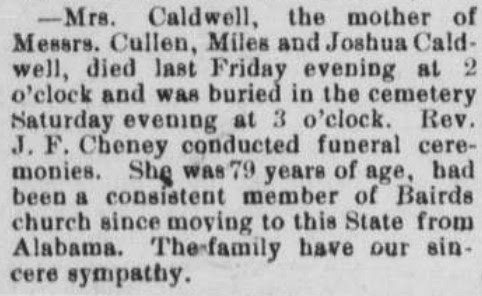
Cullen’s mother, Mary Ann Caldwell, died in Oglethorpe County, Georgia on June 11, 1897. The Oglethorpe Echo reported her death on June 18, 1897:

—Mrs. Caldwell, the mother of Messrs. Cullen, Miles and Joshua Caldwell, died last Friday evening at 2 o’clock and was buried in the cemetery Saturday evening at 3 o’clock. Rev. J. F. Cheney conducted funeral ceremonies. She was 79 years of age, had been a consistent member of Bairds church since moving to this State from Alabama. The family have our sincere sympathy.

On the same day, the Oglethorpe Echo also reported that Cullen planned to build a “nice dwelling house this summer.” Cullen was “alarmingly ill” in mid-April 1898, but had recovered within a week. In mid-August 1898, daughter Julia spent a week at home in Bairdstown visiting her family. Cullen was considering a move to Maxeys, Oglethorpe County, Georgia in November 1898, but decided to stay where he was. However, on October 20, 1899, the “Maxeys’ Local Matters” column of the Oglethorpe Echo reported “a number of invitations were sent out to an entertainment at Mr. C. J. Caldwell’s Monday night and those who attended report an enjoyable time.” Does that mean he actually lived in Maxeys at the time? I believe he lived in Bairdstown, not Maxeys based on an October 20, 1899 article published in Oglethorpe Echo, which also tells us what Cullen was celebrating:

—A party was given at Mr. C. J. Caldwell’s last Monday evening in honor of Mr. John Caldwell’s return.

—Mr. John Caldwell, from Arkansas, is now at home on a visit to his parents, Mr. and Mrs. C. J. Caldwell.

Cullen’s son-in-law, Raddie (Red) Boatwright (husband of daughter Julia), died at his home in Wilkes county on April 10, 1900. The Oglethorpe Echo carried the announcement of his death on April 13:

—Mr. Raddie Boatwright died at his home in Wilkes last Monday evening. May God comfort the bereaved family.

Julia, now a widow, and her son, Guy M. Boatwright, moved back to her parents' home in Woodville, Greene County, Georgia which is where the census enumerator found them on June 7, 1900. In addition to Cullen, his wife Sarah, Julia, and her son Guy, their son John (age 23) and daughter Cumi (age 21) were living there as well. Cullen and Sarah had been married for 42 years. Sarah was enumerated as having had nine children, seven of which were living. Cullen worked as a farmer and John a farm laborer. A black male named Abe Cheney (age 20) also lived in the home. He was enumerated as a servant and worked as a farm laborer. They lived six houses from his brother Miles and his family. Cullen was visited by Charlie Smith and Ed Caldwell from Siloam, Greene County, Georgia in March 1901. Sometime before July 26, 1901, Cullen’s house(s) apparently burned. On July 26, the Oglethorpe Echo reported the following:

—Mr. C. J. Caldwell is hauling stock to the mill to rebuild the houses he had burned. We all sympathize with him in his loss which is good as far as it goes but let us do something more substantial.

I looked for an article reporting the fire but did not find one.

A wedding took place at the Caldwell home when Cullen’s daughter Cumi married Joseph P. Clark in Greene County on December 18, 1901. The marriage announcement was published in The Echo on December 20, 1901:

—Miss Cumi Caldwell and Mr. J. P. Clark, near Maxeys, were married Wednesday at the bride’s home in Greene county. Mr. Clark is a flagman on the Georgia railroad and Miss Caldwell is one of the pretty young women of Greene county and they entered married life with bright and flattering prospects.


In May 1902, the Oglethorpe Echo reported that Cullen had “been in rather bad health for two weeks.” An Administrator’s Sale notice for the estate of Mrs. A. J. Callahan published in the Oglethorpe Echo on October 31, 1902 reported that Cullen lived in Bairdstown. Her land was bordered on the west by Cullen’s and P. M. Stevens. 

Cullen’s daughter Cumi died in Greene County on July 21, 1903 following a short illness. The Echo published the announcement of her death, as well as that of an infant son, on July 24, 1903:

—The many friends here of Mr. J. P. Clark sympathize with him in the loss of his wife which occurred Monday at Union Point. Mrs. Clark was Miss Cumi Caldwell and a sweeter little girl never lived. 


—At her home in Union Point on the 21st inst. Mrs. J. P. Clark passed away after an illness of three days. She was the youngest child of Mr. and Mrs. C. J. Caldwell. She was loved and admired by all who knew her. She was in her 23rd year, had been married about two years. Her infant babe was buried just two days before she was. They were both laid to rest in the cemetery here, Bro. J. D. Mell conducting the funeral services. The family have our heartfelt sympathy. We commend them to God who makes no mistakes but doeth all things well and for the best.


Both Cumi and her son were buried at Bairdstown Cemetery in Bairdstown, Oglethorpe County, Georgia.

As the month of July began, Cullen was sick and was still sick at the end of the month. He may have suffered from the same illness that killed Cumi and her son. Cumi’s death would not be the only one in 1903. Her sister Julia died in Wilkes County, Georgia on December 7, 1903. Julia was buried at Sardis Baptist Church Cemetery in Rayle, Wilkes County, Georgia. Daughter Julia’s husband, Radamanthus M. Boatwright, had died in Wilkes County on April 10, 1900, now leaving their young son an orphan. Guy would remain in the care of his grandparents, Cullen and Sarah.

On April 22, 1910, Cullen and Sarah lived in Bairdstown with Guy, now 13 years old, still living with them. Cullen worked as a farmer on a general farm. Sarah was enumerated as having had nine children, five of which were living. I have been unable to find two of the children. Cullen and Sarah had celebrated 52 years of marriage. 

Cullen submitted a Confederate Pension Application in Greene County on August 8, 1910. At the time, Cullen owned 175 acres of land valued at $1000. He owned livestock that included a cow and calf valued at $20, horses and kitchen furniture valued at $75, and he received $125 a year for rental of some of his land. Mr. J. R. Robins submitted a witness application stating he had known Cullen for 48 years and had served with him during the war. Robins was captured at the same time as Cullen and was with him in prison. Cullen and his wife paid taxes on $1025 in 1908, $1050 in 1909, and $1090 in 1910. He was paid a pension of $60 for 1912. 

Exactly two years after the last census was taken, Cullen died in Greene County, Georgia on April 22, 1912. He was buried at Bairdstown Cemetery. His obituary and tombstone tell us he was a Mason. The Oglethorpe Echo reported his death on May 3, 1912:

The many friends of Mr. C. J. Caldwell of near Bairdstown regret to learn of his death and burial last week. He was a Mason and a member of Howard lodge at Maxeys. He was seventy-five years old, joined the Baptist church when young and served his country in the Confederacy.


At the time of his death, Cullen owned two acres of “very poor land” in Greene County that had a cash value of $800. His household and kitchen furniture was valued at $100. Sarah filed a Widow’s Application for a U.S. Confederate Pension on July 12, 1912. On May 25, 1912, she filed a petition with the Greene County courts seeking one year of support from the estate.

Greene Court of Ordinary, Years Support.

In Re. Mrs. C. J. Caldwell,

And now in response to the citation published, come Hodgson Brothers, and show that they are creditors by judgment of C. J. Caldwell, the deceased out of whose estate a years support is sought, and they caveat the return of the appraisers setting the same aside upon the following grounds:

    1. The same is excellsive, having reference to the station and habits of the applicant, and the debts of the estate of the deceased.
    2. The valuation of the land set apart at $800 is entirely too small, and land being fairly worth $2,000, and not more than half thereof should be set apart as a years support to said widow.
    3. Said applicant is already in the enjoyment of said land as a homestead, and is not entitled to a years support in additional thereto.

Wherefore caevators pray that these their grounds of caveat be sustained, and that judgment be rendered accordingly.

[Signature unreadable]


The petition was withdrawn on June 1, 1912.


A request was made to the courts to appoint five discreet and proper persons to act as appraisers for the estate, to pay for her support and maintenance, and to set apart sufficient household furniture. 


W. A. Hewell, W. P. McWhorter, W. J. Durham, C. G. Moody, and G. F. Callahan were appointed as appraisers for the estate. They assessed that $1000 be set aside for Sarah’s support and maintenance for a period of 12 months, and that she be allowed to keep all the household and kitchen furtniture owned by Cullen at the time of his death.


References

  • A Gentleman and a Democrat, The Greensboro Herald, Greensboro, Georgia, September 3, 1868.
  • Administrator’s Sale, The Oglethorpe Echo, Crawford, Georgia, October 31, 1902.
  • Bairdstown, The Oglethorpe Echo, Crawford, Georgia, December 6, 1895.
  • Bairdstown, The Oglethorpe Echo, Crawford, Georgia, July 31, 1903.
  • Bairdstown, The Oglethorpe Echo, Crawford, Georgia, March 15, 1901.
  • Bairdstown, The Oglethorpe Echo, Crawford, Georgia, May 2, 1902.
  • Bairdstown,The Oglethorpe Echo, Crawford, Georgia, November 18, 1898.
  • Brought by Mail: From the Different Sections of Oglethorpe County—Near Bairdstown, The Oglethorpe Echo, Crawford, Georgia, February 26, 1892.
  • Brought by Mail: From the Different Sections of Oglethorpe County—Little River, The Oglethorpe Echo, Crawford, Georgia, November 16, 1894.Death of Cumi Caldwell Clark, The Echo, Lexington, Georgia, July 24, 1903. 
  • Brought by Mail: From the Different Sections of Oglethorpe County, The Oglethorpe Echo, Crawford, Georgia, January 4, 1895.
  • Brought by Mail: From the Different Sections of Oglethorpe County—Bairdstown, The Oglethorpe Echo, Crawford, Georgia, June 18, 1897.
  • C. J. Caldwell, Georgia, U.S., Confederate Pension Applications, 1879-1960.
  • C. J. Caldwell, U.S., Civil War Prisoner of War Records, 1861-1865.
  • C. J. Coldwell, Georgia, U.S., Wills and Probate Records, 1742-1992.
  • Collen J. Caldwell, U.S., Civil War Prisoner of War Records, 1861-1865.
  • Cullen J, Caldwell, Georgia, U.S., Returns of Qualified Voters and Reconstruction Oath Books, 1867-1869.
  • Cullen J. Caldwell, Georgia, U.S., Returns of Qualified Voters and Reconstruction Oath Books, 1867-1869, Greene County, Georgia, July 6, 1867.
  • Cullin I. Caldwell, Alabama, U.S., County Marriage Records, 1805-1967.
  • Cullin J. Caldwell and Sarah W. Bailey, Alabama, U.S., Select Marriage Indexes, 1816–1942.
  • Cullin J. Caldwell, Alabama, U.S., County Marriage Records, 1805-1967.
  • Cullin J. Caldwell, Alabama, U.S., County Marriage Records, 1805–1967 for Cullin Caldwell, Tallapoosa 1834–1948.
  • Cumi Caldwell wedding announcement, The Echo, Lexington, Georgia, December 20, 1901.
  • Echoes by Mail: Those Sent Us by Correspondents from Different Sections of the County—Bairdstown, The Oglethorpe Echo, Crawford, Georgia, October 20, 1899.
  • Echoes from Little River, The Oglethorpe Echo, Crawford, Georgia, April 15, 1898.
  • Exemption of Personalty and Setting Apart and Valuation of Homestead advertisement, Greensboro Herald, December 6, 1877.
  • Find a Grave, database and images (https://www.findagrave.com/memorial/43091306/infant-son-clark: accessed 06 February 2024), memorial page for Infant Son Clark (1903–1903), Find a Grave Memorial ID 43091306, citing Bairdstown Cemetery, Oglethorpe County, Georgia, USA; maintained by D Mathis (contributor 47000209).
  • Find a Grave, database and images (https://www.findagrave.com/memorial/51378317/julia-boatwright: accessed 03 January 2024), memorial page for Julia Caldwell Boatwright (21 Apr 1875–7 Dec 1903), Find a Grave Memorial ID 51378317, citing Sardis Baptist Church Cemetery, Rayle, Wilkes County, Georgia, USA; maintained by SP (contributor 48324886).
  • Find a Grave, database and images (https://www.findagrave.com/memorial/43091291/cumi-j-clark: accessed 03 January 2024), memorial page for Cumi J. Caldwell Clark (20 Jul 1880–20 Jul 1903), Find a Grave Memorial ID 43091291, citing Bairdstown Cemetery, Oglethorpe County, Georgia, USA; maintained by D Mathis (contributor 47000209).
  • From Our Correspondences: The County Localized by Communities—Bairdstown, The Oglethorpe Echo, Crawford, Georgia, July 03, 1903.
  • From Our Correspondents: The County Localized by Communities—Bairdstown, The Oglethorpe Echo, Crawford, Georgia, July 26, 1901.
  • Helena Dots, The Advocate-Democrat, Crawfordville, Georgia, August 12, 1898.
  • Julia B. Caldwell and R. M. Boatwright, Georgia, U.S., Marriage Records From Select Counties, 1828-1978.
  • Maxeys’ Local Matters: As Our Special Correspondent Finds Them, The Oglethorpe Echo, Crawford, Georgia, October 20, 1899.
  • Mrs. C. J. Coldwell, Georgia, U.S., Wills and Probate Records, 1742-1992.
  • Mrs. Sarah W. Caldwell, Widow’s Application, Georgia, U.S., Confederal Pension Applications, 1879–1960.
  • Official Advertisements, The Weekly New Era, Atlanta, Georgia, May 11, 1870.
  • Personal visit to Bairdstown Cemetery.
  • Robert E. Caldwell and Miss Wattie Hudson, Georgia, U.S., Marriage Records From Select Counties, 1828-1978.
  • Robert Esmond Caldwell, U.S., Social Security Applications and Claims Index, 1936-2007.
  • U.S. Federal Census, 138th District, Greene County, Georgia, 1880.
  • U.S. Federal Census, Bairdstown, Oglethorpe County, Georgia, 1910.
  • U.S. Federal Census, District 138, Greene County, Georgia, 1880.
  • U.S. Federal Census, District 19, Chambers County, Alabama, 1850.
  • U.S. Federal Census, Militia District 140, Greene County, Georgia, 1870.
  • U.S. Federal Census, Penfield, Greene County, Georgia, 1870.
  • U.S. Federal Census, Southern Division, Chambers County, Alabama, 1860.
  • U.S. Federal Census, Woodville, Greene County, Georgia, 1900.
  • U.S. Federal Census, Woodville, Greene County, Georgia, 1900.
  • U.S. Federal Census, Woodville, Greene County, Georgia, 1910. 

Friday, June 30, 2023

Vassie Verlin Lankford

Vassie Verlin Lankford, daughter of Oscar Olan Lankford and Joanna “Anna” E. Pace, was born March 17, 1901 in Gwinnett County, Georgia. She was the second of three children born to Oscar and Joanna—Loy Olen Lankford, Vassie Verlin Lankford, and an unnamed infant. She went by Verlin and is my 3rd cousin 3x removed. Our nearest common relatives are Nathan Lankford and Marion Caldwell (married about 1790 in Rutherford County, North Carolina), my 5th great grandparents.

On May 11, 1910, the Lankford family lived at Lawrenceville and Decatur Roads in the Berkshire District of Gwinnett County. Verlin’s grandparents, John Bailis and Clara A. (Minor) Lankford and uncle John Marcus “Mark” Lankford lived next door. Verlin’s father was a farmer on a general farm. Her parents had been married for 12 years. Her mother was enumerated as Anna, the mother of three children, two of which were living.  

Verlin married Walter Augustus Carroll, son of John Thomas Carroll and Lovely Ann Loucecily McCurdy, on April 26, 1919 in Fulton County, Georgia. Her first name was spelled “Verland” on the marriage license. Verlin and Walter were blessed with four children—John Walter Carroll, James “Eugene” Carroll, Betty Anne Carroll, and Mildred “Charlotte” Carroll. 

On January 26, 1920, Verlin and Walter lived with his parents and brother Mark in the Berkshire District. Walter worked as an automobile machinist. Verlin was 18 and Walter 19 years old. By 1925, the couple had moved to a house located at 67 Lowry Street in Atlanta. Walter had changed jobs and now worked as a roofer. 

On April 3, 1930, the Carroll family (Verlin, Walter, John, Eugene, and Betty) lived in a home located on Trinity Place in Decatur. Verlin and Walter owned the home, valued at $4500. The census record shows they also owned a radio. Walter worked as a policeman for DeKalb County. John and Eugene were both attending school. 

About 1935, Walter became a policeman for the city of Decatur in DeKalb County, Georgia. This was reflected in the 1936 Atlanta, Georgia City Directory, showing they had moved to a house on Lockwood Terrace in Decatur.

On April 13, 1940, Verlin, Walter, son John, and daughter Betty still lived in the Lockwood Terrace home. Verlin was enumerated as “Verlyn.” Her name would be spelled the same way in daughter Charlotte’s 2021 obituary. Betty’s age was inaccurately enumerated as one year old, with the fifth grade being the highest completed. Walter was a city policeman. 

When Verlin’s husband Walter registered for the World War II draft on February 16, 1942, he recorded Lockwood Terrace as his home address. Verlin was recorded as the person who would always know Walter’s address. Walter worked for G. S. Swords at Decatur’s City Hall.


Walter's World War II registration card

Verlin died at home on December 1, 1943. She was buried at Decatur Cemetery on December 3 following a service at Trinity Chapel officiated by Rev. George M. Acree. Verlin was provided an honorary escort by the Decatur Police Department. She was survived by her husband, sons John and Eugene, daughters Betty and Charlotte, parents, and brother Loy.


Photo used with permission of Joe Stoner, Find A Grave ID 47793749

Sadly, Verlin’s husband Walter died on New Year’s Eve 1944 leaving their four children orphans. At the time, John (24) was living in Houston, Texas, and James (22) in the military. Walter’s obituary noted that their son Sgt. Eugene Carroll was serving “with Gen. Patton’s Army during all the invasions” of World War II when Verlin died but was home on leave when Walter died. Both underage at 15 and 14 respectively, Charlotte and Betty were still living in Georgia. Charlotte’s 2021 obituary notes that she “left Decatur and moved to live with her aunt in Houston, Texas, but soon came back to Georgia to be raised by her aunt in Avondale Estates, Georgia and finished school in Decatur.” I do not find a record to show that Betty also moved to Houston. It appears she was attending Decatur High School in 1945 so if she did move, like Charlotte, she did not stay long. Betty would eventually move to Houston though where she lived a full and happy life as a wife, mother, grandmother, and educator.

References

  • Atlanta, Georgia, City Directory, 1925, 1936.
  • Betty Murdock obituary; https://www.legacy.com/us/obituaries/houstonchronicle/name/betty-murdock-obituary?id=48908342. 
  • Find a Grave, database and images (https://www.findagrave.com/memorial/77419565/vassie-verlin-carroll: accessed 23 June 2023), memorial page for Vassie Verlin Lankford Carroll (17 Mar 1901–1 Dec 1943), Find a Grave Memorial ID 77419565, citing Decatur Cemetery, Decatur, DeKalb County, Georgia, USA; maintained by Larry Wynn (contributor 47256286).
  • Find a Grave, database and images (https://www.findagrave.com/memorial/252692650/mildred-charlotte-smithmier: accessed 26 June 2023), memorial page for Mildred Charlotte Carroll Smithmier (27 Jul 1930–29 Sep 2021), Find a Grave Memorial ID 252692650, citing Decatur Cemetery, Decatur, DeKalb County, Georgia, USA; maintained by Sujava (contributor 47686977).
  • Funeral Notice, Mrs. Walter A. Carroll, The Atlanta Constitution, December 2, 1943.
  • Mrs. Walter A. Carroll obituary, The Atlanta Constitution, Atlanta, Georgia, December 3, 1943.
  • Obituary of Mildred Charlotte Smithmier, Charlotte Memorial Funeral Home; https://charlottememorial.com/tribute/details/5135/Mildred-Smithmier/obituary.html. 
  • U.S. Federal Census, Avondale Estates, DeKalb County, Georgia, 1950.
  • U.S. Federal Census, Berkshire, Gwinnett County, Georgia, 1910, 1920.
  • U.S. Federal Census, Decatur, DeKalb County, Georgia, 1940.
  • U.S. Federal Census, Militia District 531, DeKalb County, Georgia, 1930.
  • U.S. Federal Census, Stone Mountain, DeKalb County, Georgia, 1880.
  • Verland Lankford and Walter A. Carroll, Georgia, Marriage Records from Select Counties, 1828–1978.
  • W. A. Carroll, Decatur Officer 9 Years, Is Dead, The Atlanta Constitution, Atlanta, Georgia, January 1, 1945.
  • W. A. Carroll, U.S. WWII Draft Cards Young Men, 1898–1929.
  • Walter Augustus Carroll, U.S., World War II Draft Cards Young Men, 1940–1947.