Showing posts with label Shields. Show all posts

Friday, March 6, 2026

Robert Shields: A Family Tradition Re‑Examined

Another figure in my 250th‑anniversary project on Revolutionary War–era ancestors is my 6th great‑grandfather, Robert Shields—a man whose life is remembered by his descendants but sparsely documented in surviving records.

Robert was born in Virginia, likely in Augusta County. His tombstone gives his birthdate as November 9, 1749, while the Daughters of the American Revolution (DAR) lists it as circa 1738–1740. SmokyKin, a large genealogical site focused on early Sevier County settlers, repeats the November 9, 1749 date and places his birth in what is now Harrisonburg, Rockingham County. With no surviving birth or death record, the exact year remains uncertain.

Around 1761, Robert married Nancy Stockton, daughter of Richard and Agnes Stockton. Together they raised 11 children—1 daughter and 10 sons—born in the Shenandoah Valley in what was then Augusta County and later became Rockingham County: Janet (or Jennet), Thomas, Richard, David, William, John, James, Robert, Joseph, Benjamin, and Jesse. Although some online trees include an infant son named Ezekiel, said to have been born and died in 1778, no records support his existence, and researchers do not count him among the documented children of Robert and Nancy. Their sons are often referred to as the “the Ten Brothers.”

Robert’s tombstone states that he served as a private in “Francis Lang’s Company” during the Revolutionary War, a detail that immediately raised questions. Because Robert died in 1802, long before the pension laws of 1818 and 1832 that generated the service records we rely on today, he left no pension file, no sworn testimony, and no official record of his service. The only surviving federal documentation comes from a 1976 application submitted by his 2nd great‑granddaughter, Francis Dennis Mize, requesting a government‑issued veteran’s marker. Her application states that Robert enlisted in 1777 and was discharged in 1783, relying heavily on a likely long‑remembered association between Robert and a soldier named Francis Lang.


Photo used with permission of Paul J. Lambert
(Find A Grave member 46544256)

Because the VA required proof before issuing a military headstone, Robert’s service had to be verified to federal standards. His modern marker therefore reflects not only family memory but also formal recognition of his Revolutionary War service nearly two centuries after his death. The following two images are the original 1976 application that secured that acknowledgment.


Veterans Administration application submitted by
Robert’s 2nd great granddaughter in 1976

Yet family memory is not always correct. When I searched Fold3, a subscription site for digitized military records, I found no service file for Robert—not surprising for a man who died before pension laws existed. But when I turned to the man whose name appears on Robert’s tombstone, I discovered something unexpected: Francis Lang never commanded a company at all.

Lang enlisted as a private on July 18, 1780, in Charles County, Maryland, serving first under Capt. Charles Smith in the regiment commanded by Col. Smith of the Maryland Line. As the Maryland Line reorganized, he continued—still a private—under Capt. Bluff in the regiment of Col. Ford, remaining in service until his discharge by public proclamation in November 1783 at Nottingham in Prince George’s County. During those years, he fought in major southern battles including Guilford Courthouse, Camden, the Siege of Ninety Six, and Eutaw Springs.

So why does Robert’s tombstone reference “Francis Lang’s Company”? The most reasonable explanation is that the inscription reflects family memory of an association, not a documented chain of command. Robert may have known Lang, served near him, or spoken of him often—but no surviving record links Robert to Lang’s unit or to any specific regiment. The inscription preserves a tradition, not evidence.

To understand what Robert’s service might have looked like—if he served at all—it helps to look at the units active in the regions where he lived. This context is useful, but it is not proof of his participation.

Men from Augusta and Rockingham counties often joined the 8th Virginia (“The German Regiment”), the 12th Virginia, or local militia battalions. Others enlisted in Maryland units, especially those living near the border. Soldiers from these regions fought at Brandywine, Germantown, Monmouth, Camden, Cowpens, Guilford Courthouse, Ninety Six, Eutaw Springs, and eventually Yorktown. If Robert served, he might have encountered some of these campaigns—but no document ties him to any of them.

Cross‑border enlistment was common: Rockingham County was only 30–50 miles from Maryland, and Augusta County only 50–75 miles. A Virginia‑born man serving in a Maryland unit was far from unusual. Still, without a muster roll, pay record, or pension file, none of these scenarios can be confirmed. They remain possibilities only—historical context, not evidence.

After the war—likely in the 1780s or early 1790s—Robert joined the wave of Shenandoah Valley families migrating into East Tennessee. He settled in what became Sevier County, where he and his sons built Shields Fort, a small frontier stockade near present‑day Pigeon Forge and Shields Mountain. According to the biography of his eldest son, John Shields—later a member of the Lewis and Clark Expedition—the family lived in the fort for years as protection during periods of conflict. Many settlers abandoned the area due to attacks, but Robert and his family remained.

Robert died in Sevier County on January 18, 1802, long before pension laws could have documented his service. Nancy died in 1805, also too early to qualify for the widows’ pension acts. Both rest at Middle Creek Cemetery in Sevierville.

But he left a family who remembered him, a fort he helped build on the Tennessee frontier, and a legacy strong enough that his descendants fought to have him recognized as a veteran nearly two centuries later. As we mark 250 years since the Revolution, remembering Robert feels like a way of honoring all the ordinary soldiers whose stories were never fully written down—men who served, endured, and helped shape the country we live in today.

A descendant claims that Robert served in the Revolutionary War, but no primary records confirm it. The only known claim comes from a 1976 government marker application submitted by that person. Until a military record is found, his service must be considered unproven. The DAR now classifies Robert’s Revolutionary War service as unproven, noting that earlier applications relied on evidence—likely family tradition—that no longer meets modern standards. The DAR’s own notation confirms this, stating that his previously accepted service is no longer considered valid and that future applicants must provide new, verifiable proof.


Robert as recorded in the DAR index, including a notation that
“Future Applicants Must Prove Correct Service”


DAR explanation for the notation

Robert does not appear in Eckenrode’s 1912 List of the Revolutionary Soldiers of Virginia, a key statewide compilation based on surviving military records. I also checked the National Archives, the Internet Archive, the Digital Public Library of America, the University of Virginia Library, and the Library of Virginia websites and did not find Robert listed in any military records, further indicating that no contemporary documentation of his service has been found.

Although some online trees refer to a “Capt. Francis Long,” no militia records from Augusta or Rockingham counties list a man by that name as an officer; the only documented Long captains of the era were John and Benjamin Long of Rockingham County.

So, when I began this sketch, I expected to be able to name an ancestor who served with the Continental Army during the Revolutionary War, but it appears that now I cannot. No Revolutionary War battles were fought in the area that later became Sevier County. When Robert settled there in the 1780s, the war in the South was essentially over, but the region remained a tense frontier. Settlers along the French Broad and Little Pigeon Rivers faced periodic conflict with Cherokee groups and relied on small forts and local militia for protection. These were post‑war frontier skirmishes rather than Revolutionary War engagements, and they were never recorded as Continental service.

In the end, Robert’s story reminds me that not every Revolutionary‑era life left a clear paper trail, yet each one—documented or not—helped shape the world the Revolution made.

References

Friday, June 20, 2025

Hazel A. Shields

Hazel A. Shields was born September 12, 1926, in Georgia, the daughter of Walter C. B. Shields and Virginia “Gennie” Maria Craig. She was one of eight children born to the Shields family. Her siblings included Ralph Shields, Vernon “Doc” Lee Shields, Josephine Shields, W. C. “Dub” Shields, Betty Jean Shields, and Buddy Shields. The family had experienced tragedy before Hazel’s birth with the loss of her older brother, Melburn, who died at approximately age three.

Hazel is my 1st cousin 2x removed, with our nearest common ancestors being Samuel Cas Shields and Martha Ann Ogle—my 2nd great-grandparents and Hazel’s grandparents.

The Shields family’s movements in the 1930s can be traced through various records, though Hazel’s whereabouts in the 1930 census have yet to be found. By 1935, the family had established themselves in the Hall District of Pickens County, Georgia, presumably in Jasper.

The Pickens County Progress provides glimpses into Hazel’s early education. In December 1938, the paper reported that Hazel entered first grade alongside her siblings Ralph, Vernon, and Josephine. Just two months later, in February 1939, Hazel demonstrated academic promise when she, Ralph, and Josephine were placed on the first-grade honor roll.

The 1940 census, taken on May 13, paints a challenging picture of the family’s circumstances. Despite being 13 years old, Hazel had only completed the third grade, and none of the Shields children had attended school since March of that year. The census reveals her father working as a farmer and her brother serving as a farm laborer.

Hazel’s marriage to Ulysses “Ulis or Eulis” Carter, son of Lander A. and Mary L. Carter, occurred sometime between the May 1940 census and 1949. This timeline is established through two key records: the 1940 census, where Hazel was still single, and the 1949 Bradley County, Tennessee city directory, which documented the couple living in Cleveland. The directory also noted Ulis’ employment as a laborer at Stivers Lumber Company.

Though Ulis fulfilled his patriotic duty by registering for the World War II draft, records do not indicate any military service during the war.

The 1950 census, taken on May 10, provides a detailed snapshot of Hazel and Ulis’ life in Bradley County’s enumeration district 6-6. At the time, Hazel was 23 and Ulis was 36. The census reveals Ulis’ employment as a ripsaw helper at a lumber company, though he was between jobs that week and searching for work. Hazel’s status was listed as “unable to work.”

Ulis’ mother lived nearby with her second husband, William Sprayberry, and their son Earl, just a few houses down the same street.

Hazel’s life came to an untimely end on September 6, 1951, just six days shy of her 25th birthday. She died at her home near Straw Hill, a residential area in Cleveland, after a battle with pulmonary tuberculosis. Her struggle with the disease had begun nearly three years earlier, on November 13, 1948.

The Straw Hill Baptist Church hosted her funeral service on September 7, after which she was laid to rest in Cleveland’s Red Hill Cemetery. Hazel left behind her husband Ulis; sisters Josephine and Betty; brothers Ralph, Vernon, Dub, and Buddy; and her parents.


Photo by Laurie Wilson, Find A Grave member 47098859

References

  • Find a Grave, database and images (https://www.findagrave.com/memorial/107992768/hazel-carter: accessed April 7, 2025), memorial page for Hazel Shields Carter (12 Sep 1926–6 Sep 1951), Find a Grave Memorial ID 107992768, citing Red Hill Cemetery, Cleveland, Bradley County, Tennessee, USA; maintained by Laurie Wilson (contributor 47098859).
  • Hazel A. Carter, Certificate of Death no. 51-19748, State of Tennessee, Department of Public Health, Division of Vital Statistics, 1951.
  • Hazel Carter, U.S., City Directories, 1949.
  • Mrs. Eulis Carter, Cleveland Daily Banner, p. 3, September 6, 1951.
  • Pickens Hi-Lights: Grade Honor Roll, Pickens County Progress, Jasper, Georgia, February 2, 1939.
  • Pickens Hi-Lights: P.C.H.S. Still Growing, County Progress, Jasper, Georgia, December 8, 1938.
  • U.S. Federal Census, E.D. 6-6, Bradley County, Tennessee, 1950.
  • U.S. Federal Census, Hill District, Pickens County, Georgia, 1940.
  • Ulis Carter, U.S., World War II Draft Cards Young Men, 1940–1947.

Friday, January 3, 2025

New Shields Family Photos

While going through online trees recently, I found the two photos featured in this post—one of the Samuel Cas Shields family and one of my grandmother, Daisy Lee Shields. Both photos were posted on another Shields family researcher’s online family tree. That researcher, Oliver Cagle, and I are 2nd cousins once removed, and we are both descendants of Cas and his wife, Martha Ann Ogle. Oliver’s grandmother was Cas and Martha’s daughter, Melona Jane Shields, and a sibling of my great-grandfather, James Stewart Shields. Years ago, Oliver, my sister, and I exchanged Shields family information and photos, but he did not have these particular photos back then. After discovering the photos, I reached out to Oliver to inform him of my intention to use them on my blog and asked where he found them. He replied that they came from either his grandmother or her daughter Betty, both of whom have since passed away. 

The family photo features (from left to right) Melona Jane Shields, Maude Maree Shields, and Pearl Lewcrilly Shields in the front row. Jane, also known as Janie or Dicie, later married, moved to California, had four children, and lived to the age of 95. Maude married young and sadly died at age 16, likely due to childbirth complications. Pearl’s life was particularly tragic. She married a man who struggled with alcoholism and was unable to support their family of five children (four sons and one daughter). Pearl contracted tuberculosis and died at the age of 31. After her death, her husband abandoned the children, who ranged in age from 2 to 11. They spent some time with their grandparents, Cas and Martha, but due to financial constraints, the four youngest children were eventually placed at Georgia Baptist Children’s Home. The sons were placed in one home and the daughter in another, through their church, where they stayed until they turned 18. The oldest son, being old enough to work, lived with an uncle (Elmer Shields) for a short time and then with an aunt (Addice Shields). Despite their tragic beginnings, all five children grew up to lead good, productive lives.

In the back row are (from left to right) Walter C. Brown Shields, Sallie Addice Shields, Albert Conley Shields, James Stewart Shields, and Martha and Cas Shields. Walter, a farmer in Whitfield County, Georgia, married and had eight children before he passed away at age 57. Addice, the mother of six children, was married three times. She lived to age 87 after taking care of her mother and brother Blaine Arthur Shields following Cas’ passing. Conley, who lived to age 72, married and had one daughter and worked in construction. Stewart, my Pappy, married and had 12 children. He passed away at age 70 after working as a farmer for many years in Whitfield County, Georgia, and then at a cardboard manufacturer in Chattanooga, Tennessee. Martha and Cas Shields, farmers in Sevier County, Tennessee, before moving to Whitfield County, Georgia, raised 10 children before their deaths at age 91 and 85, respectively.

Oliver estimates that his grandmother was about 13 years old at the time the family photo was taken, which would place it around 1920.


Samuel Cas Shields family (ca. 1920). Photo from Oliver Cagle.

The second photo features my granny, Daisy Lee Shields, the eldest child of James Stewart Shields and Hattie Jane Rhinehart. I believe Daisy was in her late teens or early 20s when this photo was taken on the back porch of Cas and Martha’s home in Tunnel Hill, Georgia. Daisy was married six times and had one daughter. She worked as a beautician and lived to the age of 77. If you would like to learn more about Daisy’s life, click here.


Daisy Lee Shields (ca. 1930). Photo from Oliver Cagle.

Although I titled this post “New Shields Family Photos,” these photos are not new in the traditional sense—but they are new to me. It was thrilling to discover these photos, as I had never seen either of them before. I do have one photo of Cas and Martha Shields, taken around 1910, with all but two of their children—my great-grandfather Stewart, who had already married and left home, and Maude, who had not been born yet. I am thankful Oliver took the time to post these photos. 

Friday, December 6, 2024

James Stewart Shields

James Stewart Shields was born on November 15, 1891, in the Birds Creek area of Sevierville, Sevier County, Tennessee. His parents were Samuel “Cas” or Caswell Shields and Martha Ann Ogle. He went by his middle name, Stewart. Cas and Martha had 10 children: James Stewart Shields, Milas Odell Shields, William Elmer Shields, Walter “Walt” C. Brown Shields, Sallie “Addice” Shields, Albert “Conley” Shields, Blaine Arthur Shields, Melona Jane “Janie” Shields, Pearl Lewcrilly Shields, and Maude Maree Shields. Stewart, my great grandfather, was affectionately called “Pappy” by my siblings and me. Our nearest common relative is his daughter Daisy, my grandmother (Granny). 

Stewart allegedly comes from a long line of the Shields family, centered around Robert and Nancy Stockton Shields, who had 10 sons. These brothers, known as “The Ten Brothers,” were among the early settlers in Sevier County, Tennessee. Their descendants have significantly influenced the region’s history and development. Their journey and contributions are detailed in the book The Shields Family: Particularly the Oldest and Most Numerous Branch of that Family in America by John Arthur Shields, originally published in 1917.

Robert and Nancy Shields also had one son, Ezekial, who did not survive infancy, and one daughter, Jennet (or Janet). I say Stewart allegedly comes from this line of Shields because I have been unable to find a record that connects Stewart’s father to his grandfather, Jesse William Shields.

Twenty-three years ago, when my sister and I connected with Tommy Shields, one of Cas’ grandsons, Tommy shared a piece of family lore that Cas was illegitimate. Cas’ wife, Martha (Ogle) Shields (Tommy’s grandmother), and Lela (Vineyard) Shields (Tommy’s mother and wife of William Elmer Shields’) claimed that Jesse was not Cas’ father. Martha further told Elmer that Jesse had been dead for seven years when Cas was born, and that it was quite a scandal at the time. It was believed that Cas’ father was a Dunlap, a traveling salesman with the Dunlap Tire Company, who sold rubber buggy tires and whips.

Cas appears in the 1870 District 13, Sevier County, Tennessee census with his mother, Mary A. Shields (40), and siblings: Martha (18), Elizabeth (13), Sarah (9), John (6), and William (3). Cas is listed as six months old in this census record. The only record I found with a death date for Jesse William Shields is a Find A Grave memorial, which shows he died in 1869. Unfortunately, the memorial does not provide proof of death, nor do I find a record to prove it, other than an 1890 Veterans Schedule that lists Mary as Jesse’s widow. But if Jesse passed away in 1869, it makes sense that Cas was just six months old, contrary to the seven-year discrepancy mentioned above.

Sadly, until I find a record connecting Cas to Jesse, I am unable to confirm that Stewart belongs to the line of the 10 Shields brothers.

On June 8, 1900, James and his family resided on a rented farm in the 13th Civil District of Sevier County, Tennessee. His parents were listed as 30 years old and had been married for eight years, indicating they married in 1892. The census record noted that Martha had four living children—James, Milas, William, and Walter—all of whom were at home. His father worked as a farmer. The William S. Shields family, who lived two houses away, were Stewart’s paternal uncle’s household.


1900 census Soundex card

Stewart married Hattie Jane Rhinehart, daughter of William Dearnald Rhinehart and Roda Elizabeth “Bettie” Sneed, in Sevier County on March 30, 1909. Hattie’s brother-in-law, Ashley Sutton, and Stewart posted a $1250 bond when they filed for the marriage license on March 29. The ceremony was officiated by the local Justice of the Peace, A. D. Eledge, who lived just seven houses away from Stewart’s family. At the time, Hattie was 14-years-old and Stewart was 17. Following the death of Hattie’s father in 1908, it is possible her mother was eager to see one of her daughters married.


Hattie and Stewart had 12 children over a span of 30 years: Daisy Lee Shields, Willie Mae Shields, James B. Shields, Betty Ann Shields, Paul Sam Shields (he went by Paul Sam), Bessie Lucille Shields, Mary Nell Shields, Dorothy Jolene Shields, Bobbie Jean Shields, Charles Dewayne Shields, Loyal Mack Shields, and an infant who did not survive. Unfortunately, I have not been able to pinpoint any dates for the infant.

After their marriage, Stewart and Hattie moved in with Hattie’s widowed mother, Bettie, in the 13th Civil District of Sevier County. The census enumerator found them there on April 29, 1910. Hattie’s sister Ollie and brothers James and Arlie were also living in the home. Bettie was farming on a rented general farm. Stewart and Hattie’s siblings worked as farm laborers, while Hattie was the only person in the household not working. Stewart’s sister-in-law, Malonia, lived next door with her husband Ashley Sutton and daughter Georgia. 


1910 census Soundex card

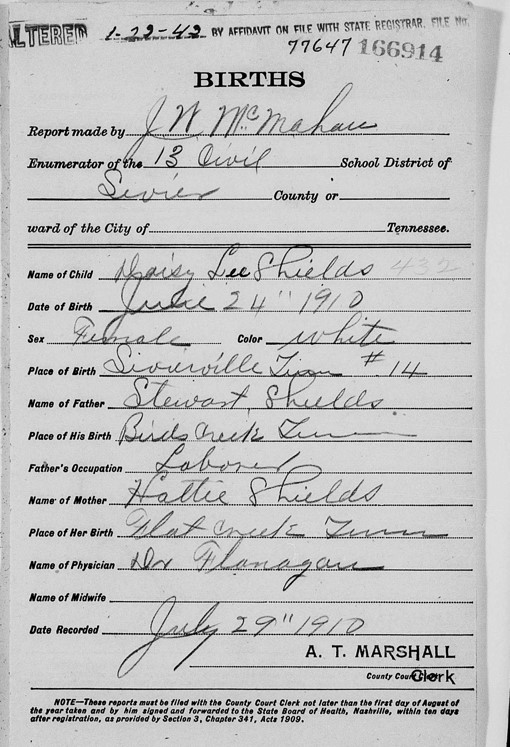
Two months after the census was taken, on June 24, 1910, Hattie gave birth to their daughter Daisy in Birds Creek, Sevier County, Tennessee.

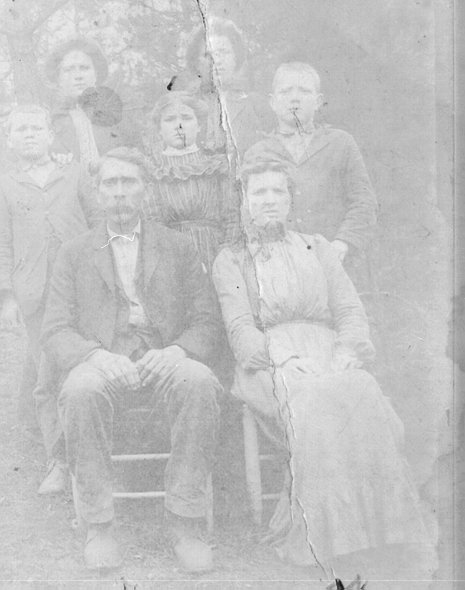
Around 1910, Stewart’s father, Cas, gathered his wife and children for a family photo. Since Stewart had married in 1909, he was not included in this picture. 


Front: Melona Jane Shields in father Samuel Cas Shields' lap,
Albert Conley Shields, Pearl Lewcrilly Shields in mother
Martha Ogle Shields' lap, Blaine Arthur Shields, Sallie Addice Shields.
Back: Milas Odell Shields, William Elmer Shields, Walter C. Brown Shields.
Oldest son James Stewart Shields is not in the photo.

Sometime between 1910 and 1913, the Shields family moved to north Georgia, where Stewart’s father, Cas, found the farmland to be better and cheaper than the mountainous land around Sevierville. Cas went ahead on his own and bought a farm in Whitfield County, Georgia, situated on a hill with a long driveway between Praters Mill and Deep Springs. He then returned to Sevierville to bring the rest of the family. They traveled to Dalton using two two-horse wagons, each pulled by mules, accompanied by two cows, four dogs, two coops of chickens, and all their furniture. The children alternated between walking and riding in the wagons. The approximately 120-mile trip took 8 to 10 days, with the family camping by creeks and in farmers’ fields along the way.

Sometime after Daisy was born and before their second daughter Willie Mae was born in 1914, Stewart loaded up the wagon and followed Cas and the rest of the Shields family to Whitfield County. Hattie’s mother, Bettie, joined Stewart, Hattie, and their daughters on the move. Around 1914, Hattie’s sister, Malonia, fell ill with what was believed to be cancer. Wanting to be near family for support and care, she and her family also relocated to Whitfield County. Malonia passed away on November 25, 1916, and was buried at Deep Springs Baptist Church Cemetery in Dalton, Whitfield County. This cemetery is also the final resting place for several of my direct Holland ancestors. My Granny, Daisy Shields, married into the Holland family.


Stewart, my Granny Daisy, Hattie, and Willie Mae (ca. 1916)

Stewart played the banjo, fiddle, and guitar, while Hattie played the fiddle, banjo, and mandolin. Several of their children were also musically inclined, making music a constant presence in their home. In 1910, Stewart and Hattie formed a band called ‘The Skillet Lickers’ and performed around Sevier County. Music was in their blood, a passion passed down to their children.

Stewart owned 65 acres of land in Tunnel Hill. At some point after his children reached adulthood, he gave one acre each to his daughter Daisy and his son, Paul Sam, both located just down the dirt road. When we were young, we often visited my Granny and would walk down the road to see my great-grandparents, filling buckets with blackberries to make pies later that day. One night, Paul Sam’s house burned down (the exact year unknown). My sister Bonita noticed through the fog one morning that his house was gone, having burned down overnight without anyone hearing the fire truck’s arrival.

Stewart registered for the World War I draft in Whitfield County on June 5, 1917. At that time, he lived in Varnell, near Dalton, in Whitfield County. He worked as an independent farmer near Varnell to support his wife and two children. He described himself as of medium height and build, with blue eyes and light-colored hair.


Stewart’s World War I draft registration card

The North Georgia Citizen published a list of men who had registered in Whitfield County on June 7, which included Stewart and his brother Elmer. On August 30, the same newspaper published an additional 10 names of men who had registered, as well as a list of those who had claimed exemption. Stewart was among those requesting exemption. On September 6, they reported that Stewart had been granted exemption by the local board.

On January 5, 1920, Stewart and his family resided in the Lower Tenth Militia District of Whitfield County. Stewart worked as a farmer on a general farm, while his 54-year-old widowed mother-in-law, Bettie, lived with them and also worked as a farm laborer on the home farm. Stewart, Hattie, and Bettie were all literate. Daisy and Willie were attending school, and their daughter Betty was just three months old.


1920 census Soundex card

I recently discovered the family photo below which was posted online by Oliver Cagle, a 2nd cousin once removed. Unlike the family photo I shared earlier, I was thrilled to see Stewart included in this one. Oliver estimates that his ancestor, Melona Jane Shields, was about 13 years old at the time the photo was taken, which would place it around 1920.


Front left to right: Janie, Maude, Pearl. 
Back left to right: Walter, Addice, Conley, Stewart, Martha, and Cas Shields. 
Ca. 1920
.

On February 10, 1930, Stewart’s sister Maude passed away in Georgia at the age of 16. Her last name was Horrell, suggesting she was married. It is possible that Maude died in childbirth. She was buried at Grove Level Community Cemetery in Dalton, where her parents and sister Pearl would later be laid to rest beside her.

On April 18, 1930, Stewart, Hattie, and their eight children were living in Dalton, at Prater’s Mill and Deep Springs Roads. Stewart was working as a farmer on a general farm. His father, Cas, his mother, and his brother, Blaine, lived next door. Cas was also a farmer, and Blaine worked as a laborer on the farm. Hattie’s mother, Bettie, had moved back to Sevier County and was living with her widowed sister, Mary Sneed Loveday, and her niece and nephew, Ellen and George Loveday.

Stewart, Hattie, Daisy, Willie, James, and Betty were all literate. Paul and Bessie were not yet able to read and write, but they were attending school. The census enumerator noted that Stewart was 17 and Hattie was 15 when they married.


1930 census Soundex card

By 1935, the Shields family had moved to the Blackstock District of Catoosa County. They were still living there on April 23, 1940. Stewart and his son Paul Sam were both farmers, working a 30-hour week, while Hattie managed the household. Stewart’s highest level of education was third grade; the grade box for Hattie was unchecked. Although Daisy, Willie, James, and Betty had left home, seven children remained: Paul Sam, Lucille, Mary, Jolene, Bobbie, Charles, and Mack. 


Hattie, Stewart, and their son, Mack

Stewart and Hattie’s home in Tunnel Hill sat at the end of a gravel road, just down from my Granny’s house. You passed Granny’s house first; the road seemed to run right into the back of Stewart and Hattie’s house, where everyone would enter. The front of the house featured a porch stretching across its entire length, overlooking a beautiful pasture. Rocking chairs lined the porch, and my oldest sister recalls sitting out there, listening to the Grand Ole Opry on the radio. The back of the house had an overhang, creating a covered porch.


Stewart and Hattie’s home

Life on the farm was bustling. Besides tending to the fields, which were sown with a variety of vegetables, there were also cows and chickens to care for. It was crucial to preserve food for the winter months. Before my Mama and Daddy got married, she would spend summers with Stewart and Hattie. She once told me she thought of Hattie as a mother figure, even more so than her own mother. Several of Stewart’s children were close in age to Mama, and two were even younger than her, so she always had playmates, despite them being her aunts and uncles.

In the late 1930s and early 1940s, the house had an outhouse and likely did not have indoor plumbing. Mama remembers saving corn cobs to use in the outhouse. The beds were made from corn shucks, and there was no electricity or telephone. They washed clothes in a nearby spring using a scrub board and octagon soap, then hung them on a line to dry. Mama spent a lot of time with Stewart and Hattie in the early 1940s after her mother was declared unfit by the courts and left home. Mama’s father, a truck driver, was often away for long periods. Hattie played a key role in Mama’s life.

Stewart’s sister, Pearl (Shields) Hester, succumbed to tuberculosis at the age of 33 on July 26, 1941, at Stewart and Hattie’s farm in Dalton. Her breath could be heard from the porch, and she left behind five children aged 2 to 11. Pearl was laid to rest next to her sister Maude at Grove Level Community Cemetery. On June 30, 1942, Stewart was named as the contact who would always know Paul Sam’s address on his World War II draft registration card. Paul Sam worked on the farm with his father, who resided in Tunnel Hill. Stewart’s mother-in-law, Bettie, died of breast cancer in Sevierville on July 23, 1945, and was buried two days later at Catons Chapel Cemetery.

Again in the late 1940s, after Mama and Daddy separated just one year into their marriage, Mama and my oldest sister Bonita moved to Tunnel Hill to live with Stewart and Hattie. Mama found a job in Chattanooga, and Hattie took care of Bonita while she worked.

On April 18, 1950, Stewart and Hattie lived in Catoosa County with their children Bobbie, Charles, and Mack. Stewart had left farming behind and worked as a scrapper at O. B. Andrews Company, a cardboard manufacturer in Chattanooga, Tennessee. His job involved removing excess material from prescored cardboard carton blanks using tools like an air hammer and chisel, knocking out scored corners or edges, and removing damaged or defective blanks. Also living with them was Stewart’s five-year-old granddaughter, Mary E. Gardner, daughter of Mary. Their address was R.D. 1 in Tunnel Hill. By 1952, Stewart was still employed at O. B. Andrews Company, now working as a stripper. This role involved similar tasks to a scrapper, focusing on removing excess material from cardboard blanks, using an air hammer to strip waste, and ensuring edges were properly trimmed.


Fay Lankford, her daughter Bonita (standing in front),
Willie Mae, Daisy, Hattie, and Stewart in the background (ca. 1953)

In 1954 and 1955, Stewart worked as a janitor at O. B. Andrews Company, continuing to make the 25-mile trip from Tunnel Hill to Chattanooga. While the exact date of his retirement is unknown, he remained with the company until he retired.


Stewart, Hattie, and their son, Elmer

Stewart’s brother, Walter, passed away from heart disease at home in Varnell, Whitfield County, on April 6, 1955. He was buried on April 8 at Red Hill Cemetery in Cleveland, Bradley County, Tennessee. Six months later, on September 26, 1955, Stewart’s father, Cas, succumbed to liver cancer at the age of 85 at his home in Dalton. He was laid to rest at Grove Level Community Cemetery in Dalton. Meanwhile, Stewart’s daughter, Bobbie, married George Ellis Hodges, son of Alfred Price Hodges and Lena Susan Sink, in St. Piqua, Ohio, on April 2, 1955. George worked as a salesman, and Bobbie was employed as a factory worker.

In May 1958, family members came together to celebrate Stewart's mother's 88th birthday. My family made the trip from Atlanta to Dalton for the occasion. The photo below captures that special day. A similar photo was also featured in The Atlanta Journal on May 27. 


Five generations (May 1958)
Front row: Bonita (my sister) and Martha (my 2nd great grandmother)
Back row: Fay (my Mama), Daisy (Granny), and Stewart (Pappy)

The four photos below were also captured during Martha’s birthday celebration. 


Stewart, Elmer and likely one of Elmer’s grandchildren (May 1958)


My sisters Jennifer and Bonita, my mother Fay Lankford, Elmer,
and Stewart (May 1958)


Front: Bonita and Jennifer (my sisters)
Back: Sam Lankford (my father) holding me, Fay, Hoyt Vest
(my step grandfather), Daisy holding Michael (my brother), Stewart,
and Hattie (May 1958)


Addice, Hattie, Lela (Elmer’s wife), Elmer, Stewart, and Blaine Shields
(May 1958)


Stewart and grandson, Chuck Shields (ca. 1960)

Hattie initially believed television was the devil’s instrument. In the late 1950s, she was suspected to have cancer and was sent to a cancer hospital in Rome, Georgia, for a year. Eventually, the doctors concluded it was not cancer and sent her home. During her absence, Stewart purchased a TV for the house. Upon her return, Hattie made him put it in the back room. Despite her initial resistance, Hattie grew to enjoy the TV shows and eventually asked Mama to name one of my sisters after an actress from a soap opera she liked.

On July 10, 1961, Stewart’s mother, Martha, passed away at the age of 91 in Dalton due to bronchial pneumonia due to senility. She was buried on July 12 at Grove Level Community Cemetery in Dalton, resting beside her husband and daughters, Maud and Pearl. Stewart himself died suddenly at the age of 71 on the evening of September 7, 1962, from a heart clot. He was found in the field by his house in Tunnel Hill, where he had lived for 20 years. Stewart was laid to rest at Nellie Head Memorial Baptist Cemetery in Catoosa County, Georgia. He was survived by his wife Hattie, their 11 children, and his siblings Addice, Jane, Elmer, Miles, Blaine, and Connelly. After his passing, Hattie moved in with their son Paul Sam.


Stewart and Hattie


Stewart at the old home place

References

  • About the Cover, Settler, vol. 3, no. 4, Sevier Printing Inc., December 1986.
  • Bobbie Jean Shields, Ohio, U.S., County Marriage Records, 1774–1993.
  • Chattanooga, Tennessee, City Directory, 1950, 1952, 1954, 1955.
  • Complete List of Those Registered in Whitfield, North Georgia Citizen, Dalton, Georgia, June 7, 1917.
  • Find a Grave, database and images (https://www.findagrave.com/memorial/124853090/jesse_william-shields: accessed November 1, 2024), memorial page for Jesse William Shields (6 Jul 1820–1869), Find a Grave Memorial ID 124853090; burial details unknown; maintained by Sherry G., Genealogical Research (contributor 47340731).
  • James S. Shields, Chattanooga, Tennessee, City Directory, 1954.
  • James S. Shields, Georgia Deaths, 1919–98.
  • James S. Shields, World War I Draft Registration Cards, 1917–1918.
  • James Stewart Shields, obituary, Chattanooga Daily Times, Chattanooga, Tennessee, September 8, 1962.
  • John Shields (explorer); https://en.wikipedia.org/wiki/John_Shields_(explorer).
  • Martha Sue Ann Shields, Certificate of Death no. 16923, Whitfield County, Georgia, 1961.
  • Maud Horrell Schields, Grove Level Community Cemetery, Dalton, Whitfield County, Georgia.
  • Paul Sam Shields, U.S., World War II Draft Cards Young Men, 1940–1947.
  • Personal memories of Fay Lankford, Bonita Streetman, Jennifer Craine, Denise Murphy, and Tommy Shields.
  • Personal visit to Grove Level Community Cemetery, Dalton, Whitfield County, Georgia.
  • Samuel Cas Shields, Georgia Department of Public Health, Certificate of Death no. 23911, 1955.
  • Scrapper: A description for the scrapper job; https://job-descriptions.org/scrapper.html.
  • Settler, no. 2, September/October/November 1984.
  • Settler, vol. 3, no. 4, Sevier Printing Incorporated, December 1986.
  • Ten More Certified, North Georgia Citizen, Dalton, Georgia, August 30, 1917.
  • U.S. Federal Census, Blackstock, Catoosa County, Georgia, 1940.
  • U.S. Federal Census, Civil District 13, Sevier County, Tennessee, 1900, 1910.
  • U.S. Federal Census, Enumeration District 23-14, Catoosa County, Georgia, 1950.
  • U.S. Federal Census, Lower Tenth, Whitfield County, Georgia, 1920, 1930, 1950.
  • Walter Shields, Georgia Department of Public Health, Certificate of Death no. 16906, 1955.
  • Whitfield’s First Honor Men Have Been Selected, North Georgia Citizen, Dalton, Georgia, September 6, 1917. 

Friday, August 11, 2023

New photo of my granny, Daisy Lee Shields

Have you inherited a framed photo and not taken the time to take is apart to see if other photos are stored behind the one that is visible? If so, you might want to look. My sister-in-law recently called to tell me how that very thing happened to her and my brother. When my siblings and I were clearing my mother’s house out after she passed, my sister-in-law kept a framed photo of her daughter, took it home, and set it aside. Over a year later, she took the frame apart and discovered five or six other photos as well as a newspaper article related to my maternal grandfather. One of the photos happened to be the photo below of my maternal grandmother, Daisy Lee Shields—one I had never seen before. I have many photos of my granny, but this one is the best. A distant cousin who knew granny once commented that she thought of herself as a glamour queen. Perhaps at this stage in her life, she was right.  

Friday, March 17, 2023

Ollie C. Rhinehart

Ollie C. Rhinehart, daughter of William Dearnald Rhinehart and Roda Elizabeth Sneed was born August 1888 in Tennessee, most likely Sevier County. She was the second child of five—Sarah “Malonia” Rhinehart, Ollie C. Rhinehart, James (Jim) Daniel Rhinehart, Arlie Mack Rhinehart, and Hattie Jane Rhinehart. She is my 2nd great-aunt with our nearest common relatives being her parents, my 2nd great-grandparents. Her sister Hattie is my great-grandmother.


The Rhinehart family. Ollie is probably the young woman on the left in the back row.

On June 11, 1900, Ollie and her family lived in Civil District 13 of Sevier County, Tennessee. Her parents had been married 14 years. Her mother was enumerated as having had five children, all of which were living. Her father was a farmer and her brother James (10), a farm laborer. Ollie and her sister Malonia, enumerated as Sarah M., could both read but not write. James was unable to read or write. 

Ollie lost her father William when she was 19 years old and he 44. His death occurred on April 19, 1908 in Sevierville, Sevier County, Tennessee. William was buried at Catons Chapel Cemetery in Sevierville. 

On April 29, 1910, Ollie (21), lived in a rented farm in Civil District 13 of Sevier County with her widowed mother, brothers James (20) and Arlie (17, enumerated as Arley), sister Hattie (16), and Hattie’s husband James “Stewart” Shields (18). Hattie and Stewart were newlyweds, married for one year. Ollie’s mother was enumerated as a farmer on a general farm, Ollie and James as farm laborers on a home farm, and Arlie and Stewart as farm laborers working out (I assume that means working outside of their farm). Hattie was the only person in the home not working. Except for Ollie, everyone in the home could read and write. Ollie’s sister Malonia, enumerated as Lona, lived next door with her husband Ashley Sutton and their infant daughter Georgia. 

Ollie was married to George Walter “Tobe” Matthews, son of John Henry Matthews and Margaret J “Peggy” Sutton. I have been unable to find a marriage record but it probably took place sometime between August 1910 and 1911. I am able to document five children born to this couple—Melvin Matthews, William Arley Matthews, John Leonard Matthews, Hattie Lee Mathews, and Robert Matthews. Ollie gave two of her children Rhinehart family names—Arley, probably after her brother Arlie Mack Rhinehart, and Hattie, after her sister named earlier. Melvin, William, John, and Hattie were born fairly close together, between 1912 and 1918. There was a 10-year age difference between Hattie and Robert with Hattie’s birth occurring in 1918 and Robert’s in 1928.

About 1914, Ollie’s sister Malonia and her family moved to Whitfield County, Georgia. It is believed that Malonia had cancer of some sort and was very sick. The move was made so family in Georgia could help take care of her, but sadly, Malonia died on November 25, 1916. She was buried at Deep Springs Baptist Church Cemetery in Dalton, Whitfield County, Georgia at the age of 29.

On January 9, 1920, Ollie, husband Tobe, and children Melvin (8), William (6), John (4 3/12), and Hattie (2 5/12) lived in Civil District 13, District 152, of Sevier County. Her husband was enumerated as Tobe Mathes, working as a farmer on a general farm. Neither Tobe or Ollie could read or write. None of the children attended school at the time.

On April 21, 1930, Ollie and her family lived in Sevierville. The census enumerator noted that Ollie was 21 and Tobe 20 when they married. Tobe and their 19-year-old son William were laborers on a farm; Ollie was not working. Three other children lived in the home—John (14), Hattie, enumerated as Lee (12), and Robert (2 4/12). Tragically, Ollie died four years later, in Sevierville on July 24, 1934. The doctor, who last saw her on July 19, recorded pellagra of the bowels as cause of death. According to the Cleveland Clinic, “pellagra is a disease caused by a deficiency of niacin, otherwise known as vitamin B3” and is a “form of malnutrition.” Her brother James Rhinehart, was the informant on her death certificate. Ollie was buried at Catons Chapel Cemetery in Sevierville on July 25. She was 45 years old and had spent her adult life as a housewife and mother. Her youngest child, Robert, was only 6 years old.

References

  • Allie Matthews, Tennessee, Deaths and Burials Index, 1874-1955, Ancestry.com.
  • John H. Mathes and Margaret J. Sutton, Tennessee, U.S., Marriage Records, 1780-2002.
  • Mrs. Ollie Matthews Certificate of Death 16503, State of Tennessee, State Department of Health, Division of Vital Statistics.
  • Pellagra, Overview, What is pellagra?, Cleveland Clinic; https://my.clevelandclinic.org/health/diseases/23905-pellagra. 
  • Personal memories via email from Carol Defore to Jennifer Roberts, June 8, 2001.
  • U.S. Federal Census, Civil District 13, Sevier County, Tennessee, 1900, 1910, 1920.
  • U.S. Federal Census, District 4, Sevier County, Tennessee, 1930.
  • William Matthews Certificate of Death 32125, State of Tennessee, State Department of Health, Division of Vital Statistics. 

Friday, January 6, 2023

My Granny’s Bible

One of the items I inherited last year when Mama passed away was her mother’s Bible. I specifically selected Granny’s Bible because I wanted a keepsake to remember her by. I was given a couple of items when Granny died in 1987—a crocheted piece that looks like a slice of watermelon, a cloth strawberry stuffed with Poly-fil fiber, and one of her nightgowns. None of these meant anything to me though. But her Bible was something she used, perhaps daily, flipping between pages, reading the verses within the chapters. And as a genealogist, her Bible is a family treasure and record.

My Granny was Daisy Lee Shields. She married five different men, one of them twice. I have only been able to document three of the five. When I opened the Bible, I was happy to discover it documents one of the remaining two, at least his last name. That was one of several items that caught my attention as I looked through the Bible.

My parents gave the Bible to Granny for Christmas in 1958. The inside page reads:

Presented to Daisy L. Casbohm

By Sammuel T. Lankford Wife Faye Lankford and Children

Date Dec. 25, 1958.

Daddy’s name is misspelled – Sammuel vs. Samuel, as is Mama’s, Faye vs. Fay. Although the writing is similar, I believe it was written by Granny, not Mama. It definitely wasn’t written by Daddy. Assuming it was Granny, that would explain the misspellings.

There were two return address labels she had cut off envelopes—both were me. One from the apartment my husband and I lived at our first year of marriage. The other from the first (and only) house we bought, and still live in. I remember exchanging letters with Granny in the 1960s and apparently, I did so in the early 1980s.

The last page contained two separate entries handwritten by Granny. The first one referenced her sister Betty, who was the fourth child born to James Stewart Shields and Hattie Jane Rhinehart. It reads:

(The 7 Gifts.) My Sister

Betty Ann Mays, passed away 2-20-75 at University Hosp Ala. Laid to rest in West Hill Cemetery in Dalton, Ga. Funeral 2 PM Wed. or Thur  - Mt Vernon Church. Pastor Floyd Guffey. 1975.

I wondered what she meant by “The 7 Gifts” so looked at the Shields family group sheet. My great-grandparents had 11 children that survived—seven of them were girls. Was this who she was referring to? I’ll never know but it’s an interesting thought. I was not sure about the spelling of the pastor’s namer so googled him. It appears his first name was Lloyd, not Floyd. She was close.

The second entry was a listing of my parents, my siblings and myself, and all our birthdates. Mama was Granny’s only child so we were her family. She dated this entry Sunday PM, Aug 16-81 and noted Luke C-14. Granny also wrote Mama’s age with an arrow pointing to my oldest sister Bonita and the number of years difference between her and my second sister Jennifer. 

Granny had a book marker from the 74th Annual Assembly of the Church of God of Prophecy between pages 228 and 229. This event took place September 11–17, 1979 in Cleveland, Tennessee which is where she lived. There was what looks to be the top left corner of a $2 bill and a Japanese government-issued Philippine peso, also known as Japanese invasion money. 


On page 513, Psalm 27, she wrote the name “Leroy.” I have no clue who Leroy was. Granny left markings and a newspaper clipping (newspaper unknown) on pages 514 and 515. The markings were on Psalm 29–33. The newspaper clipping read:

Mr. and Mrs. Mark Shields from South Carolina were recent Sunday dinner guests of the Paul Shields family. They came by while they were on vacation.

Paul Sam Shields was Granny’s brother. To my knowledge, he did not have a son named Mark and at this point, I do not know how Mark connects to the Shields family.

I found three pressed four-leaf clovers and one flower. The flower was between pages 590 and 591, Ecclesiastes 3–5. Beside chapter 5, she wrote the name “Herbie.” Herbie was someone she went to church with and her last boyfriend. 

Several pages were folded in half—the first Exodus 31–32 and the second Deuteronomy 22. 

Deuteronomy 22:5: The woman shall not wear that which pertaineth unto a man, neither shall a man put on a woman’s garment; for all that do so are abomination until the Lord they God.

Granny marked several pages having to do with “unlawful marriages and lusts.”

Leviticus 18:15: Thou shalt not uncover the nakedness of they daughter in law; she is they son’s wife; thou shalt not uncover her nakedness.

Leviticus 18:22: Thou shalt not lie with mankind as with womankind; it is abomination.

And more markings:

Leviticus 20:12—And if a man lie with his daughter in law, both of them shall surely be put to death; they have wrought confusion; their blood shall be upon them. 

Leviticus 20:13—If a man also lie with mankind, as he lieth with a woman, both of them have committed an abomination; they shall surely be put to death; their blood shall be upon them. 

Leviticus 20:14—And if a man take a wife and her mother, it is wickedness; they shall be burnt with fire, both he and they; that there be no wickedness among you.

On the page containing Leviticus 22, she wrote “Un-clean Things to Eat” across the top of the page. Beside Chapter 22, she wrote “Woman.” Granny marked the beginning of the Book of Esther with an “X” and the date 8-2-81. Beside Psalm 41, Granny wrote “For me.” Further down, beside verses 5–8, she wrote the name “Loretta M.” I do not know who Loretta was, but she also wrote her name beside Psalm 91.

Psalm 41:5—Mine enemies speak evil of me. When shall he die, and his name perish?

Psalm 41:6—And if he come to see me, he speaketh vanity; his heart gathereth iniquity to itself; when he goeth abroad, he telleth it.

Psalm 41:7—All that hate me whisper together against me; against me do they devise my hurt.

Psalm 41:8—An evil disease, say they, cleaveth fast until him; and now that he lieth he shall rise up no more.

Granny marked many verses throughout Psalm 46–59. This Bible provides the subject matter across the top of each page which are: Confidence of the church in God; The majesty of God; A prayer of pardon and renewal; and Prayers to God for deliverance. She wrote “Read this” beside Psalm 56 (Prayers to God for deliverance) and “Read Aloud” beside Psalm 59 (Prayers for deliverance from enemies). She was interested in Proverbs 22 and wanted to “read Whole C 22.” The page containing Proverbs 24 was dog eared. Granny circled Ecclesiastes 11:8:

But if a man lives many years, and rejoice in them all; yet let him remember the days of darkness; for they shall be many. All that cometh is vanity.

She must have read or studied the Song of Solomon on September 16, 1977 as she marked that date before the book title. And read the book of Isaiah on Sunday, July 7, 1981. She also marked Joel 1 to “read this chapter” and Corinthians 11 to “Read.” Granny wrote the following on an envelope flap she left in the Bible (both sides):

St. Matthew C-5 V27-28 thru 32. Christ’s Sermon on the Mount. About Divorcement 31-32.

 Mark Chapter 22 about fig tree.

Matt: 5-27 commit adultery

She marked Matthew 6:9-13:

Matthew 6:9—After this manner therefore pray ye; Our Father which art in Heaven, Hallowed be thy name.

Matthew 6:10—Thy kingdom come. Thy will be done in earth, as it is in heaven.

Matthew 6:11—Give us this day our daily bread.

Matthew 6:12—And forgive us our debts, as we forgive our debtors.

Matthew 6:13—And lead us not into temptation, but deliver us from evil; For thine is the kingdom, and the power, and the glory, for ever. Amen.

At the top of Romans, Granny wrote “Men leaving the natural use of women.” She marked Hebrews 13:1-4:

Hebrews 13:1—Let brotherly love continue.

Hebrews 13:2—Be not forgetful to entertain strangers; for thereby some have entertained angels unawares.

Hebrews 13:3—Remember them that are in bonds, as bound with them; and them which suffer adversity, as being yourselves also in the body.

Hebrews 13:4—Marriage is honourable in all, and the bed undefiled; but whoremongers and adulterers God will judge.

And finally, she marked a verse in Revelation 21:8:

But the fearful, and unbelieving, and the abominable, and murderers, and whoremongers, and sorcerers, and idolaters, and all liars, shall have their part in the lake which burneth with fire and brimstone; which is the second death.

And Revelation 22:14–15:

Blessed are they that do his commandments, that they may have right to the tree of life, and may enter in through the gates into the city.

For without are dogs, and sorcerers, and whoremongers, and murderers, and idolaters, and whosoever loveth and maketh a lie.

I was happy to find a few nuggets in Granny’s Bible. I wish I knew what the passages she marked meant to her. There seemed to be a running theme. Did they have something to do with her six marriages? What experiences had she gone through? What had she put her husbands through? Was she feeling guilt and seeking forgiveness? We will never know but I hope she found what she was looking for.