Friday, February 24, 2017

Lost relatives

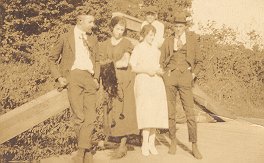
Many of us have old family photos that were never labeled and now it's almost impossible to identify the people looking back at us. I have quite a few nameless family photos. I've made it a mission to identify as many as I can.

The people in the four photos below are some of the lost relatives I'm hoping to one day identify. These photos once belonged to my great-uncle Prince Albert Burnette. Uncle Prince was born 1903 in Walton County, Georgia. Not long after his birth, his family moved to Greene County, Georgia where he lived until his 1993 death in Greensboro. Uncle Prince's wife was Mary Lee Queen, born 1904 in Union County, Georgia. Her father was Lewis Benton Queen and her mother Cornelia Vandora Dellinger. I believe both were from Union County, Georgia. Because Daddy doesn't know who these people are, it's possible they were members of the Queen or Dellinger families.

I've posted one other photo from Uncle Prince's collection here.

Here's where you come in. Do you recognize any of these people? If you do, I'd love to hear from you.


Friday, February 17, 2017

Antique postcards

Last weekend, I pulled out a large box of papers that came into our possession after the death of my mother-in-law. Busy with everything else in life, I sat the box aside without looking to see what was inside. Finally, after way too many years have passed, I opened the box and looked inside. Wow! It was full of genealogical treasures—obituaries, funeral cards, a few photos, school papers, letters, greeting cards, birth records, death records, etc. Lots of historical documents to keep a family historian happy for a long time.

Two items in the box caught my attention because of their age—postcards mailed to Helen Margaret Smith, my husband’s grand aunt. Now what is a grand aunt you ask? I didn’t know either so had to google it. Per Reference*, “a grand-aunt or grand-uncle is the sibling of your grandparent, while great-aunts and great-uncles are further removed. However, “grand” and “great” are often used interchangeably.” Helen’s sister was Bertha Edna Smith, my husband’s grandmother.

The first card is dated June 10, 1909 and is postmarked from Bethlehem, Pennsylvania. Helen lived in Paulton, Westmoreland County, Pennsylvania at the time. Postage to mail the card was one cent. There is no message written on the postcard–just the word “Auntie.” The image on the front is labeled “Canal Scene, Bethlehem, PA.” Unfortunately, I don’t know which aunt might have sent the card. The card has slight damage around the edges but it otherwise in good condition.


The second card is dated November 9, 1911 and is postmarked from Wilkinsburg, Pennsylvania, a borough in Allegheny County, nine miles from Pittsburgh. Helen still lived in Paulton when she received this card. The message written on the card is “Am attending a Luther League Convention in St. Stephens Lutheran Church of E. E. Pitts” and is signed “Lovingly, E.C.H.” Again, I don’t know who sent the postcard but do know that Helen’s mother’s maiden name was Horne so it could be a member of that family. It was obviously someone close since it was signed “Lovingly.” The image on the front is labeled “Drive to Stanton Avenue, Highland Park, Pittsburgh, Pa.” This card has slightly more damage around the edges but like the 1909 card, is otherwise in good condition.


I was curious about the Luther league so searched Newspapers.com and found the following article published by The Pittsburgh Press on November 5, 1911:
The thirty-ninth semi-annual convention of the Pittsburgh district, Luther league will be held Thursday in St. Stephen’s Lutheran church, Hamilton and Brushton aves. In the morning Miss Gertrude Dunmire of Monongahela City, will speak on “How to Make Our Committees More Efficient.” In the afternoon addresses will be made by Rev. J. G. Reinartz, of East Liverpool, O., and E. F. Daume, of this city. K. J. F. Wilharm will render a report of the State Luthern league convention, recently held in Easton. In the evening, Rev. W. F. Kennerly, of Alliance, O., will speak on “The Cost of the Kingdom.” There are over 2,000 members of the Pittsburgh district League. C. W. H. Hess is president; Rev. H. B. Ernest vice president, Miss Margaret Strohecker secretary, and O. W. A. Oetting, treasurer.
The article doesn’t tell me much but it was nice to connect it to the message written on the postcard.

I blogged about Helen on December 10, 2014. She was just a teenager when she died on March 18, 1913 after suffering from endocarditis, an inflammation of the inner layer of the heart per Wikipedia. A beautiful young woman taken too soon.

Helen Margaret Smith

Unknown friend and Helen Margaret Smith (on the right)

Friday, February 10, 2017

EXTRA! The War Is Over—V-J Day

I've got several timelines in the works but nothing ready for tonight so instead I'm posting a photo of a copy of the Warren Tribune Chronicle I found in a box of papers (or should I say treasureslots of genealogical finds) that belonged to my mother-in-law, Mary Athya Murphy. The newspaper is dated August 14, 1945 and was published in Warren, Ohio. She would have been 16 years old when this historical event took place. I wish I knew she had this newspaper while she was still alive. I would have loved to talk to her about it and see what she remembered about V-J Day.


Friday, February 3, 2017

Robert T. Hobbs

Robert T. Hobbs, son of Robert L. Hobbs and Johannah E. V. Kilgore (or Kalgren), was born about 1855 or 1856 in Georgia. He was the second child of four—Rebecca F. Hobbs, Robert T. Hobbs, Sarah C. Hobbs, and David P. Hobbs. He went by Bob.

Robert and I are 1st cousins, 4x removed. Our nearest common relatives are Nathan Augustus Hobbs Sr. and Mary Elizabeth Lankford, Robert’s paternal grandparents and my 4th great-grandparents.

On June 13, 1860, five-year-old Robert and his family lived in Griffin, Spalding County, Georgia. His father was a painter with real estate valued at $250 and a personal estate of $150. His mother was enumerated as Johamail E. V. Hobbs; his sister as Sarah C. Hobbs. Life for everyone changed in April 1861 with the start of the Civil War. By November 1864, Robert and his family most likely felt the effects of the war as Sherman’s troops went through Griffin as they moved towards Macon, Georgia on their march to the sea.

1860 Spalding County, Georgia census
On June 10, 1870, 14-year-old Robert and his family were still living in Griffin. Robert was now a painter, I assume helping his father who was still painting. He was able to read but unable to write. Robert’s mother was enumerated as J. E. V. Hobbs; his sister Sarah M. E. Hobbs. Tragedy struck the family at the end of the decade when Robert’s 12-year-old brother David died in November 1879. The 1880 Griffin, Georgia mortality schedule listed the cause of David’s death as inflammation of the brain. Like his father and brother, David was a house painter.

1870 Spalding County, Georgia census

1880 Spalding County, Georgia mortality schedule

Just seven months after the death of young David, tragedy would again strike the Hobbs family. On Saturday, June 12, 1880, Robert attended a dance in Griffin and was shot by a man named Tom Sullivan. The shooting of Robert was big news in Griffin and was reported in the Weekly Constitution on June 22:
GRIFFIN, June 14.—One of the most desperate and exciting affrays that ever occurred in Spalding county took place about three miles from town last Saturday evening, just as nightfall, in which two men were shot, one of whom will probably die. The result of the other’s wound is unknown, as he was the aggressor, and has made his escape. There was a big dance out at Gray’s Pond, five miles from the city, on Saturday. Mr. Pall Morris had carried Bob Hobbs out to assist him at a lemonade stand. The day passed off without any trouble until late in the evening, just before the party broke up, when Tom Sullivan, a desperate young farmer, came up to the lemonade stand and bantered Hobbs for a fight, saying he could and wanted to whip him. Hobbs saw Sullivan was drinking, and told him to go away, as he wanted no difficulty. Sullivan then commenced to abuse Hobbs in ever conceivable branch of the cussing art, finally ending in that one word reflecting on Hobbs’s mother. Mr. Morris at this junction spoke up (he had all the time warned Hobbs to keep quiet, as he wanted no difficulty there), and in very emphatic terms ordered Sullivan away. Sullivan’s sisters in the meantime had come up and implored Morris not to hurt him, as he was drinking. After a moment’s hesitation Sullivan broke out in a threat and said he would go home and get his shot-gun and waylay Hobbs on his way home. He repeated his threat so often that in order to avoid any further trouble Mr. Morris took Hobbs in a buggy with himself and John Glass, thinking Sullivan would not dare attack him there. Hobbs was to have returned in the wagon with the lemonade stand. When they had reached Mr. Freeman’s house, about three miles from the city, it was nearly night; a crowd was standing near the big oak tree, right in front of the house. Morris and his party came traveling along in the buggy, little thinking of Sullivan and his threat. Suddenly, about thirty yards ahead, Sullivan hove in sight with a shot-gun in hand, which he leveled at once. By the time Morris could stop his horse, Sullivan was not more than twenty feet away. Glass jumped out of the buggy, but Morris and Hobbs could not so do, so quickly did Sullivan shoot. The gun was loaded with shot, and the entire load took effect in the rear of Hobbs’ thigh. It is supposed that he must have thrown up his legs when Sullivan fired. As soon as shot, Hobbs turned to Morris and said, “He has killed me;” then jerking out his own pistol, fired three shots at Sullivan, the latter moving slowly off at the time. Morris then handed Hobbs another pistol, and five bullets more went whistling after Sullivan. All this time Hobbs kept his seat in the buggy, and Morris had his arm around him as a support. When the eighth shot was fired, Hobbs turned again and said, “Boys he has killed me.” Some gentlemen standing near took him from the buggy then, and Morris hurried on after a physician. Dr. John L. Moore went out and dressed the wound, pronouncing it a most frightful and dangerous one. There was a hole large enough to cover the fingers of a hand. The excitement at the time was very startling, as a number of ladies were present. Their screams lent confusion and thrillingness to the scene. Sullivan moved across the railroad and has not been seen since. It is rumored that he was shot in the left side and that a doctor had extracted the bullet. Mr. Morris received a few stray shot, but was not hurt much. Had Sullivan been ten feet further, both Hobbs and Morris would probably have received the charge in their stomachs. It is a great mystery why some of the men standing at Freeman’s, and who knew of Sullivan’s threats, did not stop him when he came up with his shot-gun. If Hobbs should die, it will be a neck-stretching for Sullivan, as the appearances all indicate a most strocion // unreadable// attempt at murder. Two years ago, Hobbs was on the police force in the city as an extra, and arrested Sullivan for disorderly conduct. The latter said then he would make it warm for Hobbs if he ever came out his way. This, however, was forgotten, and Hobbs little feared a meeting or so dreadful a calamity when he went out. A week ago today Hobbs was severely cut about the throat and back in a street fight. Yesterday evening late he was resting quietly, but in an extremely critical condition. It is thought he cannot survive.
Robert must have been brought home after being shot as the census enumerator found him living with his parents in Griffin on Monday, June 14, 1880, two days after being shot. At age 24, Robert was the only child left a home. His mother was enumerated as Jahamel E. V. Hobbs. Both Robert and his father were house painters although neither were working on June 14. The census enumerator noted that his father had been sick for six months that year so since it was June, he hadn’t worked during 1880. Robert was enumerated as sick with a “Gun shot wound” in the column marked “Is the person (on the day of the Enumerator’s visit) sick or temporarily disabled, so as to be unable to attend to ordinary business or duties? If so, what is the sickness or disability?”

1880 Spalding County, Georgia census
Robert succumbed to the gun shot wound on Thursday, June 17, 1880. His death was reported in the Atlanta Weekly Constitution on June 22, 1880:
Griffin, June 17.—Robert Hobbs, Jr., who was shot last Saturday evening by Sullivan, died tonight at 7 o’clock. A reward has been offered for the capture of Sullivan.
Atlanta Weekly Constitution, June 22, 1880

The Weekly Constitution reported on June 22 that Robert was buried in Griffin on June 18:
Griffin, June 18.—The funeral of Robert Hobbs took place this morning. Griffin fire company No. 1, of which he was a member, attended in a body. The sheriff and his posse are out in search of Sullivan, and I am told this morning it is quite likely they have struck his trail. If he should be apprehended Spalding county will be the scene of a first-class hanging. Whisky was the cause of this murder-another ten-strike for the prohibitionists at the coming municipal election.
On June 24, the North Georgia Citizen reported that the governor had offered a reward for Sullivan’s arrest, although he was listed as John, not Tom:
Governor Colquitt has offered a reward of one hundred and fifty dollars for the arrest of John Sullivan, the murderer of Robert Hobbs, in Spalding county, on the 12th inst.
North Georgia Citizen, June 24, 1880
Tom Sullivan was captured on Monday, June 28. The Weekly Constitution reported his capture on June 29:
All Around Us—It is stated this morning that Sullivan, Hobbs’s murderer, has been captured at Cedartown. Sheriff Bridges went there last night. It is to be hoped that the rumor is not unfounded, as this community feels very much outraged at the tragedy.
I found no record to show that Robert ever married, nor of the location of his final resting place, other than Griffin. I have also been unable to find a record of what happened to Sullivan after he was captured.

By all accounts, Robert was an upstanding young man in his community—he worked with his father as a house painter, was an extra on the police force, and a member of the local fire company. At the age of 24, he was taken from his family far too young.

Friday, January 27, 2017

George Richard Horne, Sr.

George Richard Horne, Sr., son of Moses Horne and Elizabeth Larimer, was born December 1, 1869 in Apollo, Armstrong County, Pennsylvania. He was one of eight children—Amanda Larimer Horne, Jennie Horne, Lydia E. Horne, Josephine B. Horne, Ollie Bertha Horne, George Richard Horne, Sr., and Keziah Chambers Horne. There was an eighth child, but I don’t know its sex or name. I found this child noted in 1900 census records when Elizabeth Horne was enumerated as having had eight children, five of which were living. He was my husband’s great grand uncle.

5/3/24 update: The unknown child was William Alexander Horne, born November 23, 1871, and likely died an infant. Also, Ollie Bertha Horne is incorrect. I believe her correct name to be Olean (or Olena) “Ollie” R. Horne. And Lydia's middle name is likely Etta.

I wrote the following text when I researched and blogged about George’s sister Josephine on November 27, 2015:
I haven’t been able to find the Horne family in 1870 census records. Since George was born in Apollo in 1869 I expected to find them there. I ran an ancestry.com search but found nothing. Since that didn’t work I manually checked the 20 pages of Apollo census records and still found nothing. Disappointing to say the least since I need to identify the eighth child. In 1876, county land ownership maps for Apollo recorded the Horne family as living on Indiana Street in Apollo. The D. H. Williams and R. S. Cochran families were neighbors. I feel certain they were in Apollo in 1870. I just have to find them.
Nothing has changed. I again searched for the Horne family in 1870 census records and again, came up empty. I’ll keep searching.

5/3/24 update: I finally found the Horne family in 1870, living in Washington Township, Westmoreland County, Pennsylvania. The family was incorrectly transcribed as 'Worn' instead of 'Horne.' Moses Horne worked as a carpenter; his real estate was valued at $1200 and personal estate at $500. Elizabeth Horne was keeping house.

On June 26, 1880, George and his family lived in Apollo. His father was a “dealer in groceries” and his mother a dressmaker. At the age of 10, George was enumerated as “clerk in store” so I assume he was helping his father in the grocery store.

1880 Apollo, Armstrong County, Pennsylvania Census

George married Emma I. Schmidt (parents unknown) in 1892, I assume in Apollo. Emma’s death certificate indicates that she was born in Switzerland. Together George and Emma had four children—Herbert Moses Horne, Ollie B. Horne, George Richard Horne, Jr., and Phyllis E. Horne. George and Emma didn’t waste time starting their family. Son Herbert was born in Apollo on January 17, 1893. Daughter Ollie was born in March 1895. Their son George Jr. was a Christmas Day baby, born in Apollo in 1896. And daughter Phyllis was born on August 3, 1898. By the time 1900 rolled around, their family was complete.

On June 7, 1900, George and his family lived on Farragut Street in the Allegheny Township of Vandergrift Borough, Westmoreland County, Pennsylvania. The family lived next door to Effie (Jack) and her husband Addision Beale. Effie Jack was the daughter of Eunice Alvira Smith and Daniel Jack. Eunice was the sister of John Milton Smith who married George’s sister, Amanda Larimer Horne (and my husband's great-grandmother). George’s sister Lydia and her family lived two doors away. George’s sister-in-law, Ida Schmidt, age 22 and born in Switzerland, lived with them.

1900 Vandergrift, Allegheny Township, Westmoreland County, Pennsylvania Census

On May 3, 1910, George and his family lived on Farragut Avenue in Vandergrift Ward 1, Westmoreland County. George was enumerated as a roller in a sheet mill. The census enumerator recorded George and Emma as having been married once each, for 18 years. Emma was the mother of four children, all of which were living. George’s sister-in-law, Edith Schmidt, age 30 and born in Sweden, lived with them.

1910 Vandergrift, Westmoreland County, Pennsylvania Census

George’s father, Moses, died of heart disease on April 11, 1910. George was the informant on the death certificate which was filed on April 12. Moses was buried at Apollo Cemetery in Apollo on April 13. His mother, Elizabeth, died in Apollo on May 1, 1913. She had suffered from senile dementia for three years. Elizabeth was buried beside her husband at Apollo Cemetery on May 3.

The Indiana Gazette headlines, December 20, 1915
Tragedy struck the Horne family in 1915 when George was killed in a train accident. He died on December 19, 1915 from a fractured skull and other injuries caused after being struck by a locomotive on the Conemaugh Division of the Pennsylvania Railroad at the West Apollo Crossing. The account of the accident was the lead story in The Indiana Gazette in Indiana, Indiana County, Pennsylvania on December 20, 1915.
Three Relatives of Indiana Families Are Killed In a Collision
Brother-in-law of Ray Craig; An Uncle of Mrs. John McGregor and A Nephew of John McConnell Met Horrible Deaths Near Apollo Early Sunday Morning 
Two More Died in the Hospital
Robert Milliron, aged 37 years, a mill worker of Vandergrift, and a brother-in-law of Ray Craig, local Adams Express agent and George Horne, aged 50, a mill worker of Vandergrift, and an uncle of Mrs. John McGregor, of Indiana, were instantly killed, together with Clifford McConnell, aged 27 years, of Vandergrift, a nephew of John McConnell, of Indiana, when the jitney bus in which they were riding with W. H. George, of Vandergrift, Robert R. Trautman, Herbert Horne and Henry Graden, also of Vandergrift was struck by a fast freight on the Conemaugh division of the Pennsylvania Railroad at a grade crossing in West Apollo, early yesterday morning.
Herbert Horne, who is a cousin of Mrs. John McGregor, is in a critical condition from internal injuries in the Allegheny General Hospital, Pittsburgh, with but slight hopes entertained for his recovery.
The occupants of the jitney bus were returning to their home in Vandergrift, when the accident occurred. It is believed George was unable to stop the bus because of a steep grade crossing in West Apollo. The bus had almost crossed the tracks when the fast freight train rounded a curve and crashed into the rear of the machine. Milliron and George were crushed between the freight engine and the wrecked jitney bus while the three others were hurled clear of the track. The bus was entirely demolished.
Physicians at the hospital said that Trautman and Horne cannot live. Graden was reported improving at his home but physicians said that while he is expected to recover his condition is still serious. 
(A telegram just received announced the deaths of Trautman and Horne.)
After the accident the injured were carried into the Elks club but Milliron died before medical attention could be given. Horne and McConnell were dead when found. Trautman and Herbert Horne after being attended by physicians were placed on a special train and taken to Pittsburgh. They were taken from the Pittsburgh station to the hospital in the Allegheny police patrol. 
The story was also picked up by the Associated Press and ran in The Morning Herald in Uniontown, Fayette County, Pennsylvania on December 20, 1915.
4 Killed, 3 Hurt When Fast Train Hits Jitney Bus 
(By Associated Press to The Herald)
Pittsburgh, December 19.—Four persons were killed and three injured, two probably fatally, early today when a fast freight train on the Conemaugh division of the Pennsylvania railroad struck a jitney bus at a grade crossing in West Apollo. Geo. Horne, aged 50, and Clifford McConnell, aged 27, were instantly killed, while Hobert Milliron, aged 37, died shortly after the accident. W. H. George, aged 42, was brought here and died in a local hospital several hours later.
Robert R. Troutman, aged 27, and Herbert Horne, aged 23, a friend of George Horne, aged 23, a friend of their condition is critical [sic]. Henry Graden, aged 37, is in a serious condition but may recover. All the dead and injured were from Vandergrift. The bus was owned and operated by George. It is believed that George was unable to stop the automobile because of the steep grade at the crossing.
Altoona Tribune,
December 20, 1915
In the Morning Herald story, Herbert Horne was listed as a “friend of George Horne, aged 23, …” however, George had a son named Herbert who would have been about the same age so I believe this was probably him. If that’s the case, Herbert didn’t die from his injuries but instead survived and lived until December 19, 1933 when he died of cardiac failure.

The story was picked up a third time by the Altoona Tribune in Altoona, Pennsylvania on December 20.
A Railroad Train Struck a Jitney 
Vandergrift, December 19.—Three persons were killed, three were probably fatally hurt and one escaped injury last night when a jitney bus containing seven passengers was struck by a Pennsylvania railroad train at a grade crossing in West Apollo, near here. 
The killed are George Hoine [sic], aged 54; Robert Milliron, 37, and Clifford McConnell, 23, all of Vandergrift. W. H. George, aged 42, owner of the machine died tonight. Robert R. Trautman, aged 27, and Herbert Horne, 23, are probably fatally injured.
George was buried at Vandergrift Cemetery in Vandergrift, Westmoreland County, Pennsylvania. His will was probated in Westmoreland County in 1916.

Friday, January 20, 2017

Henry Briest’s Bible

Several years ago, I stopped by the Prince William County Library in Manassas, Virginia to return a book I borrowed via interlibrary loan. On my way to the exit, I noticed a box of books for sale near the door so stopped to take a look. One book caught my attention—a small leather bound Bible.


The Bible is brown leather and has an ornate design on the front and back covers. It measures 5 ½ inches tall by 3 ¼ inches wide. The outside edge is one inch thick and gold in color.


When you open the Bible, you see that someone wrote the name “Henry Briest” in pencil on the first page.


The back of that page has “Henry Briest Trenton New Jersey” written in ink.


The title page reads:
The Holy Bible, Containing the Old and New Testaments, translated out of the original tongues, and with the former translations diligently compared and revised, by His Majesty’s Special Command. Appointed to be read in churches. Printed by Authority. Glasgow: William Collins, Licensed Queen’s Printer. MDCCCLXIV.

The back side of the title page reads:
Licence. In terms of Her Majesty’s Letters Patent to Her Printers for Scotland, and of the Instructions issued by Her Majesty in Council, dated Eleventh July, Eighteen Hundred and Thirty-nine, I hereby License and Authorize William Collins and Company, Printers in Glasgow, to Print, within the Premises situated Number One Hundred and Eleven North Montrose Street, Glasgow, and to Publish, as by the Authority of Her Majesty, an Edition of the Holy Bible, in Pearl Type, Trigesimo-secundo Size, consisting of Fifteen Thousand Copies, as proposed in their Declaration, dated Fifth August, Eighteen Hundred and Sixty-one; the terms and conditions of the said Instructions being always and in all points fully compiled with and observed by the said William Collins and Company. J. Moncrief, Edinburgh, 20th August, 1861.

The last page of the Bible was used to do a little math with someone writing the numbers 31, 24, 31, and 39 – 125.


The Bible is coming apart at the spine and some of the pages are pulling away from the glue, but otherwise is in pretty good condition.


My husband’s grandfather, George Durie Athya, was born in Glasgow, Scotland so because of that connection, I decided to make the purchase and paid the price marked on the Bible—10 cents.

Neither I nor my husband have any connection to Henry Briest but that doesn’t mean I’m not curious about who he was. The dates on the Bible’s title page made me wonder if Henry was a Civil War soldier who might have carried it into battle. Unfortunately, because I don’t know when he was born or who his parents were, it’s not that easy to figure him out. I performed a search on ancestry.com and found several men named Henry Briest:

  • Born in Trenton on October 16, 1851. His parents were George and Elizabeth Briest. The Civil War started in 1861 so this Henry would have only been 10 years old and too young to serve. 
  • Born in Minnesota about 1859 and still living there in 1930. Again, too young. 
  • Born in Germany in 1853 but ended up in Minnesota so is probably related to the second Henry listed here.
  • Served as a private in Company K, 14th Regiment 14, U.S. Colored Infantry. He died on December 15, 1864 and was buried at Chattanooga National Cemetery in Tennessee. This regiment was organized in Gallatin, Tennessee, nowhere near Trenton.
  • Lewis H. Briest, born 1846, served as a private in the 1st Regiment, New Jersey Infantry. He was a musician in his regiment. His middle initial is “H” so he could have been Henry but I always find him listed as Lewis, never Henry so I don’t believe this is him.
  • The best option is a man who served as a private in Company A of the 3rd Battalion, New Jersey Veteran Infantry which organized at Camp Bayard in Trenton, New Jersey. So far, I haven’t been able to connect him to a family but I feel he’s probably the man I’m looking for.

Did Henry Briest in fact serve in the Civil War and carry this Bible into battle? And just how did his Bible end up in Manassas, Virginia? The 3rd Infantry fought at Manassas Junction. Perhaps he was there and lost the Bible.

I have questions that can’t be answered so instead, I’ll end with a couple of interesting facts:

  • The Roman Numeral MDCCCLXIV is equivalent to number 1864.
  • The Queen referred to on the title page of the Bible would have been Victoria. According to Wikipedia, “Victoria (Alexandrina Victoria; 24 May 1819 – 22 January 1901) was Queen of the United Kingdom of Great Britain and Ireland from 20 June 1837 until her death.”

Photo by John Jabez Edwin Mayall [public domain], via Wikimedia Commons 

Friday, January 13, 2017

Mary Opal Stone

My granddaddy, Samuel Jackson Holland, was married three times during his lifetime. I knew two of his wives—numbers two and three. My granny and direct ancestor, Daisy Lee Shields, was his second wife. My grandmother, Patsy Reba Seibers, was his third wife.

Daisy Lee Shields

Patsy Reba Seibers

His first wife, Mary “Opal” Stone, died in 1931 so obviously, I never knew her. If fact, if she had lived, I would never have been born! We knew very little about Opal and I’ve been curious about her for a while so decided to let ancestry.com help me discover what I could about her. Here’s what I found.

Mary Opal Stone, daughter of Luther William Jefferson Stone and Ella Shellhorse, was born about 1905. Census records for 1910 and 1930 show she was born in Georgia. The census record for 1920 however shows she was born in Texas. I don’t find any evidence of that so am not sure what to think about it. It appears that her parents spent most of their lives in Gordon County, Georgia so I’m assuming that’s where she was born. Of course, we all know it’s dangerous to assume these things so I should still look for proof of her birthplace.

Marriage license for Luther Stone and Ella Shellhorse

Opal’s paternal grandparents were Winfield Scott Stone, born 1854, and Sarah F. Bunch, born 1857.

Winfield Scott Stone
Photo from Kimberly Cochran, ancestry.com.

Her paternal great-grandfather was William Jefferson Bunch—a confederate soldier born January 1, 1835 in North Carolina. Jefferson died on January 27, 1863 in Roane County, Tennessee while serving in Company F of the First Regiment, Georgia Cavalry. Her paternal great-grandmother was Amanda, born about 1839 in Georgia.

Photo by Evening Blues, Find A Grave Memorial# 11291343.

When Opal was born, she already had two older brothers—Buren F. Stone, born on November 5, 1899 in Calhoun, Gordon County, Georgia and Leonard Stone, born about 1902 in Georgia, most likely Gordon County.

On April 29, 1910, Opal and her family lived on Shag Road in Fairmount, Gordon County, Georgia. Opal was listed as a 6-year-old son, born in Georgia. Her parents had been married for 13 years. It was the first marriage for both. Opal’s father was a farmer. By 1910, two more brothers had been added to the family—Vester, born about 1907 and Doyal, born December 13, 1909. Both Vester and Doyal were born in Georgia.

1910 Fairmount, Gordon County, Georgia census record

Another brother, Henry C. Stone, joined the family on March 6, 1913. Henry was born in Georgia as well. Sometime after Henry’s birth and before 1916, Opal’s mother must have died, although I can’t find a death record to confirm that. I did find another researcher that recorded Ella’s death date as November 2, 1915, however, she didn’t show proof of that fact. The researcher also listed Ella’s full name as Mary Ella Shellhorse. All something to work from, but needs to be proven.

Four months after Ella’s death, Opal’s father married his second wife, Zola O. Durham, on March 26, 1916 in Gordon County.

Marriage license for Luther Stone and Zola Durham

On January 3, 1920, Opal and her family lived at Callahan and Spring Place Road in the Eighth Militia District of Gordon County, Georgia. The census enumerator got Opal’s sex right this time, however, she was recorded as born in Texas. Opal was a farm laborer on a home farm. Her stepmother was enumerated as Ola Stone. Luther and Zola produced three more siblings for Opal—a brother named William Harold Stone, born on January 30, 1917 in Calhoun, Gordon County, Georgia; a sister named Oma Lee Stone, an April Fool’s baby born in 1919 in Gordon County; and a sister named Edna Mae Stone, a Valentine’s Day baby born in 1921 in Calhoun.

1920 Gordon County, Georgia census record

Opal married my granddaddy, Samuel Jackson Holland, son of Elijah Jeffers Holland and Cornelia Jane “Janie” Dove, about 1922 in Georgia. Together they had one child—William Luther Holland, born on October 31, 1923 in Georgia. They called him W.L. It appears that W.L. was named for Opal’s father Luther William Jefferson Stone.

Samuel Jackson Holland

William Luther Holland

On April 23, 1930, Sam, Opal, W.L., and his mother Janie lived off of Cedar Valley Road in Whitfield County, Georgia. Their next-door neighbors were Milas and Effie Shields, uncle and aunt of my granny, Daisy Lee Shields. Sam’s mother Janie died at the age of 58 in Varnell, Whitfield County, on September 19, 1930. Janie was buried at Deep Springs Baptist Church Cemetery in Dalton, Whitfield County. Seven short months later, Opal died at the age of 26 on April 26, 1931 in Whitfield County. Sam and Opal had been married for nine years at the time of her death. W.L. was just seven years old when his mother died.

1930 Whitfield County, Georgia census record

Two months after Opal’s death, Sam (my Granddaddy) married Daisy Lee Shields (my Granny), daughter of James Stewart Shields and Hattie Jane Rhinehart. Granny helped Granddaddy pay Opal and Janie’s funeral expenses by making and selling quilts.

And that’s all I know about Opal. The circumstances of her death and the location of her final resting place are a mystery to me. She died young, just 26 years of age. What happened to her? Was it an illness, an accident, or perhaps childbirth? I wish I knew. As far as her burial, one would assume that she was buried at Deep Springs Baptist Church Cemetery with the rest of Sam’s family. Or possibly at Pleasant Hill Baptist Church Cemetery in Calhoun where her father was buried. I’m hoping the Georgia Archives will release the 1931 death certificates soon and maybe we’ll find out.

Granddaddy never shared anything about Opal. He didn’t talk much about his family. By the time he was 26 years old, he had lost his father, brother, sister, mother, and wife, leaving him the sole surviving member of his family. He kept his pain to himself.

I still can’t tell you Opal’s entire life story but I know a lot more about her than I did last week. I hope to find her someday. Perhaps I’ll get lucky and find a photo of her as well. One can only hope.