Friday, June 3, 2022

Homestead records from Greene County, Georgia

Always on the hunt for new records, I periodically scan the billions of free records accessible on the FamilySearch website. Many of these records are indexed, but many are not. Don’t let that stop you though. After a fellow researcher found burial records in the unindexed historical images for direct Athya ancestors from Glasgow, Scotland in both our families, these images have become one of my “go to” places to research. It’s easy to use, you just need to set up a free account. From the unindexed Historical Images page, you simply enter an area you want to search, and you’ll get a list of all they have available. You’re on your own from there, just start browsing. I try to spend a little time each week in these records.

In today’s post, I share recent finds of homestead records for ancestors from Greene County, Georgia—Caroline B. (Hobbs) Lankford, her husband James M. Lankford, and James’ brother William A. Lankford. Caroline and James Lankford are my 3rd great-grandparents. I already had her homestead record, found on a visit to the Georgia Archives years ago, but had never seen the other two. Luckily, the Greene County, Georgia "Record of Homesteads, Book A" has an index in the front so I knew what page to look for them. The image below is the cover of that book with an overlay of a portion of the “L” index. I’ve also posted images of the legal notices that were published in The Greensboro Herald of Greensboro, Georgia for each homestead record.


Record of Homesteads, Book A, Greene County, Georgia
and a portion of the "L" index (click to enlarge)
 
Caroline B. Lankford

Page 110, No. 61. Georgia, Greene County. To the Ordinary of said County. The Petition of Caroline B. Lankford wife of James M. Lankford of said County, respectfully showeth that she is the head of a family, consisting of herself & 5 children, to wit, Emma Lankford, Amorette B. Lankford, Nathan Lankford, Samuel Lankford & Maria Lankford, and that she desires, under the provisions of Section First, Article Seven of the Constitution of Georgia, and an act of the General Assembly entitled “An Act to provide for setting apart a Homestead of Realty and Personalty, and for the valuation of said Property,” etc., approved October 3, 1868, to have laid off and set apart, to be escempt from levy and sale, as a Homestead for the use of her said family, on or out of a Town Lot in Penfield, containing 4 acres, bounded by lands of Robinson & Mercer University, belonging to her husband James M. Lankford, a portion or the whole of said real estate not to escceed the value of Two Thousand Dollars in specie.

Your Petitioner further showeth that, under the provisions of said Constitution and of said Act, she desires to have set apart, to be escempt from levy and sale, for the use and benefit of said family, certain Personal Property, not to escceed One Thousand Dollars in Specie, a schedule of which said personalty is hereth attached, marked eschibit “A,” to which reference is hereby made.

Your Petitioner therefore asks, that the usual notice in such cases may issue, and be published, as is by law required, and as in duty bound petitioner will ever pray, etc.

Witness J. L. Tarwater.
Caroline B. Lankford (her mark), Wife of James M. Lankford.

Eschibit “A.” Schedule of Personalty of Caroline B. Lankford, Wife of James M. Lankford.

Household & Kitchen furniture        $100.00

25 Hogs $50.00                                   50.00

5 Cows & yearlings                               5.00

1 Gold Watch & Chain                        30.00

1 One Horse Wagon                           20.00

                                                $275.00

Filed in office July 6, 69 & Hearing published for July 17, 1869. D. A. Newsom, Ordinary

Georgia, Greene County. To Jefferson F. Wright, County Surveyor. You are hereby commanded to proceed upon the Lands claimed by Caroline B. Lankford, Wife of Jas. M. Lankford of said County, said lands described in a petition on file in my office, and shall lay off the Homestead awarded by Section First, Article Seventh of the Constitution of Georgia, on or out of the Lands claimed by the said Caroline B. Lankford. And make a Plot of the same, and an affidavit, that the same is correctly platted and laid off and that to the best of your knowledge and belief, is not worth more than Two thousand Dollars in specie; and that you return the same to me on or before 17th day of July 1869.

Herein fail not under the penalty to be imposed for contempt. Given under my hand and official signature this 9th day of July 1869.  -- D. A. Newsom, Ordinary


Homestead plat for Caroline B. Lankford

Georgia, Greene County. Personally appeared before me Jefferson F. Wright, County Surveyor, and in for the County aforesaid, who being duly sworn deposeth and sayeth, that the above is a correct Plat of the Homestead of Caroline B. Lankford. That the same is correctly surveyed and laid off under and by virtue of an Order from D. A. Newsom, Ordinary of said County, herewith filed, and that to the best of his knowledge and belief, the same parcel of land described by the foregoing Plot is not worth more than Two Thousand Dollars in species. --Jefferson F. Wright S.G.C.

Sworn to subscribed before me this 17th day of July 1869. A. J. Shannon, Deputy Clerk Court of Ordinary.

Approved July 17th 1869. D. A. Newsom, Ordinary. Recorded this 23rd day of July 1869. Isaac R. Hall, Clerk.

The image below is the legal notice published in The Greensboro Herald on July 22, 1869.


James M. Lankford

Page 106, No. 57. James M. Lankford a debtor and the head of a family of Greene County, Georgia claims that the following schedule of property owned by him is escempt from levy & sale, under the Statutes of said State to wit. 

1 House & Lot in Penfield, Greene Co. Georgia, worth $100.00.

1 Cow & Calf. Seventy five Dollars worth of provisions.

10 Head of Hogs, Beds, Bedsteads & Bedding.

1 Spinning wheel & 2 Pair Cards, Ordinary Cooking untensils & Table.

Crockery.

This January 9th, 1869. -- James M. Lankford

Recorded this 10th day of June 1869. Isaac R. Hall, Clerk

The image below is the legal notice published in The Greensboro Herald on January 14, 1869.


(click to enlarge)

William A. Lankford
Page 120. No. 66. Georgia, Greene County. To the Ordinary of said County. The Petition of William A. Lankford of said County respectfully showeth, that he is the head of a family consisting of his wife Nancy O. Lankford and three children, and that he desires, under the provisions of Section First Article Seven of the Constitution of Georgia, and an act of the General Assembly entitled “An Act to provide for setting apart a Homestead of Realty and Personalty, and for the valuation of said property,” etc., approved October 3, 1868, to have laid off and set apart to be escempt from levy and sale, as a Homestead for the use of his said family, on or out of one hundred and thirty one acres of Land in said County, adjoining lands of William Moncrief, Wm. Mayo and others, a portion or the whole of said real estate not to escceed the value of Two Thousand Dollars in specie.

Your Petitioner therefore prays that an order may issue to the County Surveyor of said County, if none to some other Surveyor, requiring him to lay off and make a plat of a Homestead for said family and make return thereof in accordance with the law.

Your Petitioner further showeth that, under the provisions of said Constitution and of said Act, he desires to have set apart to be excempt from levy and sale for the use and benefit of said family certain Personal Property, not to escceed One Thousand Dollars in specie a schedule of which said personalty is hereto attached marked eschibit “A” to which reference is hereby made.

Your Petitioner therefore asks that the usual notice in such cases may issue, and be published, as is by law required and as in duty bound petitioner will ever pray, etc.

William A. Lankford By his Attys at Law, Robinson & Branch


“A.” Schedule of Personalty of William A. Lankford.

1 Horse $75.00. 4 Cows & 2 Calves $80.00. 3 Head Hogs $25.00.        $180.00

1 one horse Wagon $15.00. 1 Two horse Wagon 5.00.                                20.00

1 old Buggy $5.00. 1 Lot Farming Tools $5.00.                                          10.00

1 Lot Household Furniture consisting of Beds, Bedding

Chairs, Crockery, Cooking Utensils, H.                             50.00

25 Bushels of Corn $25.00. 4 Bales Cotton $360.00.                                385.00

2000 lbs. Fodder.                                                                                          20.00

1 Note on Miles Caldwell $75.00. 1 Note on Lacy Moncrief 9.00.             84.00

1 Note on Colemus Jack $100.00. 1 Note on Josiah Pollard 62.50.           162.50 = $911.50

Filed in Office Oct 6th 1869. Hearing published for 16th Oct 1869. A. J. Shannon Deputy.

Georgia, Greene County. To Jefferson F. Wright, County Surveyor. You are hereby commanded to proceed upon the Lands claims by William A. Lankford of said County, said land described in a Petition on file in my office and shall lay off the Homestead awarded by Section First Article Seventh of the Constitution of Georgia on or out of the Lands claimed by the said William A. Lankford, and make a Plat and an Affidavit, that the same is correctly Platted and laid off and that to the best of your knowledge and belief is not worth more than Two Thousand dollars in specie, and that you return the same to me on or before the 16th day of September 1869. Herein fail not, under the penalty to be imposed for contempt.

Given under my hand and Official signature this 6th day of October 1869. D. A. Newsom, Ordinary.


Homestead plat for William A. Lankford (click to enlarge)

Georgia, Greene County. Personally appeared before me Jefferson F. Wright, County Surveyor, in and for the County aforesaid, who being duly sworn deposeth and saith, that the above is a correct Plat of the Homestead of William A. Lankford. That the same is correctly surveyed and laid off under and by virtue of an order from D. A. Newsom Ordinary of said County herewith filed, and that toe the best of his knowledge and belief the said parcel of Land described by the foregoing Plat is not worth more than Two Thousand Dollars in specie. --  J. F. Wright, S.G.C.

Sworn to & subscribed before me 15th day of October 1869. A. J. Shannon, Deputy. Recorded this 20th day of October 1869. Isaac R. Hall, Clerk.

The images below are legal notices published in The Greensboro Herald on October 21, 1869.


References

Friday, May 27, 2022

Kate Athya

Kate Athya, daughter of John Athya and Catherine Bell, was born in Govan, Glasgow, Lanark, Scotland on July 7, 1856. She was the 3rd child of 13—Ada Athya, John Athya, Kate Athya, Christina Emily Athya, Alice Athya, Helen Athya, Jane Bigland Athya, Edwin Athya, Maria Watson Athya, Florence Anna Athya, Charles A. Athya, George Howard Athya, and Harriet Sanderson Athya. An announcement of Kate’s birth was published in the Glasgow Herald on July 9, 1856:

BIRTHS. At Nithsdale Place, on the 7th inst., Mrs. John Athya; a daughter.


Glasgow Herald, July 9, 1856

Kate was baptized at Regent Place United in Glasgow, Lanark, Scotland on September 7, 1856. 

The Athya family lived in Anderston, Lanark, Scotland in 1861. By 1871, they had moved to the parish of Cathcart, Renfrew, Scotland. Her father was a grain merchant. 

About December 21, 1872, Kate contracted scarlatina maligna, a severe form of scarlet fever. She died on December 31 at Kirklinton, Langside, Cathcart, Renfrew, Scotland at the age of 16. The Glasgow Herald published a death announcement on January 1, 1873:

DEATHS. At Kirklinton, Langside, on the 31st ult., aged 16, Kate, second daughter of John Athya. Friends will please accept this intimation.


Glasgow Herald, January 1, 1873

Kate’ father was the informant on the statutory register of death. The record shows that he was an American produce merchant. 


Statutory register of death (click to enlarge)

To date, I have been unable to find a burial record.

Kate is my husband’s 1st cousin 3x removed, with their nearest common relatives being Isaac Athya and Janet Graham, my husband's 3rd great grandparents.

References

  • Births, Glasgow Herald, July 9, 1856.
  • Cathcart, Renfrewshire, Scotland Census, 1871.
  • Deaths, Athya, North British Daily Mail, Glasgow, Strathclyde, Scotland, January 1, 1873.
  • Deaths, Glasgow Herald, Glasgow, Scotland, January 1, 1873.
  • Kate Athya, Statutory Registers, Deaths 560/1, National Records of Scotland.
  • Scarlatina maligna, The Free Dictionary; https://medical-dictionary.thefreedictionary.com/scarlatina+maligna.
  • Scotland Births and Baptisms, 1564-1950, database, FamilySearch (https://familysearch.org/ark:/61903/1:1:FQ7G-SXK : 12 February 2020), Kate Athya, 1856.
  • Scotland Births and Baptisms, 1564-1950, database, FamilySearch (https://familysearch.org/ark:/61903/1:1:X1BC-99F : 12 February 2020), Kate Athya, 1856.
  • Scotland, Lanarkshire Church Records, 1823-1967, database, FamilySearch (https://www.familysearch.org/ark:/61903/1:1:6622-4ZLH : 9 February 2022), Kate Athya, 1856.
  • ScotlandsPeople census returns index, 1861.

Friday, May 20, 2022

George Athya – on the footpath

What do you do on a nice spring day in Surrey, England? Why, grab a cycle and go for a ride of course. Just don’t go cycling on a footpath. That’s apparently what a group of British soldiers did in May 1911, including my husband’s grandfather, George Durie Athya. Apparently, that was against the law, and if my research is correct, still is today.

I recently found an article in the Surrey Times and County Express where a Pte. George Athya was included in a list of soldiers who was fined for cycling on a footpath in Guildford, a town in Surrey located about 28 miles outside of London. 

Surrey Times and County Express, Guildford, Surrey, England, May 6, May 1911.

Farnham. Farnham Petty Sessions.

THURSDAY.—Before: Mr. R. Mowbray Howard (chairman), Mr. G. Goodall, Col. E. A. FitzRoy, C.A. , Mr. F. Mangles, Captain Bacon and Mr. C. E. Borelli. …

ON THE FOOTPATH. Pte. Henry Ayres was fined 7s. 6d. for having cycled on the footpath at Ash.—P.S. Sawyer said a considerable number of soldiers had ridden on the path, and, while he was taking the name of one, others committed the offence.—The following were fined 7s. 6d. for similar offences at the same time and place: Pte. Joseph Skerritt, Pte. Geo. Parker, Pte. Charles Phipps, Pte. Archibald Vernon, Pte. George Athya, James Hancock, Pte. Wm. Richardson, Pte. Leslie Brown, Albert Foyster and Lieut. Eric Pharozyn. Captain John A. Orr was fined 20s. for having ridden a motor-bicycle on the footpath.

So, was this our George Athya? Let’s look at the records. We know George was in the military from March 15, 1909 to March 6, 1919, serving with the Queen’s Own Cameron Highlanders, Labour Corps.


Roll of Individuals entitled to the "War Badge" (click to enlarge)


George Athya, British Army WWI Medal Rolls Index Cards (click to enlarge)

The 1911 England census for the civil parish of Farnborough includes a private George Athya on line 14. The top of the form states “Return of all Commissioned Officers, Warrant Officers, Non-Commissioned Officers, Trumpeters or Drummers, and Rank and File, who passed the night of Sunday, April 2, 1911, in these Barracks or Quarters, or arrived on the morning of Monday, April 3rd, not having been enumerated elsewhere. [See Instructions 2 and 3 on page 11.]”


Cropped 1911 England census listing George Athya (click to enlarge)

Ancestry’s index provides additional information not shown on sheet 129 of the census record. I added a couple of notes in parentheses. 

Name: George Athya

Age in 1911: 20 

Estimated Birth Year: 1891 (his birthday was June 26, 1892)

Birth Place: Glasgow, Lanarkshire (he was born in Bothwell, Lanarkshire—9 miles from Glasgow)

Civil parish: Farnborough

Country: England

Street Address: Qudenarde Barracks, Church of England Soldier’s Home, West Square, Brigade Office, Caretaker R A M C Recreation Ground, Marlborough Lines, Aldershot

Marital Status: Single

Rank: Private

Military Unit 1: Battalion Cameron Highlanders

The barracks were located in Farnborough, “a town in northeast Hampshire, England” according to Wikipedia. Farnborough is about 13 miles from Guildford, Surrey, England according to Google Maps, certainly within range of the barracks. Based on the information above, I feel certain that the George Athya who was fined for cycling on the footpath is my husband’s grandfather. 

It’s always fun to find snippets of their lives.

References

Friday, May 13, 2022

Ralph Morgan Lankford

This blog post is another in a series connecting the dots in my tree to the souls buried at Bairdstown Cemetery in Bairdstown, Oglethorpe County, Georgia.

Ralph Morgan Lankford, son of John Wesley Lankford and Martha Elizabeth Young, was born in Georgia on July 26, 1898. I haven’t found a birth record for Ralph but assume he was born in Greene County since his parents lived in Union Point in 1900. There were six children born into this family—Gussie Y. Lankford, Ralph Morgan Lankford, Robert L. Lankford, Ethel Louise Lankford, John Rollin Lankford, and an unknown child. Ralph would be my 2nd cousin, 3x removed with our nearest common relatives being Charles L. Lankford and Miss Moore, my 4th great grandparents.

On June 15, 1900, the Lankford family rented a home in Union Point. His father, enumerated as Jno. Lankford, worked as a farm laborer. His mother, enumerated as Mallie, had given birth to two children (Gussie and Ralph), both of which were living. Ralph’s parents, who had been married for nine years, could both read and write. There was a five-year age difference in Ralph and his older sister Gussie. 

Ralph died on January 26, 1902, cause unknown. Because his family still lived in Union Point in 1910, I assume his death took place in Greene County. His parents buried Ralph at Bairdstown Cemetery in Bairdstown, Oglethorpe County, Georgia, the same cemetery as his paternal grandparents, Robert Chester and Elizabeth (Bennett) Lankford. The bottom half of his tombstone is hard to read, but as best as I can tell, it’s engraved with the following:

RALPH MORGAN

Son of J. W. & M. E. LANKFORD,

JULY 26, 1898,

JAN. 26, 1902

A little time on earth he spent,

To God for him his angel sent. 

The tombstone is the only record I find that records his birth and death dates. He was 3 ½ years old at the time of his death.

The 1910 census record, taken in Union Point on April 25, shows that Ralph’s mother had given birth to six children, four of which were living. This record accounts for the unknown child mentioned above. 

References

  • Ralph Morgan Lankford’s tombstone, personal visit to Bairdstown Cemetery, Bairdstown, Georgia.
  • United States Federal Census, Union Point, Greene County, Georgia, 1900, 1910. 

Friday, May 6, 2022

Navy Memorabilia

For today’s post, I share four pieces of Navy memorabilia that belonged to my father-in-law, Earl Murphy. Earl served in the U.S. Navy from February 1946 to December 1948.


Earl Lloyd Murphy

The first item is a book, The Bluejackets’ Manual, 12th edition, published by the United States Naval Institute (Annapolis, Maryland) in 1944. According to Wikipedia, the book is “… the basic handbook for United States Navy personnel. First issued in 1902 to teach recruits about naval procedures and life and offer a reference for active sailors, it has become the “bible” for Navy personnel, providing information about a wide range of Navy topics. The current version, issued in 2017, is the 25th Edition and is given to all enlistees.”

My husband Charlie received The Bluejackets’ Manual, and the other three items, after the death of his father in 2015. This soft cover book has seen better days—the cover is separating from the spine, pages are yellowing, and the edges of the cover and pages are fraying. Much of this probably stems from the hours my husband and his brother Pat spent thumbing through the pages as boys. They both told me they were fascinated by the book, especially Pat. They were interested in everything in it. The book hadn’t seen the light of day since coming into our home in 2015 until a month ago when Charlie came across it while cleaning his office. He mentioned it to Pat, who of course, wanted to see it again. Pat’s eyes lit up when Charlie handed the book to him. As Pat thumbed through the pages once again, he recalled doing the same thing years ago, as mentioned above, for hours at a time. He remembered looking at the signal flags—the colors and what they meant, positions of a rifleman, how to site a gun to hit a bullseye, and tons of ship classifications. He vaguely remembers pictures of trees, how to avoid the moonlight and sunlight shadows so the enemy didn’t see you. It all amazed him. As a young boy, Pat said they played cowboys and Indians and cops and robbers. Pat remembers that at the height of the Vietnam war, they played Army a lot, using lifelike looking guns—guns that wouldn’t fly in today’s world because they looked so real. But he said at the time, the whole neighborhood knew what they were doing. They were playing and having fun. I asked Pat if he remembers using any of the tactics he learned from the book and he said “probably” with a laugh. Charlie remembered the insignias, different types of ships, how to shoot and tie knots, the proper way to salute, and survival techniques such as what you could and couldn’t eat. Charlie said they probably read the book more than their dad did when he was in the Navy. The book brought fond memories to both of them.

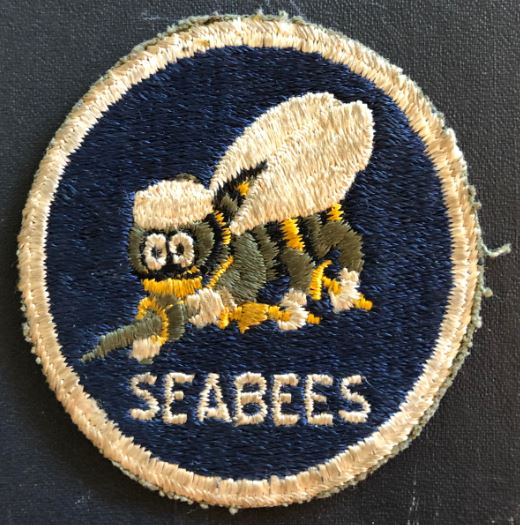
The second item is Earl’s vintage Seabees patch (ca. 1946). The patch is in pretty good shape. It doesn’t appear to have been sewn onto a uniform at any point in time. The Naval History and Heritage Command website describes Seabees history during World War II (or rather “Between the Second World War and the Korean War”) as “Following the victories in Europe and Asia, the U.S. Armed Forces rapidly demobilized. The Seabees were part of this demobilization, and by June 1946 their number had fallen from a peak strength of more than 250,000 men to approximately 20,000. In the continental United States, the web of training bases and depots dissolved, and all Seabee activity was concentrated at the Naval Construction Battalion Center, Port Hueneme, California. …” We can place Earl at Port Hueneme in August 1946 when I learned he was involved in Atomic bomb test number 6, something my husband wasn’t aware of. 

The third item is Earl’s vintage U.S. Navy ring. The sterling silver ring is very worn, although Charlie doesn’t remember his dad ever wearing it. It has an anchor with the letters USN on the front and an eagle on both sides. The anchor is worn so much it almost looks like a skull.

The fourth item is an anchor lapel pin. The pin is gold plated, and although a bit tarnished, is in good condition. It could use a good cleaning. We don’t know if this was part of Earl’s uniform or if it was just something he randomly purchased at some point. Earl was one of four Murphy sons in his family and he was the only one to serve in the Navy so at least we know it belonged to him.

In the following link, you can read about Earl’s war medals. These, and the four items above, are all treasured family heirlooms. 

References

Friday, April 29, 2022

William M. Holland

William M. Holland, son of Joshua Holland and Rebecca Ann Trussell, was born in Anderson County, South Carolina on April 2, 1841. He had two sisters, Mary Frances Elizabeth Holland (born 1853) and Willie (born 1863 after his death). William is my half 1st cousin 5x removed. Our nearest common relative is Moses Holland, my 5th great grandfather who served as a drummer in the Revolutionary War.

On November 20, 1850, William and his family lived in the Laurens District of Laurens County, South Carolina. His father was a farmer with real estate valued at $3,600. The 1850 slave schedule shows that his father owned seven slaves—three adult females (ages 25, 50, and 18), two adult males (ages 30 and 20), one 12-year-old male, and a 4-year-old female. 

On June 7, 1860, William, his parents, and sister Mary lived in Regiment 4 of Anderson County. His father was a farmer with a personal estate valued at $300, considerably less than in 1850. Seeing this, I wondered if I had found the wrong family in the 1850 census so did an extensive search of census records. The only family I found lived in Laurens County, so I have to believe it’s correct. Both William and Mary were attending school. 

Less than one year after the 1860 census was taken, William was “among the first to volunteer in the service of his country” when the Civil War began in 1861. On April 14, 1861, he enrolled as a private at Anderson Courthouse for a period of one year in Company J of the Fourth Regiment South Carolina Volunteers led by Captain William Anderson. The regiment, also known as the Confederate Guards, left Anderson, headed to Columbia, South Carolina via the railroad. They were still in Columbia awaiting orders on April 25. While there, the residents of Columbia made sure they were well taken care of. An April 25, 1861 article published in The Intelligencer confirms that:

Departure of the 4th Regt., S.C. Volunteers, "The Intelligencer," Anderson, South Carolina, April 25, 1861. The 4th Regiment S.C.V. received their orders to move toward the seat of war on Saturday the 13th inst., and were prepared to obey it Sunday and Monday following, but owing to a want of cars on this end of the Rail-road, they could not do so until Monday or Tuesday. We were glad to see, that like all the troops we have seen move, they went off in as cheerful mood as it was possible to assume, leaving many a sad heart behind them. They are still in Columbia awaiting further orders, and are well taken care of by the inhabitants of that fair City, who,—as we well know—never do things by halves.

Meanwhile, the same newspaper, on the same day, encouraged families who had the means to help the families of soldiers who had “gone to fight the battles of our country.”

They Battle for Us—We Must Support Their Families, "The Intelligencer," Anderson, South Carolina, April 25, 1861. We understand that many of the 4th Reg. S.C.V., who have gone to fight the battles of our country, have left their families in such circumstances as will soon exhibit suffering, if indeed such is not to some extent already the case. This should not be allowed by those who have the means to prevent it. Many families can with a little assistance be placed so as to help themselves, while others must be positively helped by their neighbors and friends. Look to it friends, it is a duty we owe to them, and should not be neglected. Other parts of the State are looking to this matter, and so must we.

An “Editorial Correspondence” written from the Fourth Regiment’s headquarters in Columbia on April 29, 1861 told of the “uniform kindness, hospitality and agreeable treatment of the soldiers now in their midst reflects the utmost credit upon them as a whole, and will long be cherished by the recipient of their favors” in speaking of the citizens of Columbia. The ladies (every acquaintance knows we never forget the ladies,) are foremost in the good work and untiringly seek to promote the comfort, happiness and welfare of the soldiers.” I’m sure this was comforting for William, who may have been away from home for the first time in his life.

William mustered into Confederate service in Columbia on June 7. On June 15, the regiment left Columbia for Virginia via the railroad, arriving in Richmond on June 17 in what was described by Jesse Walton Reid in his book History of the Fourth Regiment, South Carolina Volunteers as “quite an unpleasant trip.” In a letter to his wife, Reid wrote they “came the most of the way in open dirt coaches.” It wasn’t all bad though. Reid also wrote that they travelled through Wilmington, North Carolina, stopping at towns and depots along the way. People greeted them with “flags and handkerchiefs” and gave them food and drink. It was very festive. The soldiers apparently had plenty of whiskey as well. The regiment left Richmond on June 20, made a short stop at Manassas Junction on June 21, and ended their day in Gainesville, Virginia. After spending the night in Gainesville, they marched to Leesburg, Virginia the next day, arriving at Camp Carolina on June 23. Reid described the area as “beautiful country” that “literally flows with milk and honey.” They did not want for food while there. The regiment camped near the Potomac River, in view of the Blue Ridge Mountains—Virginia on one side of the river and Maryland on the other. The enemy was close by. They remained at Camp Carolina through the end of June. Again, they were treated to any type of food they wanted by the “ladies of Leesburg.” Years later, Reid wrote that during the time they spent in Leesburg, they lived like kings. At the beginning of July 1861, Reid wrote to his wife telling her how healthy the regiment was. He also told her of Virginia preachers coming to camp to preach the Gospel to the soldiers. On July 10, the regiment marched 25 miles from Leesburg to Frying Pan in Fairfax County, Virginia (near Herndon and Dulles International Airport today). Two days later, the regiment was suddenly moved from their Frying Pan camp to a location three miles away, what they would call Camp Holcomb. Over the next few days, there was talk of there being a battle soon as the Union soldiers had signed up for six-months of service and were nearing the end of that timeframe. The Confederate soldiers expected there would be a battle before the Union soldiers finished their six months. It turns out they were right. On July 17, the regiment left Camp Holcomb and marched a hard 14 miles to Prince William County, Virginia, making it in one day. A skirmish took place close by at McLeans Ford although I don’t know if Company J participated. But on July 21, the First Battle of Bull Run took place in Manassas, “the first major battle of the American Civil War” according to Wikipedia. Company J, one of seven South Carolina regiments on the battlefield that day, was part of the lead brigade at the Stone Bridge, “in advance of the regiment, to act as skirmishers” according to Reid. 


First Battle of Bull Run, Kurz & Allison, Public domain, via Wikimedia Commons.

At some point, Company J moved from the creek for another location close by. The Confederates won this battle that went on for 10 hours. Bodies and body parts of all kinds lay scattered over the battlefield afterwards. As the Union soldiers retreated, they left equipment, blankets, vehicles, guns, knapsacks, canteens, uniforms, etc. behind. The Confederates took what they could, along with many prisoners. Although in the thick of the battle, loss and injury was minimal for Company J. On July 26, 1861, the Richmond Enquirer reported that “… private John Simpson, was shot through the heart in a bayonet charge, and instantly killed. Private Kay was wounded in the neck by a piece of bomb.” 

On July 28, Company J marched 7 miles from Stone Bridge to Camp Pettus, near Centreville and then on August 11, they marched 6 miles to Germantown, Virginia. By this time, sickness was starting to set in and soldiers were being sent to hospitals. Many were dying. The measles and other diseases ran rampant throughout the regiment. On September 16, the company marched 10 miles from Germantown to Falls Church, Virginia for picket duty and then marched back to Germantown on September 21. On September 25, the company marched 8 miles to Mills Cross Roads and returned to Germantown on the 28th. At some point during this time, William contracted febris typhoides (typhoid fever), appearing on a report of sick and wounded for October 1861 showing he was at the Germantown and McLeans Ford station in Virginia. He died from the disease on October 1. 


Civil War record of William's death in Germantown, Virginia

I don’t know if William's remains were returned home to Anderson but he has a tombstone in the family plot at Neals Creek Baptist Church Cemetery that reads:

SACRED

 To the memory of

Wm. M. HOLLAND

born April 2nd 1841

died Oct. 1st 1861

For Four Years he was a devoted member of the Baptist Church, he was among the first to Volunteer in the service of his Country. Fought through the Battle of Manassas. After which he was taken with Typhoid Fever and died near Fairfax C.H. Va. In the triumph of Christian faith.


Holland family plot at Neals Creeks Baptist Church Cemetery. William's stone is on the left.

References

  • Breazeale, B. B., At the First Battle of Manassas, Company J, 4th South Carolina Infantry, 1912; https://ia600904.us.archive.org/24/items/coj4thsouthcarol00brea/coj4thsouthcarol00brea.pdf
  • Death of Mr. Joshua Holland, The Intelligencer, Anderson, South Carolina, March 18, 1896.
  • Departure of the 4th Regt. S.C. Volunteers, The Intelligencer, Anderson, South Carolina, April 25, 1861.
  • Departure of the 4th Regt., S.C. Volunteers, The Intelligencer, Anderson, South Carolina, April 25, 1861.
  • Editorial Correspondence, Head Quarters 4th Regiment, S.C.V., Columbia, April 29, 1861, The Intelligencer, Anderson, South Carolina, May 2, 1861.
  • Find a Grave, database and images (https://www.findagrave.com/memorial/101528279/willie-smith: accessed 15 April 2022), memorial page for Willie Holland Smith (30 Oct 1863–24 Jul 1932), Find a Grave Memorial ID 101528279, citing Silver Brook Cemetery, Anderson, Anderson County, South Carolina, USA; maintained by Find a Grave (contributor 8).
  • Find a Grave, database and images (https://www.findagrave.com/memorial/41290788/mary-frances_elizabeth-bowlan: accessed 15 April 2022), memorial page for Mary Frances Elizabeth Holland Bowlan (12 Mar 1853–13 May 1902), Find a Grave Memorial ID 41290788, citing Eureka Baptist Church Cemetery, Anderson, Anderson County, South Carolina, USA; maintained by Cousins by the Dozens (contributor 46904925).
  • First Battle of Bull Run; https://en.wikipedia.org/wiki/First_Battle_of_Bull_Run.
  • Mrs. W. H. Smith, The Greenville News, Greenville, South Carolina, July 26, 1932.
  • Mrs. Willie Holland Smith, Standard Certificate of Death no. 9881, State of South Carolina, Bureau of Vital Statistics, August 8, 1932.
  • Reid, Jesse Walton, History of the Fourth Regiment S.C. Volunteers, from the Commencement of the War until Lee’s Surrender, 1892; https://ia804509.us.archive.org/18/items/fourthregiment00reidrich/fourthregiment00reidrich.pdf
  • South Carolina Troops in Confederate Service, vol. II, compiled by A. S. Salley Jr., 1914; https://ia600909.us.archive.org/23/items/southcarolinatr00sallgoog/southcarolinatr00sallgoog.pdf
  • The Battle at Stone Bridge, Richmond Dispatch, Richmond, Virginia, July 25, 1861.
  • The Capture of Sherman’s Battery, Richmond Enquirer, Richmond, Virginia, July 26, 1861.
  • They Battle for Us—We Must Support Their Families, The Intelligencer, Anderson, South Carolina, April 25, 1861.
  • United States Federal Census, Broadway, Anderson County, South Carolina, 1870.
  • United States Federal Census, Laurens, Laurens County, South Carolina, 1850.
  • United States Federal Census, Regiment 4, Anderson County, South Carolina, 1860.
  • William M. Holland, Compiled Service Records of Confederate Soldiers Who Served in Organizations from the State of South Carolina.

Friday, April 22, 2022

John Francis Mayo Jr.

This blog post is another in a series connecting the dots in my tree to the souls buried at Bairdstown Cemetery in Bairdstown, Oglethorpe County, Georgia.

John Francis Mayo Jr., the son of John Francis Mayo Sr. and Annie Lou Lankford, was born on March 30, 1914 in Oglethorpe County, Georgia, most likely in Bairdstown. At the time of his birth, his parents had been married for six years. Sadly, God had other plans for John and he died at home in Oglethorpe County on March 1, 1916 following a short illness. The Oglethorpe Echo ran this news item on March 10, 1916:

On Wednesday of last week at the home of Mr. and Mrs. J. F. Mayo occurred the sad death of little J. F. Mayo Jr. He had been sick only a few days and on the night before had been up and playing around the fire. He had Membranous croup. He was three years old and was very much loved and praised by all who knew him. The little body was buried at Bairdstown cemetery Thursday evening at three thirty o’clock.

As mentioned in the Oglethorpe Echo, John was buried at Bairdstown Cemetery. 

Three weeks after John's death, his mother gave birth to a second son, James Howard Mayo. James was followed by another son, William Harold Mayo in 1920, and a daughter, Elizabeth Anne Mayo, in 1925. John is my 3rd cousin 2x removed with our nearest common relatives being Charles L. Lankford and Miss Moore.

References

  • John F. Mayo Jr.’s tombstone, personal visit to Bairdstown Cemetery, Bairdstown, Georgia.
  • John F. Mayo and Annie Langford, marriage certificate, Johnson County, Georgia, April 15, 1908.
  • United States Federal Census, Falling Creek, Oglethorpe County, Georgia, 1920.
  • United States Federal Census, Crawford, Oglethorpe County, Georgia, 1930.
  • Death of little J. F. Mayo Jr., Oglethorpe Echo, March 10, 1916.